
Display panel makers’ Q3 2026 results diverged sharply under a common variable: rising memory prices. Surging memory chip prices pushed up the cost of end products such as smartphones and notebooks, pressuring panel demand and prices, and the impact was greater for companies with heavier exposure to small and medium-sized panels. Korea’s Samsung Display and LG Display improved profitability QoQ on the back of OLED-centric product mixes, while BOE (京东方), China’s largest panel maker, swung to a quarterly loss.
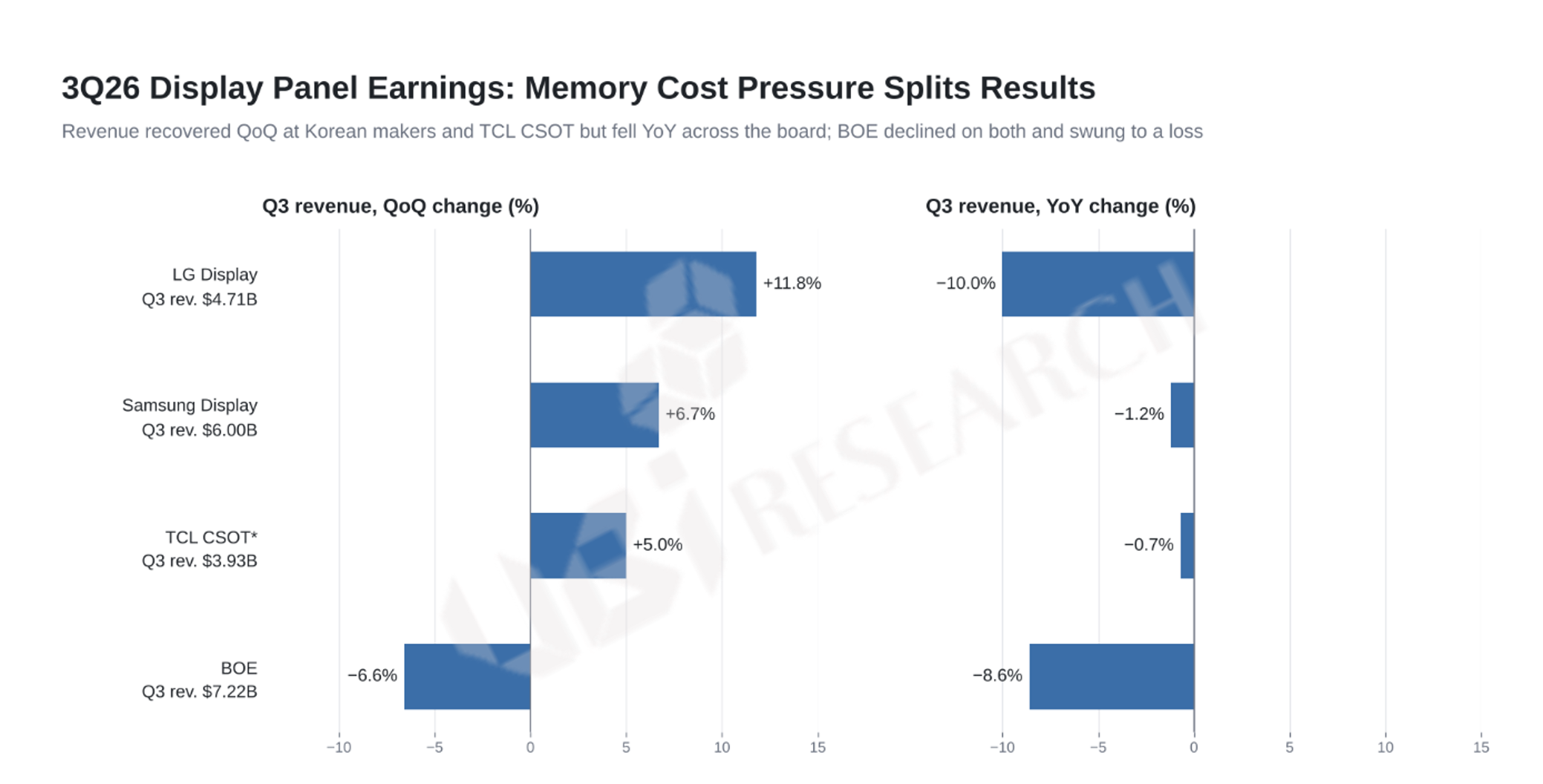
BOE’s Q3 revenue was CNY 48.677 billion, down 8.62% YoY, and net income attributable to shareholders swung to a loss of CNY 996 million. Net income excluding non-recurring items plunged 96.43% to just CNY 32.06 million. On a 1–3Q cumulative basis, it recorded revenue of CNY 151.809 billion (-1.77%) and net income attributable to shareholders of CNY 4.251 billion (-7.61%). The company cited rising memory prices, weak global consumer electronics demand, panel shipment and price adjustments, and capital market volatility as the main causes, and financial expenses reportedly rose to CNY 2.457 billion on larger foreign exchange losses. Its flexible OLED shipments for 1–3Q kept the No. 1 position in China and No. 2 globally, and it continued preparing new businesses, including connecting a glass substrate packaging pilot line to produce 24-layer substrates of 100×100mm or larger. It also expanded shareholder returns, including repurchasing about 94.39 million A shares (about CNY 550 million) and about 88.69 million B shares through the end of September for cancellation. According to industry data cited by the company, China’s AMOLED shipments in Q3 fell by more than 20% YoY and about 10% QoQ, indicating that the deteriorating small and medium-sized OLED market was directly reflected in its results.
TCL CSOT (TCL华星) sustained solid profits on the strength of LCD and IT panels. Its parent TCL Technology (TCL科技) posted Q3 revenue of CNY 50.052 billion (-0.66%) and net income attributable to shareholders of CNY 1.312 billion (+12.80%), while 1–3Q cumulative net income rose 68.06% to CNY 5.12 billion. TCL CSOT accounted for most of the group’s profit, with 1–3Q revenue of CNY 76.73 billion and net income of CNY 5.71 billion, and its Q3 revenue reportedly rose 5% QoQ to CNY 26.46 billion. Notebook and automotive panel shipments grew 41% and 45%, respectively, but flexible OLED smartphone panel prices reportedly remained weak. TV panel prices dipped slightly in July–August before stabilizing in September.
Samsung Display’s Q3 revenue was KRW 8 trillion and operating profit KRW 1.1 trillion, up 6.7% and 57.1% QoQ, respectively, but down 1.2% and 8.3% YoY. In small and medium-sized displays, new products from key customers and high-end mobile demand drove results, while in large displays, growth in the gaming monitor market led performance. The company expects limited earnings improvement in Q4 due to external factors despite year-end peak season and new-product effects, and plans to ramp up its Gen 8.6 IT OLED line in earnest. This year’s capex is reportedly around KRW 3.9 trillion. The KRW 0.6 trillion operating loss posted by Samsung Electronics’ MX/Network business in the same quarter shows that cost pressure on end products could spread to the panel supply chain.
LG Display posted Q3 revenue of KRW 6.277 trillion and operating profit of KRW 250.6 billion, turning to profit from an operating loss of KRW 108.0 billion in the previous quarter. Revenue rose 12% QoQ but fell 10% YoY due to the KRW/USD exchange rate. Helped by foreign currency translation gains, net income reached KRW 756.0 billion; shipment area rose 4% to 3.7 million m², and ASP per m² rose 16% to USD 1,250. OLED accounted for 67% of revenue, an all-time quarterly high, with a product mix of mobile 42%, IT 29%, TV 20%, and automotive 9%. For Q4, the company expects shipment area to grow by about 10% and ASP to rise in the low single digits, but noted that rising memory prices are pushing up end-product prices and slowing demand for high-end products. This year’s capex was guided at the low KRW 2 trillion range.
These results show that the impact of rising memory prices varied with each panel maker’s product mix. Korean makers that had raised the share of high-value OLED defended their profits, and TCL CSOT, with its large share of LCD and IT panels, held firm, while BOE, heavily dependent on small and medium-sized flexible OLED, swung to a loss.