
Now in final verification, the MicroLED TDDI extends Raydium’s display IC business from AMOLED, large-display and automotive applications into a new field.
Reporting & Analysis: UBI Research Editor: Dr. Choonghoon YI, CEO & Chief Analyst
Taiwanese display driver IC supplier Raydium Semiconductor is targeting year-end production of a TDDI for MicroLED displays. On August 7, 2026, MicroLED-Info reported, citing remarks from Raydium’s second-quarter earnings conference, that the company was completing product verification and aimed to begin production by the end of 2026.
TDDI integrates a touch controller and a display driver IC in a single semiconductor solution. Synaptics states in its official product information that integrated touch and display solutions reduce the overall stack-up and component count, supporting thinner and lighter product designs. The core function is to handle touch sensing and display driving within one solution.
Raydium’s latest disclosure shows that it is extending this integrated approach to a MicroLED product. The company described the development as being in the final verification stage and set year-end as the production target. The cited report did not disclose the panel size, resolution, customer or detailed product name.
Raydium has supplied display driver ICs for smartphones and IT products, large displays, and automotive and industrial displays. Its revenue in the second quarter of 2026 reached NT$6.82 billion, up 25.4% from the previous quarter and 16.6% from a year earlier. Revenue for the first half of 2026 totaled NT$12.26 billion.
Small- and medium-sized AMOLED driver ICs accounted for 49% of second-quarter revenue. Large-display driver ICs, TCONs and power management ICs represented 33%, while automotive and industrial display driver ICs made up 18%. The MicroLED TDDI project adds a new product category to a display semiconductor business already serving multiple application segments.
Raydium also has experience commercializing TDDI products. In October 2025, the company announced that its automotive TDDI had received SGS ISO 26262 ASIL B Ready product certification. In the same announcement, Raydium said its automotive display ICs, including DDI, TDDI, TCON and Bridge IC products, had been adopted in hundreds of vehicle models worldwide.
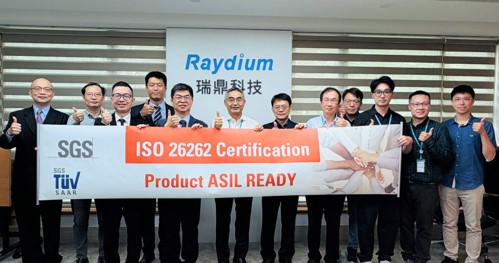
Raydium and SGS Taiwan representatives hold the ISO 26262 ASIL B Ready certificate for Raydium’s automotive TDDI. This is not a photo of a MicroLED product; it is included to show Raydium’s track record in commercializing TDDI. Source: Raydium Semiconductor, Oct. 25, 2025.
The automotive certification and the latest MicroLED development announcement concern different products. Together, however, they show the company’s progression from commercializing integrated touch and display driver ICs in automotive applications to setting verification and production milestones for a MicroLED product.
Raydium’s announcement shows that MicroLED development is expanding beyond panels and modules to integrated touch and display driver ICs. Existing TDDI combines touch and display driving in one solution to reduce stack-up and component count, and Raydium has stated that it is developing this technology for MicroLED applications.
Raydium has identified two current milestones for its MicroLED TDDI: completion of verification and production by year-end. Disclosure of the product specifications and target applications would provide a clearer view of how its established AMOLED and automotive driver IC businesses will connect with its MicroLED business.
Sources: MicroLED-Info, “Raydium Semiconductor is developing a microLED TDDI driver, hopes to begin production by end of 2026” (Aug. 7, 2026) · Raydium Semiconductor, Q2 2026 Investor Presentation (Aug. 6, 2026) · Raydium Semiconductor, Automotive TDDI ISO 26262 ASIL B Ready Certification Announcement (Oct. 25, 2025) · Synaptics, Integrated Touch & Display ICs