
Samsung Display introduced its display strategy for the age of artificial intelligence (AI) through presentations and exhibits at the “K-Display 2026” event (July 22–24, COEX, Seoul). In its presentation, Samsung Display emphasized that “no matter how much AI advances, people will ultimately view and use information through displays,” and at the exhibition, it demonstrated this vision through actual products across all application areas, including future vehicles, smartphones, AI devices, IT, and gaming.
At the Business Forum, Samsung Display presented four product innovation directions under the OPEN (Optimized design, Private function, Efficient energy, Next innovation) framework. Notable examples of OPEN features include new foldable platforms; privacy technologies that adjust light transmittance based on viewing angle; low-power technologies such as non-polarizing filters and adaptive refresh rates; and next-generation technologies such as RGB OLEDs, stretchable displays, and integrated biosensors. Samsung Display emphasized that AI and sensors are the key drivers that optimize displays for specific devices and users, protect personal information, achieve low power consumption and high efficiency, and drive the evolution toward next-generation form factors. On the manufacturing front, the company announced that it is building a virtual factory (digital twin) based on a “digital thread” that integrates R&D and production data, with the ultimate goal of creating an “autonomous factory” capable of self-learning and self-improvement. The company also noted that it is taking a cautious approach to the humanoid display market for now, considering the cost-effectiveness of such displays.
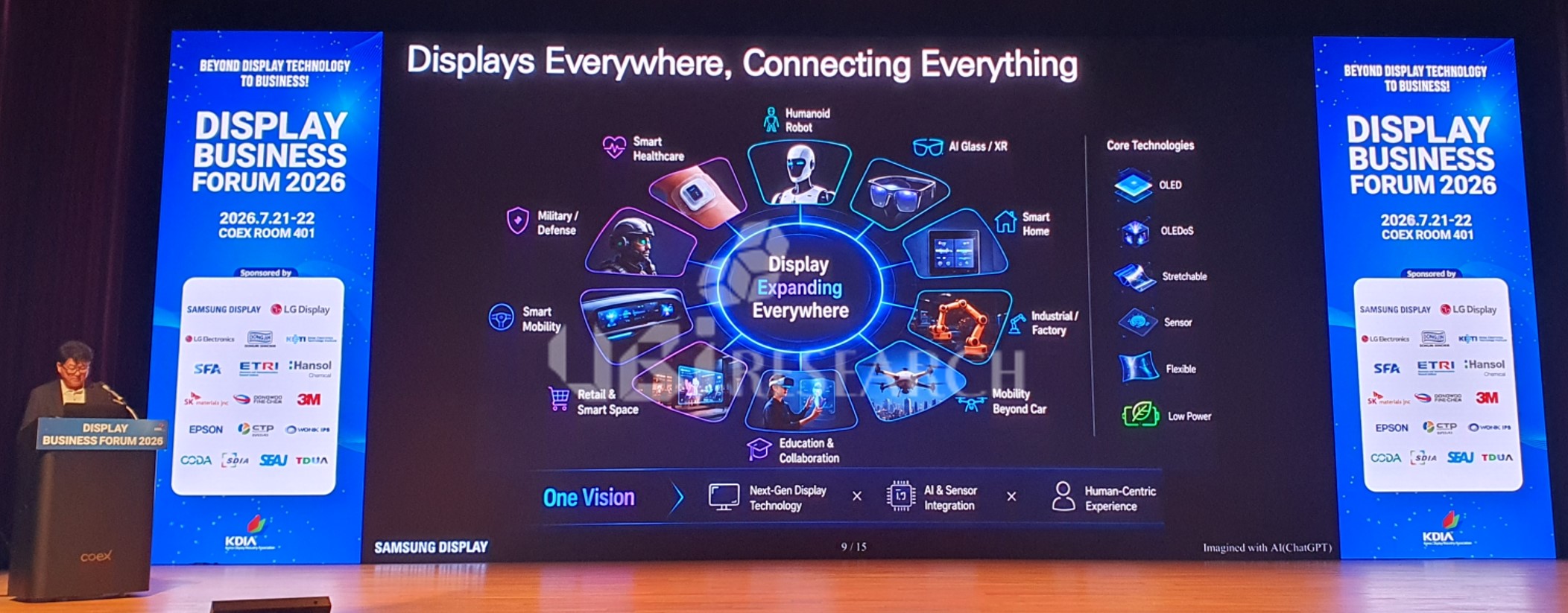
Samsung Display’s AI-era display applications and core technology strategy. (Source: UBI Research)
At the K-Display 2026 exhibition, Samsung Display unveiled a prototype center fascia based on HIAA (Hole in Active Area) technology, featuring an 80mm-diameter hole cut into the display area. A key feature of this design is the physical integration of vehicle components—such as the gearshift dial and air conditioning vents—with the digital display by positioning them within the hole. Samsung Display explained that since the commercialization of the 5mm camera hole in 2019, the technology has matured to the point where it can now implement “big holes” in the 80–100mm range. Alongside this, the company also showcased a vertical slider-type CID (Center Information Display) that remains hidden when not in use but can expand to a maximum of 15.5 inches when needed, demonstrating a personalized mobility experience for the era of autonomous driving.
Regarding display quality, the company set up an experience zone called the “True Color Garden,” where screens featuring the polarizer technology “LEAD 2.0™” and “Flex Chroma Pixel™”—which simultaneously achieve color reproduction exceeding BT.2020-96 and a high brightness of 3,000 nits—were displayed alongside real flowers and plants. For the privacy technology “Flex Magic Pixel (FMP),” the “FMP Message Wall” was set up to allow visitors to directly compare the differences in viewing angles between a standard screen and an FMP-enabled screen on the same wall.
In the IT and gaming sectors, the company showcased a 16-inch tandem OLED for laptops—the world’s first to receive VESA “DisplayHDR True Black 1400” certification— a 14-inch ultra-slim tandem OLED with a brightness of 2,000 nits—double that of its predecessor—and a 31.5-inch QD-OLED, the first monitor to simultaneously achieve 4K resolution and a 360Hz refresh rate. In the gaming zone, the company set up an experience area featuring games played on QD-OLED monitors, as well as collaboration zones with global game companies such as Krafton, Pearl Abyss, CIG (Cloud Imperium Games), and NCSoft, allowing visitors to experience the displays’ fast response times and color reproduction firsthand.
Samsung Display also unveiled, for the first time, next-generation applications: a 6.9-inch OLED-based display for humanoid robots and an “OLED Companion AI Toy” featuring a 1.3-inch circular OLED. The humanoid display naturally expresses the robot’s facial expressions and is equipped with eye-tracking functionality that follows visitors’ gaze, while the AI toy is designed as a keychain concept that combines a character doll with a circular OLED. In addition, the company exhibited concept products such as an AI pet bot, an AI pendant, and an OLED turntable, demonstrating how displays are evolving to serve as both the “face” and the interface of AI devices.
A Samsung Display official stated that this exhibition showcased how OLED and QD-OLED are expanding their applications to smartphones, laptops, monitors, vehicles, and AI edge devices. UBI Research assessed that the presentations and exhibits at this conference clearly demonstrated Samsung Display’s “dual-pronged AI strategy,” which simultaneously drives product and manufacturing innovation, and plans to continuously monitor future mass production schedules and trends in the expansion of application areas.
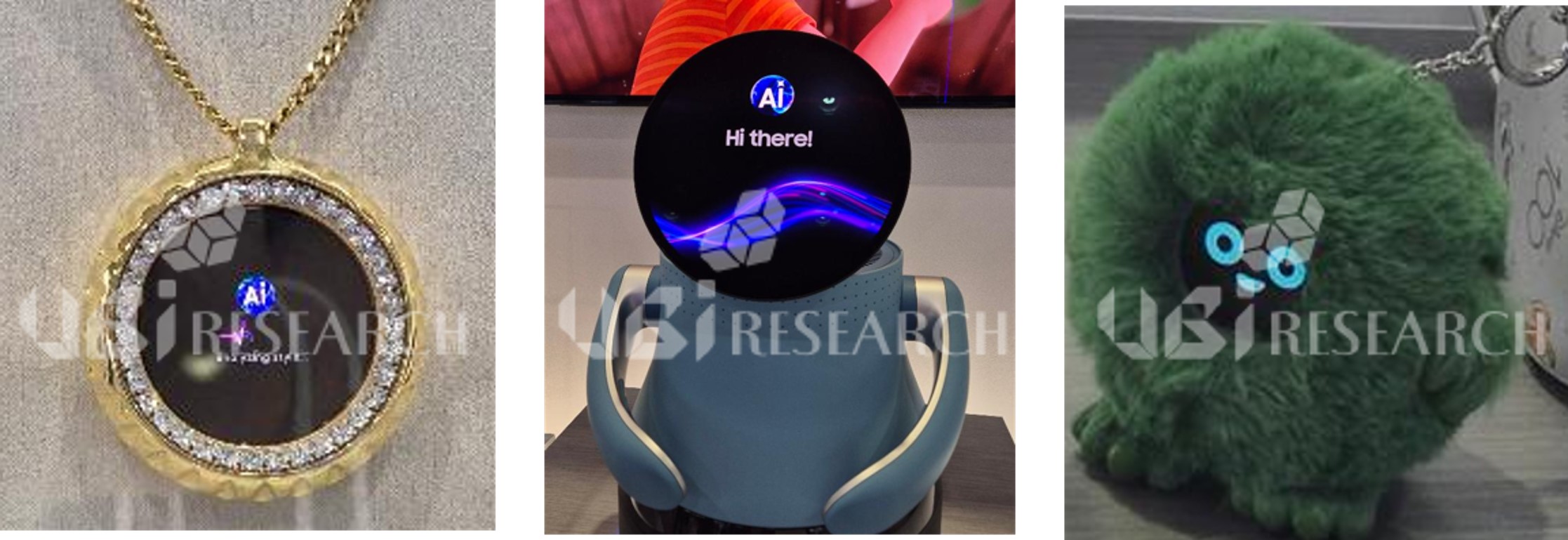
OLED-based AI pendant and AI device prototypes showcased by Samsung Display. (Source: UBI Research)
Changho Noh, Senior Analyst at UBI Research (chnoh@ubiresearch.com)
▶2026 Small OLED Display Annual Report
▶2026 Medium & Large Size OLED Display Annual Report
※ This article is produced by UBIResearchNet.
Unauthorized reproduction or citation without source attribution is prohibited.
When quoting, please clearly indicate the source (UBIResearchNet) and provide a link.