
Samsung Display projected that, in the AI era, the role of the display will expand beyond simply delivering information to become a key interface connecting humans, AI and a wide range of devices.
Cho Sung-chan, Executive Vice President and Head of the Display Research Center at Samsung Display, delivered the keynote at IMID 2026, held on August 19 at BEXCO in Busan, under the theme ‘AI’s Next Leap, Why Displays Matter More Than Ever ‘, in which he introduced the direction in which the display industry is developing and the display technologies required in the AI era. In the presentation, he explained that displays, which have advanced from CRT and LCD to OLED, mini LED and QD displays, are expanding their application areas to smartphones, automobiles, wearables, AR and VR, and robots.
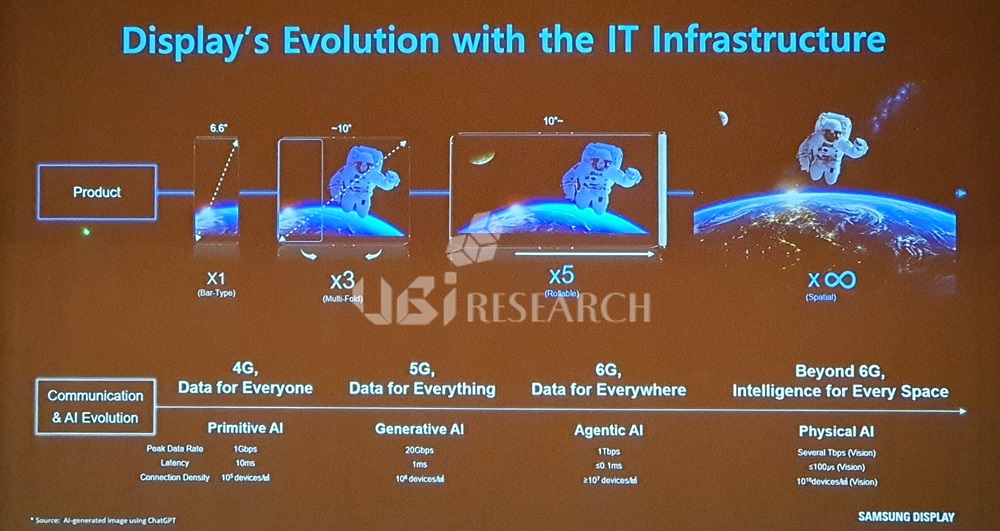
Samsung Display’s vision for display evolution alongside communication and AI development presented at IMID 2026. (Source: UBI Research)
In particular, he anticipated that the role of the display will also change as the communications environment advances from 5G to 6G and AI technology becomes more sophisticated. Whereas conventional displays were devices that presented information in one direction, going forward they will develop into two-way interfaces through which AI understands the user and the surrounding environment and delivers the necessary information via the display. Samsung Display expects that AI will create connectivity, and that connectivity will create the ultimate user experience.
AI is expected to be applied not only to display products but also to research and development and to manufacturing processes. Samsung Display explained that AI can be used to optimize the fine chemical structure of emitting materials and to improve heat dissipation characteristics and component placement at the panel design stage.
In manufacturing, the company stated that AI can optimize process conditions based on sensor data already available on the equipment and can predict quality anomalies by analyzing minute process variations. It also emphasized that productivity and quality can be raised at the same time by moving away from maintaining equipment on a fixed schedule toward predictive maintenance that services equipment when it is actually needed, together with AI-based inspection.
In the AI era, low-power technology is expected to become even more important alongside high image quality. Samsung Display stressed that lowering power consumption while maintaining image quality performance such as high brightness, contrast ratio and high refresh rate is important, and introduced driving-power reduction technologies including polarizer removal and content-adaptive refresh rate control.
On the design side, the expanded use of flexible and free-form displays was noted. Implementing the curved surfaces of various products such as automobiles and robots as displays can change the conventional flat-panel-centered way of use. In the case of robots, users want to check the status with their own eyes regardless of whether the robot operates autonomously, so free-form displays that cover curved surfaces will be an effective means. AR and VR require ultra-high resolution, and he explained that an approach is needed that converges display and semiconductor technologies, as in OLEDoS and LEDoS, and newly defines the roles of the frontplane and the backplane.
Samsung Display also emphasized user-centered functions such as privacy protection, blue light reduction and in-display sensing, along with the importance of context-aware displays. As the information generated by AI is provided in various forms including images and video as well as text, the display will take on the role of delivering information more intuitively.
Closing the presentation, Executive Vice President Cho emphasized that the display will be “a bridge connecting humans, AI systems and the world.”
The direction presented in this keynote can be summarized as a strategy of expanding the functions of the panel itself. The concept is to embed low-power driving, sensing and privacy control at the panel level and to broaden application areas through free-form displays and OLEDoS or LEDoS. Given that panel makers must secure unique functions that are not dependent on set design in order to capture added value in the AI device market, this is judged to be a very sound approach.
Changho Noh, Senior Analyst at UBI Research (chnoh@ubiresearch.com)
※ This article is produced by UBIResearchNet.
Unauthorized reproduction or citation without source attribution is prohibited.
When quoting, please clearly indicate the source (UBIResearchNet) and provide a link.