□ Samsung Display to debut ‘Wide View Display’ featuring advanced wide-viewing-angle technology and first-ever 20-inch Wide Stretchable
– Wide-viewing-angle technology delivers uniform brightness even across the curved areas of foldable and edge displays
– 20-inch large-format Stretchable display also unveiled for applications including automotive displays and digital signage
□ OLED innovations optimized for the AI era showcased in one place
– A wide range of next-generation solutions including humanoid displays and Big Hole displays
□ Samsung Display presents the most technical papers among participating companies; Galaxy S26 Ultra OLED wins ‘Korea Display of the Year’
– Presents 57 technical papers, the most among participating companies for the second consecutive year
– Galaxy S26 Ultra OLED featuring privacy display technology wins ‘Korea Display of the Year’
– Sung-chan Cho, Head of the Display Research Center, to deliver keynote on ‘Displays in the AI Era’
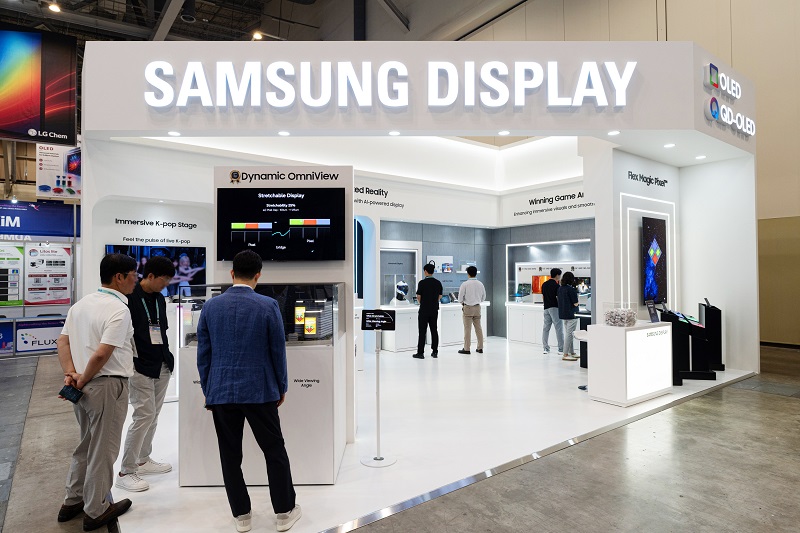
Samsung Display will participate in the 26th International Meeting on Information Display (IMID 2026), taking place at BEXCO in Busan from August 18 to 21 under the theme ‘Lightcrafting the Future.’
At this year’s conference, Samsung Display will unveil for the first time its Wide View Display featuring the latest wide-viewing-angle technology, along with the world’s largest 20-inch Wide Stretchable display. The company will also showcase a range of concept products demonstrating the potential of OLED optimized for AI applications, including displays for humanoid robots and an ‘AI OLED Pendant.’
□ Wide View Display addresses brightness loss around foldable creases with advanced wide-viewing-angle technology
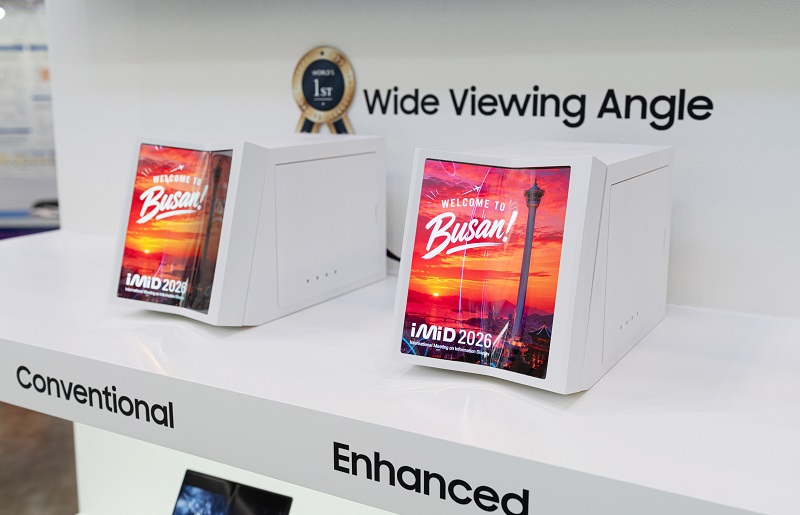
Samsung Display’s Wide View Display, making its debut at IMID 2026, is a mobile OLED incorporating the company’s latest wide-viewing-angle technology. In currently commercialized foldable displays, the curved areas on both sides of the center crease can appear at only around 40% of the brightness of the front-facing area. This is a structural limitation commonly found in flexible displays where the screen bends, and Samsung Display has been developing a range of wide-viewing-angle technologies to address the issue.
The newly introduced 7.6-inch Wide View Display features a completely redesigned material composition and structure for its organic emissive layer. As a result, even the curved portions of the display maintain bright and uniform image quality without noticeable luminance loss when viewed from the front. A Samsung Display representative said, “The Wide View Display incorporates our latest wide-viewing-angle technology to address side-angle brightness degradation around the crease of foldable smartphones and the curved sections of edge displays. Applying this technology to next-generation form factors such as foldable, slidable and rollable displays can deliver more uniform image quality with minimal brightness variation across viewing angles.”
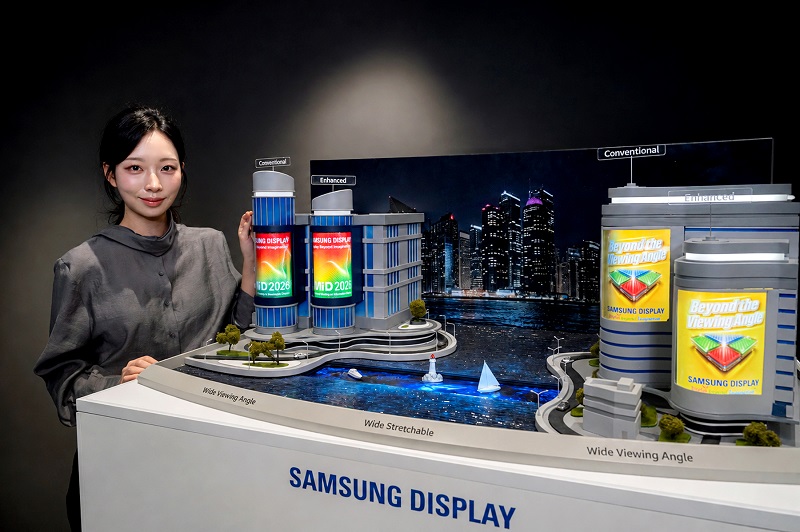
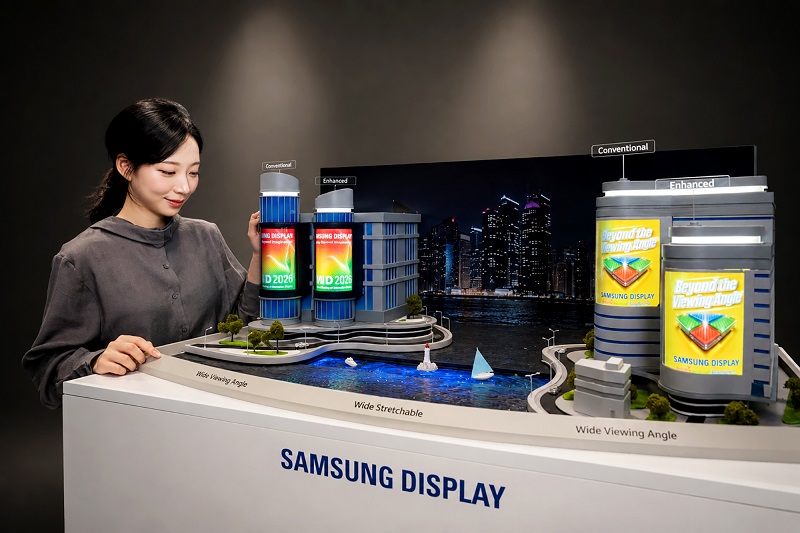
Samsung Display will also unveil the Wide Stretchable, the world’s largest display of its kind at 20 inches. The company applied tiling technology to combine two stretchable displays into a single seamless screen, more than doubling the size of its previous product.
Based on high-precision panel design and module lamination technologies, Samsung Display minimized the boundary between the two panels so that they operate naturally as one 20-inch display. Visitors will be able to experience the seamless image continuity and operating performance of the large stretchable display firsthand. The larger Stretchable display is expected to be used in a wide range of applications requiring curved or conformable screens, including automotive digital cockpits, humanoid robots and digital signage.
□ Samsung OLED demonstrates its competitiveness for the AI era, spanning AI edge devices, IT and automotive applications
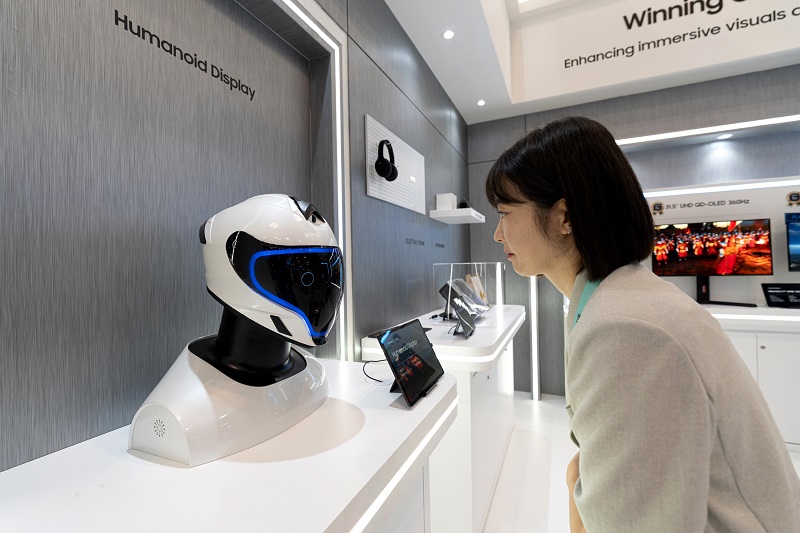
The exhibition will bring together a range of new AI edge device concepts. The ‘Intelligent Life Arena’ will feature concept products highlighting the synergy between AI and display technologies, including a humanoid display with eye-tracking functionality, an OLED Turntable inspired by analog design, and a necklace-style AI OLED Pendant.
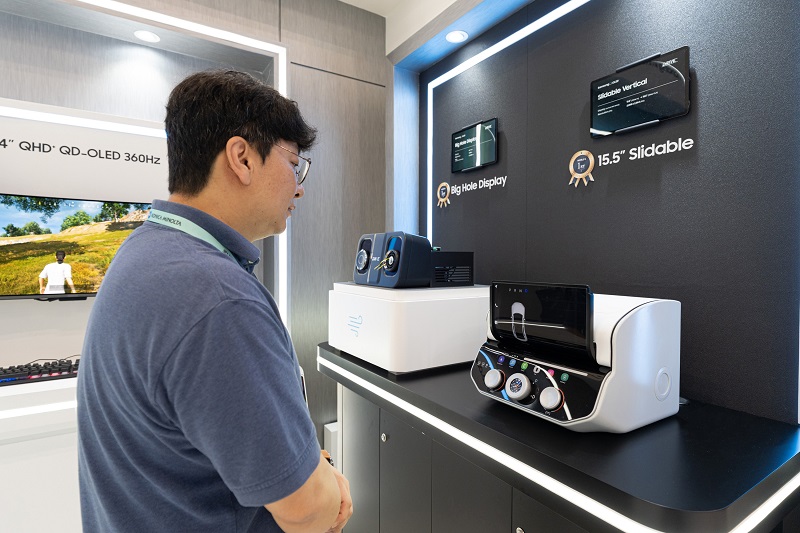
At the ‘Future Mobility Arena,’ Samsung Display will showcase a 6.4-inch ‘Big Hole Display,’ designed to increase flexibility in vehicle interior design, along with a vertically expandable CID (Center Information Display) that extends up to 15.5 inches. The zone is designed to give visitors a preview of future autonomous vehicle interiors.
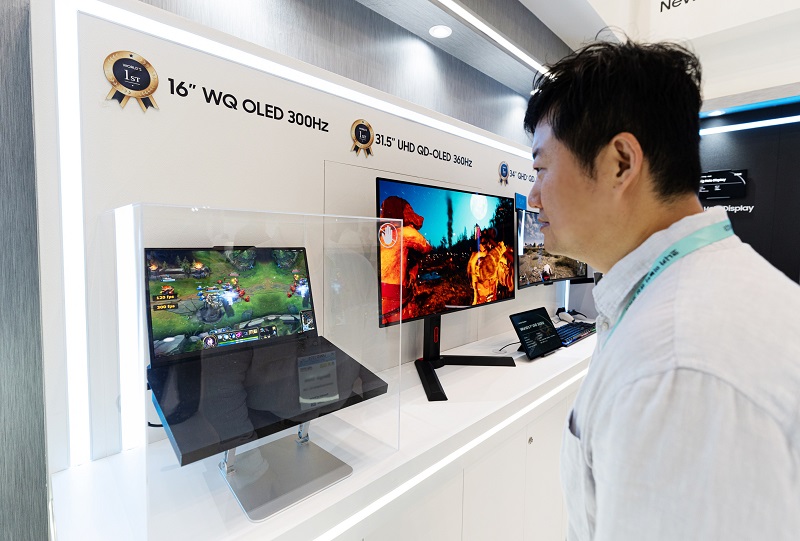
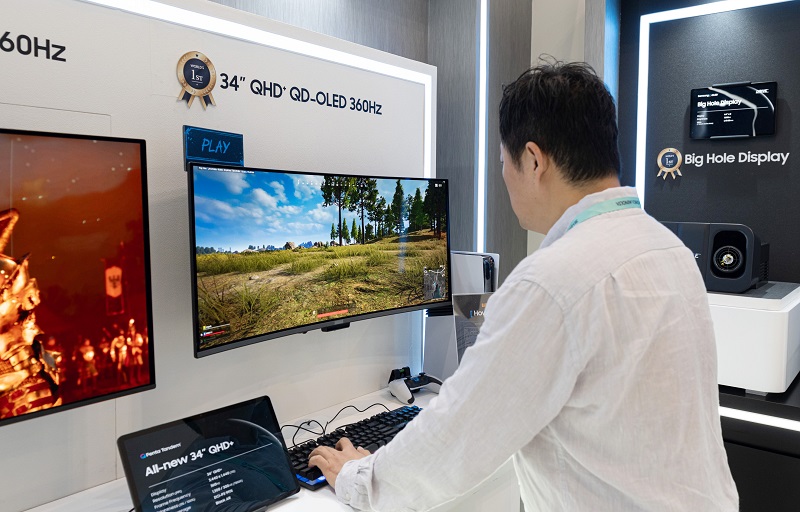
The ‘Winning Game Arena,’ designed around the concept of a futuristic digital playground, will feature three high-performance OLED products for IT applications. Visitors will be able to experience Samsung Display’s differentiated IT display technologies through a 31.5-inch QD-OLED, the first monitor panel to combine 4K resolution with a 360Hz refresh rate; a 34-inch 360Hz QD-OLED gaming monitor with a 21:9 ultrawide aspect ratio; and a 16-inch 2.5K OLED for laptops, the first self-emissive laptop display to achieve a 300Hz refresh rate.
□ Samsung Display presents the most technical papers among participating companies; Galaxy S26 Ultra OLED wins ‘Korea Display of the Year’
At IMID 2026, Samsung Display will present 57 technical papers, the highest number among participating companies for the second consecutive year, reinforcing its R&D leadership in display technology.
The OLED used in the Galaxy S26 Ultra has also received the ‘Korea Display of the Year’ award at IMID. The product was highly recognized for being the world’s first to feature a privacy display, strengthening protection of users’ personal information. Samsung Display also received the ‘Korea Display of the Year’ award last year for the foldable OLED used in the Galaxy Z Fold SE, which was optimized for multitasking and content consumption.
Meanwhile, Sung-chan Cho, Executive Vice President and Head of the Display Research Center, will deliver a keynote address at the IMID 2026 opening ceremony at BEXCO at 2 p.m. on August 19. Under the theme ‘AI’s Next Leap, Why Displays Matter More Than Ever,’ Cho will discuss the growing importance of display technology as AI advances, with displays evolving into both a critical interface connecting people and AI and an intelligent platform in their own right.
The keynote will highlight how high-performance self-emissive display technologies can enable more immersive interactions and directly influence the quality of AI experiences. It will also address how generative AI can accelerate innovation throughout display R&D and manufacturing, including material and structure optimization and automated inspection, while improving both productivity and quality.
Cho will also outline three key directions for displays in the AI era: ‘Every Space,’ referring to displays embedded across everyday environments such as robots, XR, mobility and smart spaces; ‘Ultra Low Power,’ designed to meet the demands of AI-intensive data processing environments; and ‘Context Awareness,’ in which displays integrate sensors and AI to understand a user’s condition and surrounding context. He is expected to emphasize that innovation driven by generative AI will become an increasingly important factor in determining competitiveness in the next-generation display industry.