
- Shipments plunged to 300,000 units in 1Q26 amid rising memory prices
- Low-cost, large-screen rigid OLED panels drive the recovery
- Flexible OLED share virtually disappears as supply shifts toward rigid OLED
Samsung Display’s smartphone OLED shipments to Xiaomi have continued to recover for two consecutive quarters after hitting a low point in the first quarter of 2026.
According to UBI Research, Samsung Display shipped just 300,000 smartphone OLED panels to Xiaomi in 1Q26. This represented a 94.9% decline from 5.9 million units in the same quarter of the previous year, indicating a sharp contraction in supply.
Shipments subsequently recovered to 2.2 million units in 2Q26 and are projected to increase further to 4.3 million units in 3Q26. This would represent an increase of more than 14 times from the 1Q26 low in just two quarters.
The 3Q26 forecast is 87.0% higher than the 2.3 million units shipped in the same quarter of 2025, marking the first year-on-year growth in 2026.
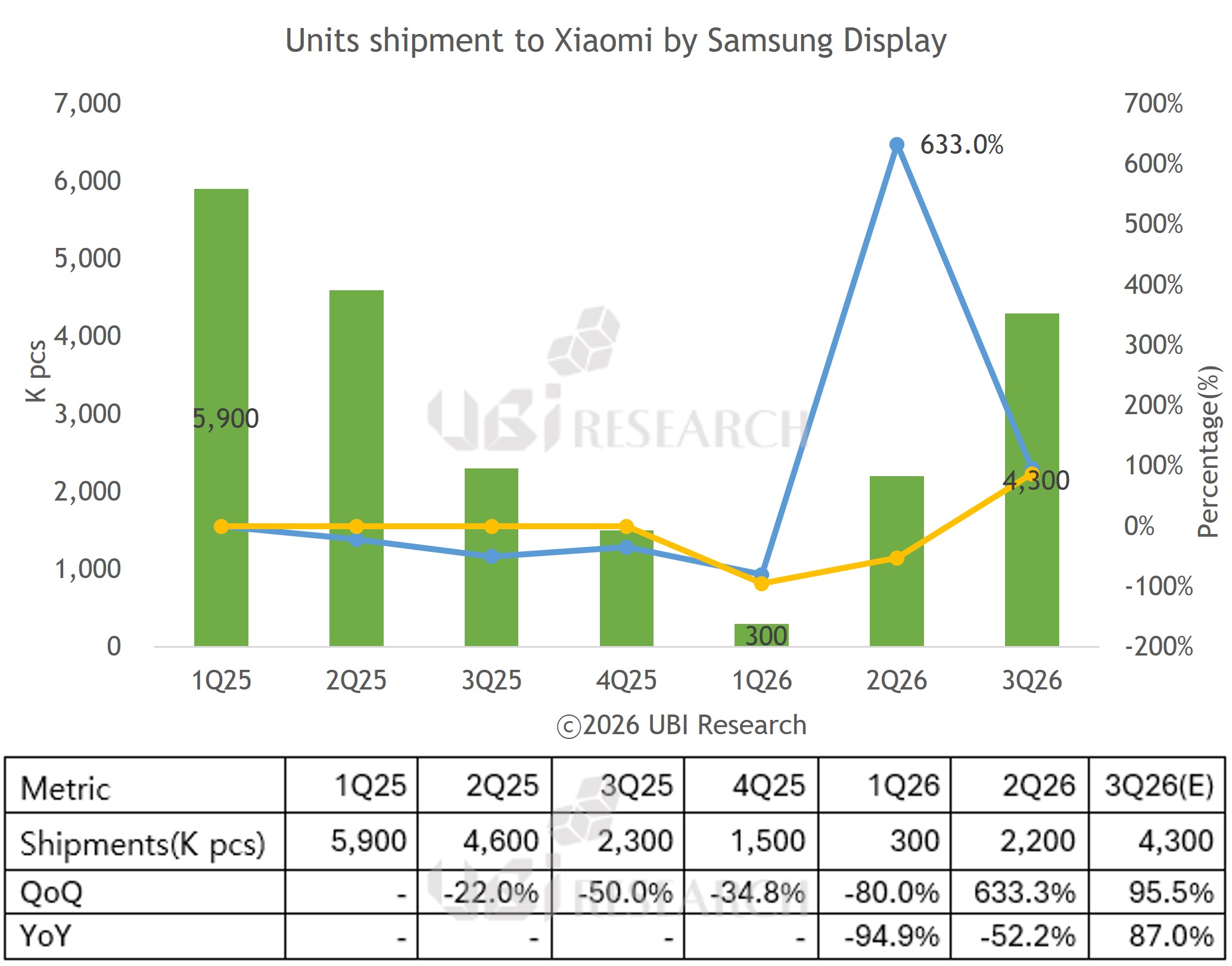
Samsung Display smartphone OLED shipment trend to Xiaomi (Source: UBI Research)
■ 1Q26: Rising Memory Costs Coincide With a New-Product Supply Gap
One of the main factors behind the decline appears to have been increasingly conservative production plans among Chinese smartphone makers, particularly those with high exposure to the mid-range and entry-level segments, as rising memory semiconductor prices since the second half of 2025 increased smartphone manufacturing costs.
Chinese smartphone brands that compete primarily on price-performance have limited ability to pass higher component costs directly on to consumers. As a result, some companies have responded by adjusting product launch schedules or reducing production volumes.
Because smartphone panel orders are typically placed ahead of mass production of finished devices, these adjustments to handset production plans appear to have affected panel shipments in 1Q26 as well.
Samsung Display’s OLED shipments to Xiaomi had already begun declining sharply from 3Q25, and the downturn intensified in 1Q26 as the absence of new-product orders further reduced demand.
■ Recovery From 2Q26 Led by Low-Cost, Large-Screen Rigid OLED
The recovery since 2Q26 appears to have been driven primarily by rigid OLED panels used in low-cost, large-screen smartphones.
With memory cost pressures continuing, Chinese smartphone makers have been adjusting component specifications in order to maintain existing retail price points. While increasing features that consumers can readily perceive during the purchasing process, such as display size and battery capacity, manufacturers have sought to lower costs by reducing certain display specifications or panel costs.
Some of Xiaomi’s entry-level models scheduled for the second half of 2026, for example, are understood to feature displays in the 7-inch range and battery capacities more than 30% larger than their predecessors, while peak display brightness has been reduced compared with previous models.
In such price-sensitive segments, the cost competitiveness of Samsung Display’s rigid OLED production lines, for which a substantial portion of depreciation has already been completed, may once again become attractive.
For Samsung Display, the increase in shipments is also expected to help support the utilization rate of its A2 line to some extent.
However, the projected shipment volume of 4.3 million units in 3Q26 should be viewed more as a recovery from the sharp decline in 1Q26 than as the beginning of a full-scale growth cycle. Compared with the 5.9 million units shipped in 1Q25, the 3Q26 forecast remains at only around 73% of that level.
In addition, shipments had already fallen to 2.3 million units in 3Q25, meaning that a significant base effect is reflected in the projected 87% year-on-year increase for 3Q26.
Cumulative shipments for the first three quarters of 2026 are expected to total 6.8 million units, down 46.9% from 12.8 million units in the same period of the previous year. Although quarterly shipments are recovering, cumulative shipments therefore remain substantially lower year on year.
■ Flexible OLED Share Virtually Disappears as Supply Shifts Toward Rigid OLED
Another notable development is the changing composition of Samsung Display’s OLED supply to Xiaomi.
Flexible OLED accounted for only around 5% of Samsung Display’s total OLED shipments to Xiaomi in 2025. In 2026, virtually all shipments have been composed of rigid OLED panels.
Chinese panel makers have increased their penetration of flexible OLED panels in Xiaomi’s flagship and upper-mid-range smartphones. As a result, Samsung Display’s supply to Xiaomi appears to have become increasingly concentrated in entry-level rigid OLED products, where price competitiveness is a key factor.
At the same time, Chinese panel makers have continued lowering flexible OLED prices in an effort to secure fab utilization, gradually narrowing the price gap between rigid and flexible OLED panels for smartphones.
Based on these market dynamics, UBI Research has continued to forecast a structural contraction in the global smartphone rigid OLED market.
■ Outlook
The key question going forward is how long the current recovery can be sustained.
If memory prices stabilize, easing BOM cost pressures on smartphone manufacturers, and the price gap between rigid and flexible OLED narrows again, adoption of flexible OLED could once more expand in mid-range and entry-level smartphones.
Conversely, if memory prices continue to rise and cost pressures persist, demand for rigid OLED could remain stronger for longer than previously expected, particularly in the lowest-priced and entry-level smartphone segments.
Samsung Display has been converting some of the smartphone OLED production capacity at its A2 line to OLED panels for IT applications. It will therefore also be important to monitor whether the recent recovery in rigid OLED shipments to Xiaomi affects the company’s future line operation strategy.
From 4Q26 onward, Xiaomi’s new-product launch cycle, smartphone makers’ inventory levels, and memory price trends are expected to be the key variables determining the direction of Samsung Display’s OLED shipments to Xiaomi.
Junho Kim, Analyst at UBI Research (alertriot@ubiresearch.com)
▶2026 Analysis Report on China’s OLED Supply Chain Management
▶China Display Industry Trends Report
※ This article is produced by UBIResearchNet.
Unauthorized reproduction or citation without source attribution is prohibited.
When quoting, please clearly indicate the source (UBIResearchNet) and provide a link.