
Samsung Research and POSTECH Demonstrate Outdoor AR Glasses Prototype Using 1.5 mm Two-Layer Metasurface Waveguide
Samsung Research at Samsung Electronics and a research team led by Professor Junsuk Rho at POSTECH have developed a 1.5 mm-thick optical combiner for AR glasses that stacks two silicon nitride (SiNx) metasurface waveguides, and published the work in Nature. The paper, titled "Metasurface waveguides for all-day augmented reality glasses," was published online on November 11 (local time). The prototype achieved an average luminance efficiency of 1,938 nits/lm with a 30° diagonal field of view (FOV) over an 8×8 mm² two-dimensional eyebox.
In diffractive waveguide AR glasses, light from a microdisplay enters the waveguide through an input grating (in-coupler), changes direction in a fold region, and exits toward the eye through an output grating (out-coupler). In this process, some light escapes along paths other than toward the eye, lowering luminance, and the loss grows as the eye position shifts. Because the same grating diffracts red, green and blue wavelengths with different efficiencies, color non-uniformity also occurs.
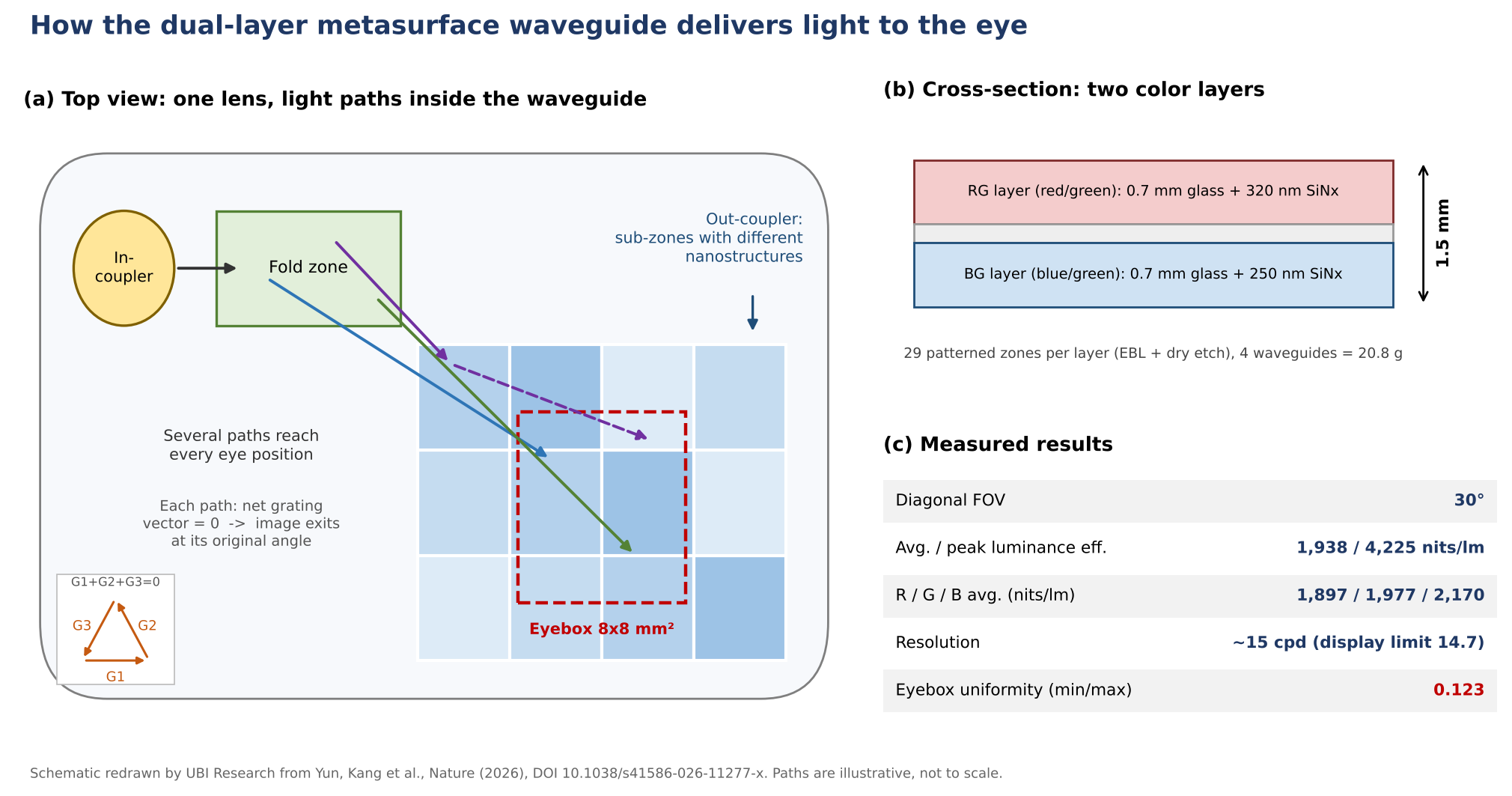
Light paths, cross-sectional structure and key measurement results of the two-layer metasurface waveguide (Source: Nature paper, reconstructed by UBI Research)
What the team changed is the path light takes inside the waveguide. Each time light hits a grating on the waveguide surface, its direction of travel is bent by a fixed direction and magnitude, called the "grating vector." Conventional two-dimensional expansion waveguides generally use a single path in which light passes once through the input, fold and output gratings in sequence. The team defined three grating vectors with different directions (G1, G2, G3) and arranged them intermixed within a single waveguide. Depending on which gratings light encounters and in what order, it reaches the output region by different routes. Because light from the same field angle is split into multiple branches that reach different parts of the eyebox, the image does not break up even when the eye moves up, down, left or right.
Using multiple paths can cause image misalignment, since the sum of bending directions differs from path to path. The team designed the combinations so that the sum of grating vectors along each path is zero. When G1, G2 and G3 form a triangle, light returns to its original direction after being bent three times. As a result, whichever path it takes, light enters the eye at the same angle at which it left the display, and images do not overlap.
The second design element is position-dependent nanostructures. The team divided the waveguide into an input section, a fold section and multiple output sub-regions, and varied the shape and spacing of the nanostructures in each. In the input section, the spacing of nanorods and nanobeams was tuned to send more of the incoming light in the required direction. The fold section was made to respond strongly only to light arriving at specific angles, so that only light that needs to be redirected changes direction. The output section increased light exiting toward the eye and reduced light leaking outward. For design validation, nanostructure simulation (RCWA) results were fed into the optical design tool LightTools, which jointly calculated brightness at 9 field angles and 5 eye positions for each wavelength.
Full color was achieved with a two-layer separated structure. The blue-green (BG) and red-green (RG) layers were each made by depositing 250 nm and 320 nm of SiNx on 0.7 mm high-index glass, and the assembled two-layer combiner is 1.5 mm thick. For each layer, 29 types of position-dependent grating patterns were fabricated by electron-beam lithography (EBL) and dry etching, with most structural dimensions within ±20 nm of design values. The four waveguides for both lenses weigh 20.8 g.
Luminance efficiency averaged 1,938 nits/lm, with a maximum of 4,225 nits/lm. The red, green and blue channel averages were 1,897, 1,977 and 2,170 nits/lm, respectively, a spread of 273 nits/lm between channels. In darkroom imaging, line pairs of about 15 cpd (cycles per degree) were resolved, close to the microdisplay's angular-resolution limit of 14.7 cpd. Outdoors, white text was visible, but the legibility of small text dropped under strong ambient light.
Professor Rho named reducing rainbow artifacts, securing mass-production technology and integrating with AI-based personalized image processing as directions for follow-up research.
Chang-ho Noh, UBI Research