
At SID Display Week 2026, held at the Los Angeles Convention Center from May 5 to 7, major OLED panel manufacturers from South Korea and China unanimously highlighted the BT.2020 color gamut as their core message, signaling that wide color gamut is now the key battleground in OLED technology competition.
Samsung Display unveiled its “Flex Chroma Pixel” OLED technology, which utilizes a PSF (Phosphorescent Sensitized Fluorescence) OLED emitter platform, and announced that it had simultaneously achieved 96% of the BT.2020 color gamut and a maximum brightness of 3,000 nits in HBM mode. This marks the first time Samsung Display has unveiled a PSF OLED prototype, and it is significant in that it overcomes the limitations of OLED—previously viewed as a trade-off between color gamut and brightness—through the combination of PSF emitters and a LEAD optical structure. In its research paper, Samsung Display presented a BT.2020-compatible platform that simultaneously improves color purity, efficiency, and lifespan by employing a PST emitter system and a new Ag-based semi-transparent cathode in both Green and Blue OLEDs.
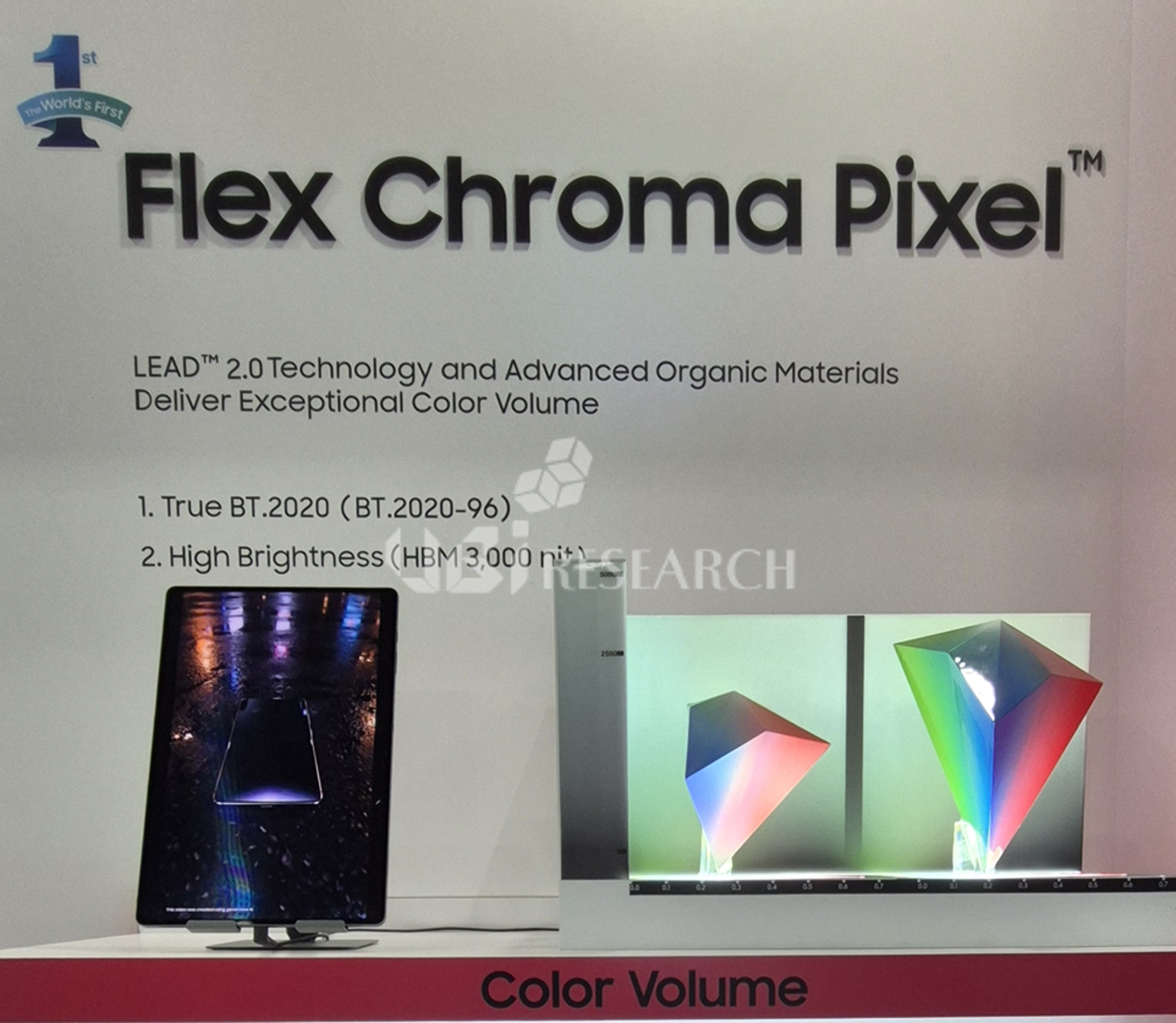
Samsung Display’s Flex Chroma Pixel OLED technology. Applying the PSF emitter platform, it simultaneously achieves 96% BT.2020 color gamut and a maximum brightness of 3,000 nits. (Source: UBI Research)
At SID 2026, LG Display clearly outlined the roadmap for the evolution of WOLED color gamut. At its booth, the company demonstrated a wide color gamut of approximately 90% of BT.2020 using a Tandem WOLED panel with an RGB stripe structure that eliminates the white sub-pixel. This technology is slated for application in monitors and TVs. LG Display has unveiled a roadmap to expand the color gamut of its WOLED panels from 90% of BT.2020 in 2026 to 100% of BT.2020 by 2030 through the adoption of next-generation light-emitting materials and modification of the color filter (CF) structure. The color gamut of LG’s conventional RGWB-structured WOLED is about 80% of BT.2020. The company also unveiled its third-generation Tandem OLED for automotive applications (18% lower power consumption, more than double the lifespan, and deep blue dopant applied).
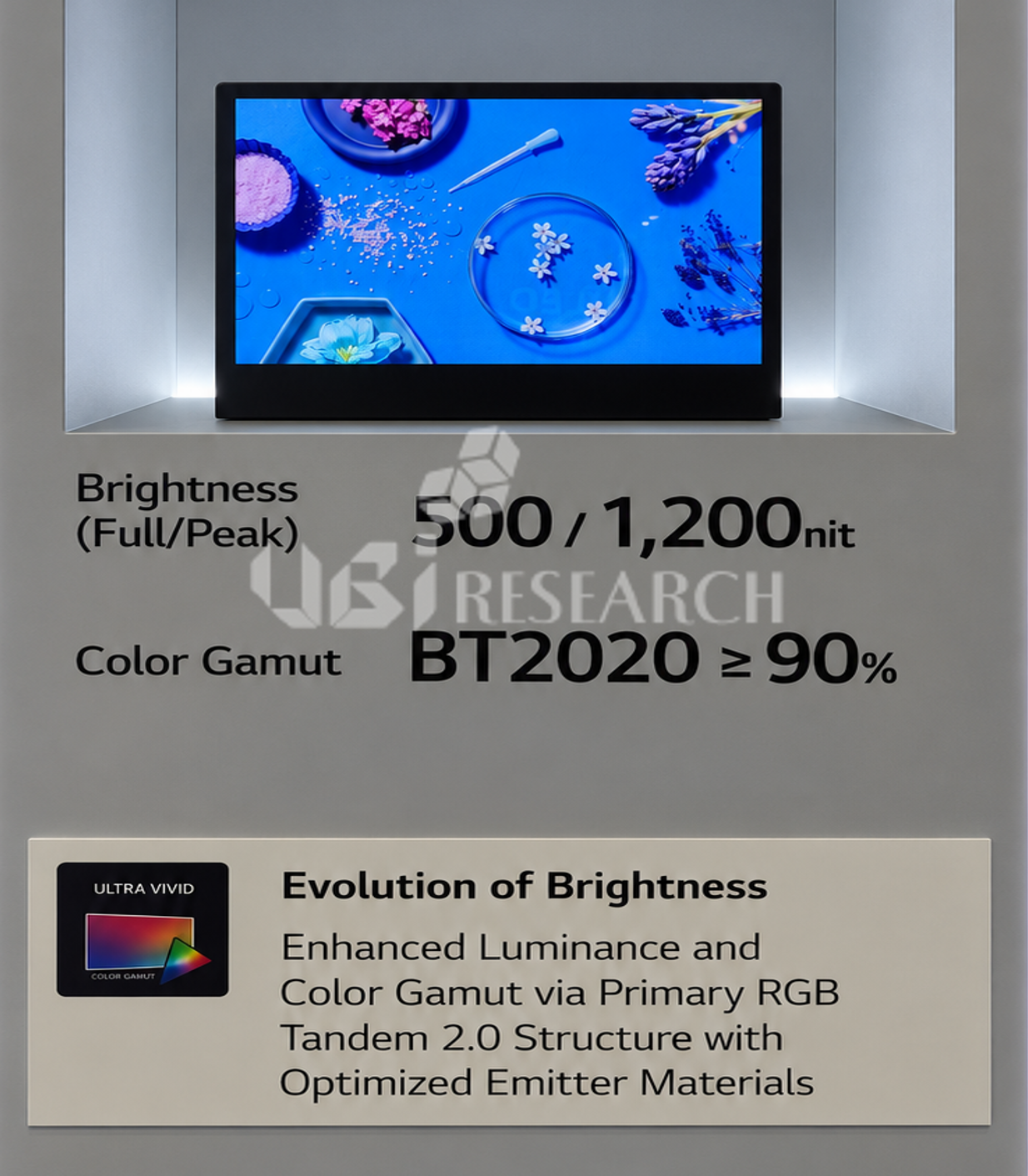
LG Display’s tandem WOLED panel with an RGB stripe structure. It enhanced wide color gamut performance to 90% BT.2020 through color filter changes and next-generation emitters. (Source: UBI Research)
The Chinese industry also made significant strides. BOE announced that its 14-inch TADF wide-color-gamut OLED display was the first in China’s display industry to receive Pantone Validated color accuracy certification. At its Innovation Partner Conference in September 2024, BOE announced that a 6.55-inch TSF OLED panel—combining TADF-sensitized Fluorescent (TSF) materials with a tandem stack structure—had achieved a BT.2020 color gamut coverage of 95%. This material platform consists of a combination of deep green TSF emitters, deep red phosphorescent materials, and blue fluorescent emitters, and is characterized by simultaneously achieving a narrow emission spectrum and 100% IQE.
Tianma announced that it achieved over 96% of the BT.2020 color gamut using its U11 stack based on NFT (New Fluorescence Technology), which integrates PSF and NFB (New Fluorescent Blue), while Visionox stated that it has entered mass production starting in the second half of 2025, securing 95% of the BT.2020 color gamut along with a 30% increase in efficiency and a 50% increase in lifespan through its pTSF technology.
The key takeaway from SID 2026 is the use of next-generation luminescent materials, such as PSF, to achieve the BT.2020 color gamut. Samsung’s PSF, Tianma’s NFT, and Visionox’s pTSF all share the same principle of using phosphorescent materials as sensitizers to transfer energy to narrow-band fluorescent dopants.
LG Display has switched the pixel structure of its mid-to-large-sized WOLED panels to an RGB stripe structure and updated its next-generation emitters and color filters, while BOE is attempting to standardize color management through Pantone certification of its TSF emitting materials.
BT.2020 is no longer merely a goal in the R&D phase but has become a core performance metric for mass-produced OLED panels. With Visionox mass-producing panels that meet BT.2020 standards and Tianma launching its U11 emitter material set, Chinese companies are actively pursuing BT.2020 OLED technology. As color gamut has emerged as a key factor in the competitiveness of next-generation OLED panels, close collaboration between panel manufacturers and emitter material suppliers, along with securing intellectual property rights for core emitter materials, will determine the medium- to long-term competitiveness of OLED panel manufacturers.
Changho Noh, Senior Analyst at UBI Research (chnoh@ubiresearch.com)
▶2026 Analysis Report on China’s OLED Supply Chain Management
▶2026 Small OLED Display Annual Report
▶2026 Medium & Large Size OLED Display Annual Report
※ This article is produced by UBIResearchNet.
Unauthorized reproduction or citation without source attribution is prohibited.
When quoting, please clearly indicate the source (UBIResearchNet) and provide a link.