
An analysis of 675 papers presented at the SID Display Week 2026 Symposium, held May 5–8, 2026 at the Los Angeles Convention Center, reveals that the display industry is entering a new inflection point driven by six major mega-trends: the transition to MicroLED mass production, the intensification of ultra-wide color gamut (BT.2020) competition, the advancement of XR optical technologies, the permeation of AI across the entire manufacturing value chain, the expansion of Glass technology into semiconductor packaging, and the evolution of LCD.
In terms of OLED patterning technology, TCL CSOT’s technology—which enables OLED production via inkjet printing on Gen 8.6 lines without a Fine Metal Mask (FMM)—and Visionox’s ViP technology—a photolithography-based maskless patterning method—are both gaining prominence.
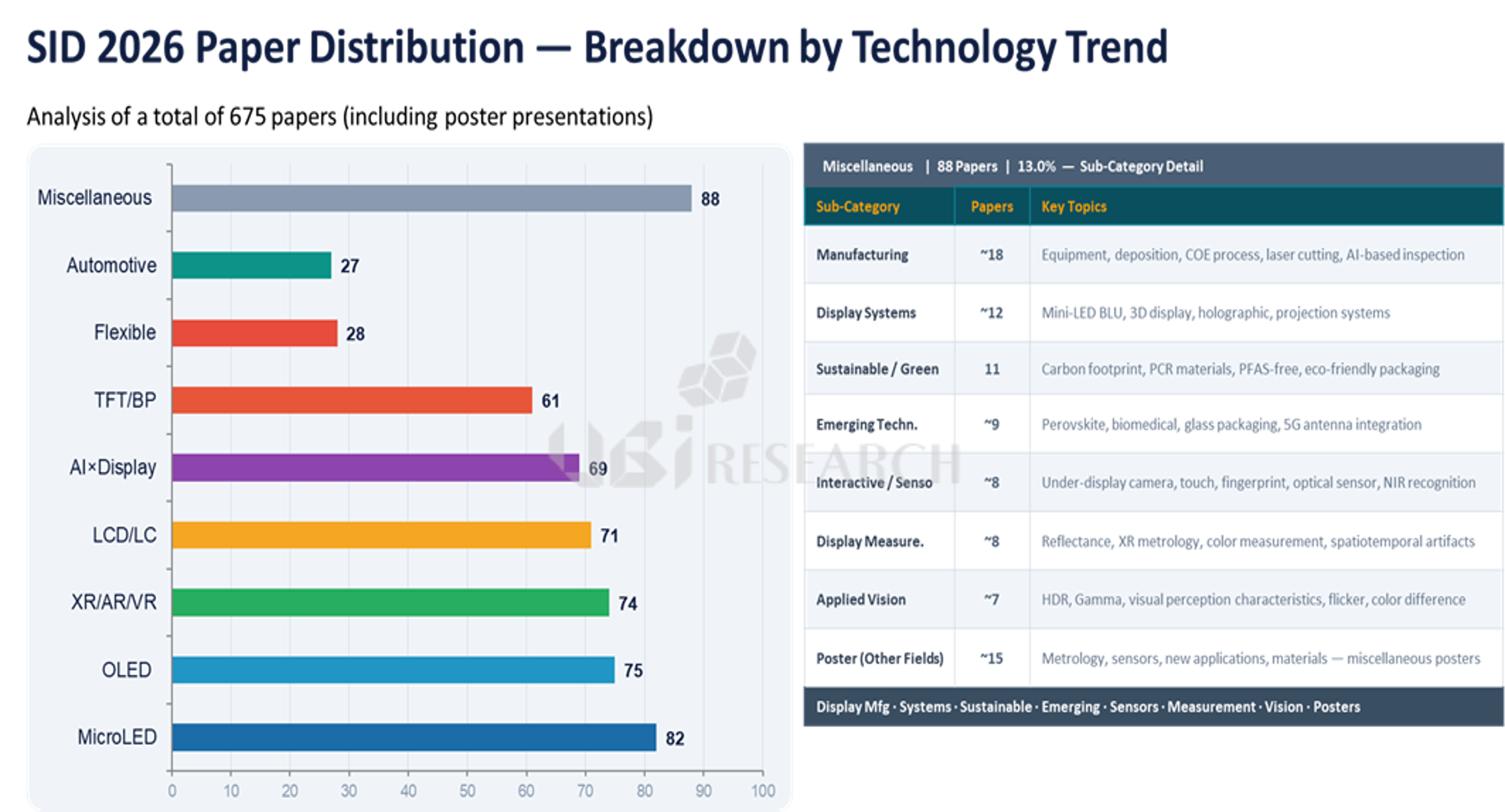
Paper distribution of the SID 2026 symposium program by technology trend. An analysis of 675 papers revealed that technological development is most active in MicroLED (82 papers), followed by OLED (75 papers), XR/AR/VR (74 papers), and AI×Display (69 papers). (Source: UBI Research)
Amid a coexistence of various approaches—including QD, perovskite, and nanowires—improving yield in mass transfer technology was identified as a key challenge. The entry of semiconductor companies such as GlobalFoundries and Aledia is accelerating ecosystem expansion. Furthermore, presentations on TGV (Through Glass Via)-based CPO (Co-Packaged Optics) development and optical communication interface design underscored that MicroLED technology is extending its reach beyond displays into next-generation optical interconnect applications.
In the OLED materials and devices sector, where 75 papers (11.1%) were presented, development of next-generation ultra-wide color gamut technology is active. The Hyperfluorescence/PSF (Phosphor Sensitized Fluorescence) camp and MR-TADF (Multi-Resonance TADF) materials are aiming to achieve BT.2020. It was also confirmed that technology enabling OLED production on Gen 8.6 lines without FMM, using inkjet printing (TCL CSOT) and photolithography (Visionox) processes, has entered the mass production stage.
The XR/AR/VR domain attracted 74 papers (11.0%), with 14 sessions concentrated on metasurface-based ultra-thin AR optical systems. Meta drew significant industry attention by publicly disclosing the optical design of its Ray-Ban smart glasses for the first time. Ultra-high-resolution Micro-OLED competition at 1,500–5,000 ppi became increasingly visible, and the integration of eye tracking and sensor technologies for intelligent XR interfaces emerged as a notable trend.
With 71 papers (10.5%), LCD continues to demonstrate its relevance through targeted advancement strategies including Field Sequential Color, AI-driven image quality enhancement, and high refresh rate technologies. LCD is expected to maintain a coexistence structure with OLED in select application segments, continuously reinforcing its technological competitiveness rather than facing wholesale displacement.
The ‘AI × Display’ domain recorded 69 papers (10.2%) across 11 independent sessions — the highest session count for any single topic. AI is now being applied comprehensively across materials inverse design, process optimization, quality inspection, and optical design. Large Language Models (LLMs) and Foundation Models tailored to display manufacturing are emerging as a new competitive axis, and AI is expected to become the core driver structurally reshaping the entire display industry value chain.
Although the Glass Interposer category accounted for only 12 papers, it stands out as one of the most strategically significant trends in terms of industry impact. As display glass manufacturing technology expands its application to semiconductor packaging substrates for AI servers, the boundaries between the display and semiconductor industries are blurring. Companies such as Intel and Resonac, which were previously unrelated to the display industry, are participating in SID with invited papers, reflecting a trend where display companies are entering the advanced packaging market.
According to UBI Research’s analysis, SID Display Week 2026 clearly demonstrates that the display industry is undergoing structural transformation across materials, processes, and application domains — well beyond conventional image quality competition. The readiness of MicroLED for mass production, the realization of BT.2020 color reproduction through Hyperfluorescence and MR-TADF, and the industrial expansion of AI and Glass technologies are all poised to become defining axes of competition in the premium display market. In particular, the Glass Interposer and CPO segments present strategic opportunities for display companies to enter the semiconductor packaging and optical interconnect markets, warranting close attention.
Changho Noh, Senior Analyst at UBI Research (chnoh@ubiresearch.com)
▶2026 Analysis Report on China’s OLED Supply Chain Management
※ This article is produced by UBIResearchNet.
Unauthorized reproduction or citation without source attribution is prohibited.
When quoting, please clearly indicate the source (UBIResearchNet) and provide a link.