
UK-based OLED technology company Excyton unveiled its 3D-OLED technology at SID Display Week 2026. The technology vertically stacks red, green, and blue subpixels and drives each subpixel independently.
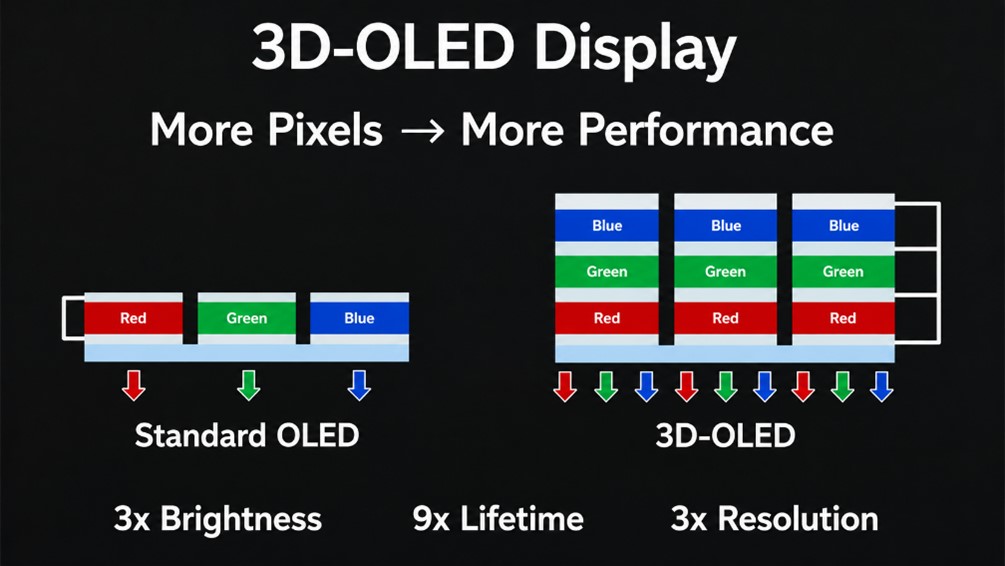
Concept diagram of the 3D-OLED technology unveiled by Excyton at SID 2026. By vertically stacking RGB subpixels, it targets 3x resolution, 3x brightness, and 9x lifetime compared to conventional horizontal layouts. (Image Source: Excyton)
In conventional RGB OLEDs, the R, G, and B subpixels are arranged horizontally within a single pixel, which limits the emission area available for each color. By contrast, 3D-OLED vertically arranges RGB elements, improving the utilization of space within the pixel and enabling high-resolution, high-efficiency OLED displays.
In Excyton’s introduction of its 3D-OLED research, the company demonstrated a pixel concept in which RGB subpixels are vertically stacked in a passive-matrix OLED display. The research presented full-color implementation of the sRGB color gamut, a brightness of 180 cd/m² based on D65, low crosstalk, and good pixel-to-pixel uniformity. Excyton has also highlighted the potential to reduce OLED display power consumption through its TurboLED® technology, and 3D-OLED can likewise be viewed as an approach to improving performance through pixel-structure innovation.
Excyton is a company that develops designs and algorithms to improve the efficiency and color performance of OLED and MicroLED displays.
UBI Research analyzed that Excyton’s 3D-OLED technology demonstrates that OLED performance improvements can be driven not only by material development but also by innovation in pixel architecture. As pixel-area utilization and efficiency improvement become increasingly important for high-resolution IT displays and low-power mobile displays, Excyton’s 3D-OLED technology is worth noting as one of the next-generation OLED structures. However, for actual mass-production adoption, further verification will be required in areas such as active-matrix driving, large-area manufacturing processes, yield of the stacked structure, and long-term reliability.
Changwook Han, Executive Vice President/Analyst at UBI Research (cwhan@ubiresearch.com)
▶2026 Small OLED Display Annual Report
▶2026 Medium & Large Size OLED Display Annual Report
※ This article is produced by UBIResearchNet.
Unauthorized reproduction or citation without source attribution is prohibited.
When quoting, please clearly indicate the source (UBIResearchNet) and provide a link.