
Although OLED and Micro-LED are attracting attention as next-generation automotive display technologies, LCDs still remain the mainstream in the actual automotive display market. LCDs offer advantages in cost competitiveness, mass production stability, long-term reliability, and scalability to larger sizes, making them widely used in various applications such as instrument clusters, CIDs, passenger displays, and rear-seat entertainment systems.
For this reason, optical film technology, which plays a key role in determining the image quality and visibility of automotive LCDs, is still regarded as an important competitive factor.
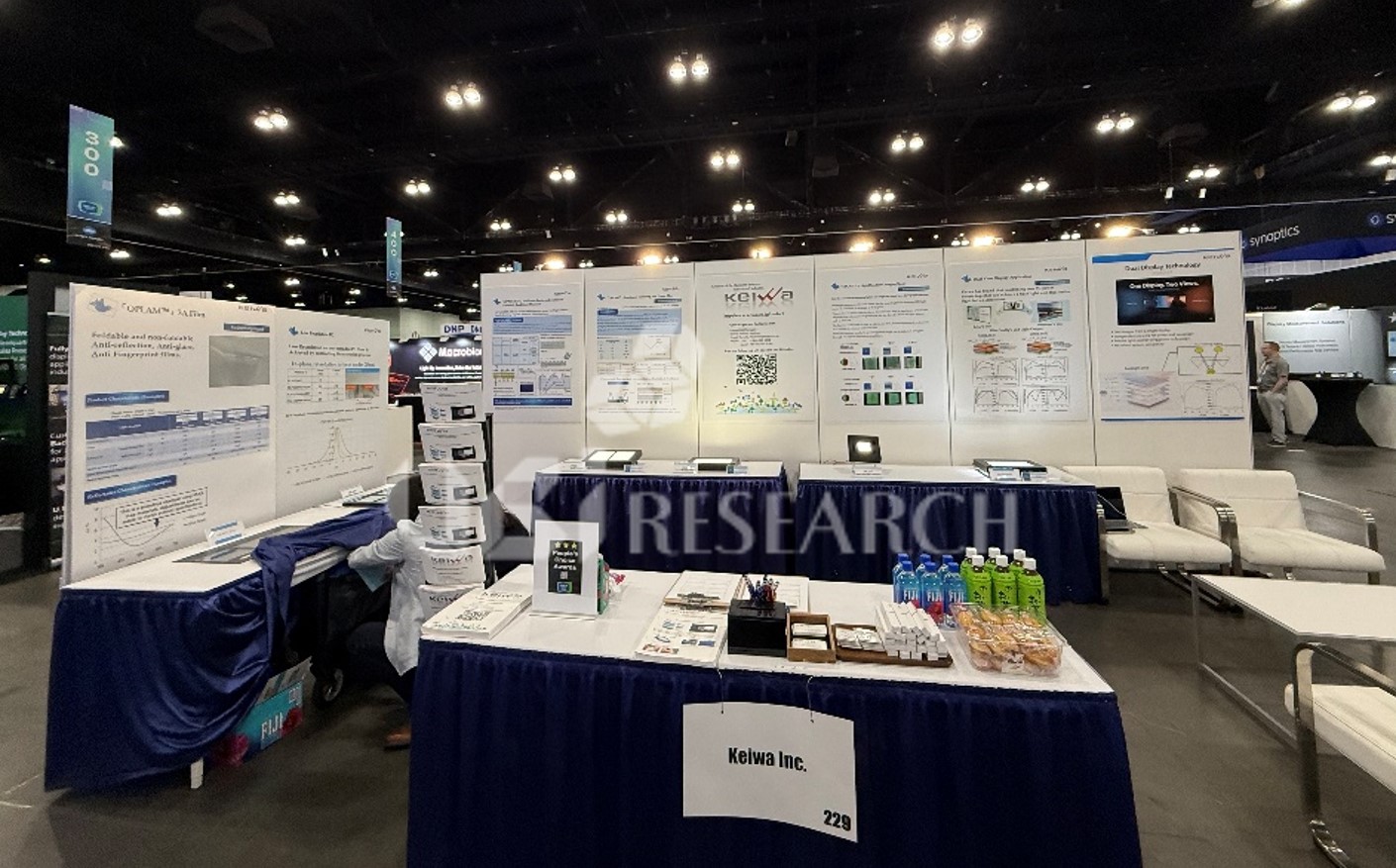
Keiwa’s booth at SID 2026. The company exhibited various optical film solutions that improve the image quality of automotive displays and Mini LED LCDs. (Source: UBI Research)
Keiwa, a Japanese company specializing in high-performance films, showcased optical film solutions for automotive displays and Mini LED LCDs at SID 2026, highlighting its technological capabilities in response to these market trends. Keiwa’s competitiveness lies not merely in supplying films, but in its optical design capability to uniformly diffuse light generated from the backlight across the entire screen, reduce luminance non-uniformity and hotspots, and improve viewing angle and brightness efficiency.
In Mini LED LCDs in particular, where a large number of LED light sources are densely arranged, optical films play a critical role in fully realizing local dimming performance. Keiwa’s composite diffusion plate integrates diffusion, viewing-angle control, and brightness enhancement functions, helping reduce the number of components while contributing to thinner modules and lower power consumption. OPALUS diffuser film is a representative product that reduces mura and improves image quality, while OPASUKI diffuser sheet and plate enhance LCD backlight image quality by achieving both high brightness and uniform diffusion characteristics.
Surface quality is also essential for automotive displays. Information must remain clearly visible even under strong sunlight, while glare, reflections, and interference patterns that may distract the driver need to be minimized. Through low-retardation control and surface profile design technologies, Keiwa suppresses interference patterns and offers both clear films and matte films according to customer requirements, supporting improvements in surface quality and visibility for automotive displays.
Keiwa’s exhibition at SID 2026 showed that competition in automotive displays is not determined by panel technology alone. As long as LCD remains a core technology in the automotive display market, the value of optical films that improve backlight efficiency, luminance uniformity, low-reflection surface quality, and slim module design will continue to be significant. Based on its precision coating and optical film design capabilities, Keiwa clearly demonstrated its presence as a capable materials company enhancing the performance and completeness of automotive LCDs and Mini LED displays.
Changwook Han, Executive Vice President/Analyst at UBI Research (cwhan@ubiresearch.com)
▶2025-2026 Automotive Display Technology and Industry Trends Analysis Report
※ This article is produced by UBIResearchNet.
Unauthorized reproduction or citation without source attribution is prohibited.
When quoting, please clearly indicate the source (UBIResearchNet) and provide a link.