
At SID 2026, Tianma introduced a GOC (Gray Overcoat)-based BM-Free COE (Color Filter on Encapsulation) technology capable of simultaneously optimizing reflectance, chromaticity, and power consumption while reducing the number of photomasks used in the COE process.
This technology retains R/B color filters, while the GOC layer performs the functions of both the G color filter and the OC planarization layer, enabling fabrication with only three photomasks (SID 2026 Digest 66-2).
A conventional OLED COE structure typically consists of color filters, a black matrix (BM), and a planarization layer formed on top of TFE (Thin-Film Encapsulation) to reduce ambient light reflection and improve contrast ratio, generally requiring five photomasks.
BM-Free COE structures replace the BM using overlapping R/B color filter structures, reducing the mask count to four, but they still require a G color filter and an OC layer.
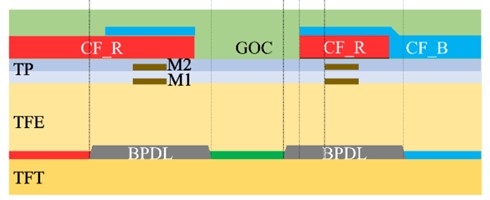
The proposed GOC (Gray Overcoat) collaborative COE structure by Tianma. It is manufactured with only 3 photomasks, allowing independent thickness adjustment of R/B color filters and GOC to optimize optical performance. (Source: Tianma)
The key feature of this technology is the independent control of the thicknesses of the GOC layer, R color filter, and B color filter.
In conventional GOC approaches, optical performance is mainly determined by the spectral characteristics of the GOC material itself.
In contrast, Tianma’s collaborative GOC-type COE structure maintains the R/B color filters while independently designing the GOC thickness, R-CF thickness, and B-CF thickness, allowing flexible adjustment of reflectance, chromaticity, and power consumption characteristics.
Through optical simulation, Tianma confirmed that the chromaticity coordinates can be controlled over a wide range depending on the thickness combinations of the GOC and R/B color filters. Experimental prototype verification showed a reflectance of 6.16% and a 21% reduction in power consumption.
Although the number of photomasks was reduced to three, diffraction characteristics demonstrated performance comparable to conventional COE structures, confirming that there was no degradation in optical performance. Technology is therefore considered capable of simultaneously achieving process simplification and yield improvement.
In addition, Tianma demonstrated a smartphone display incorporating GCL (Gray Common Layer) technology, showing approximately 20% lower power consumption compared with products using polarizers.
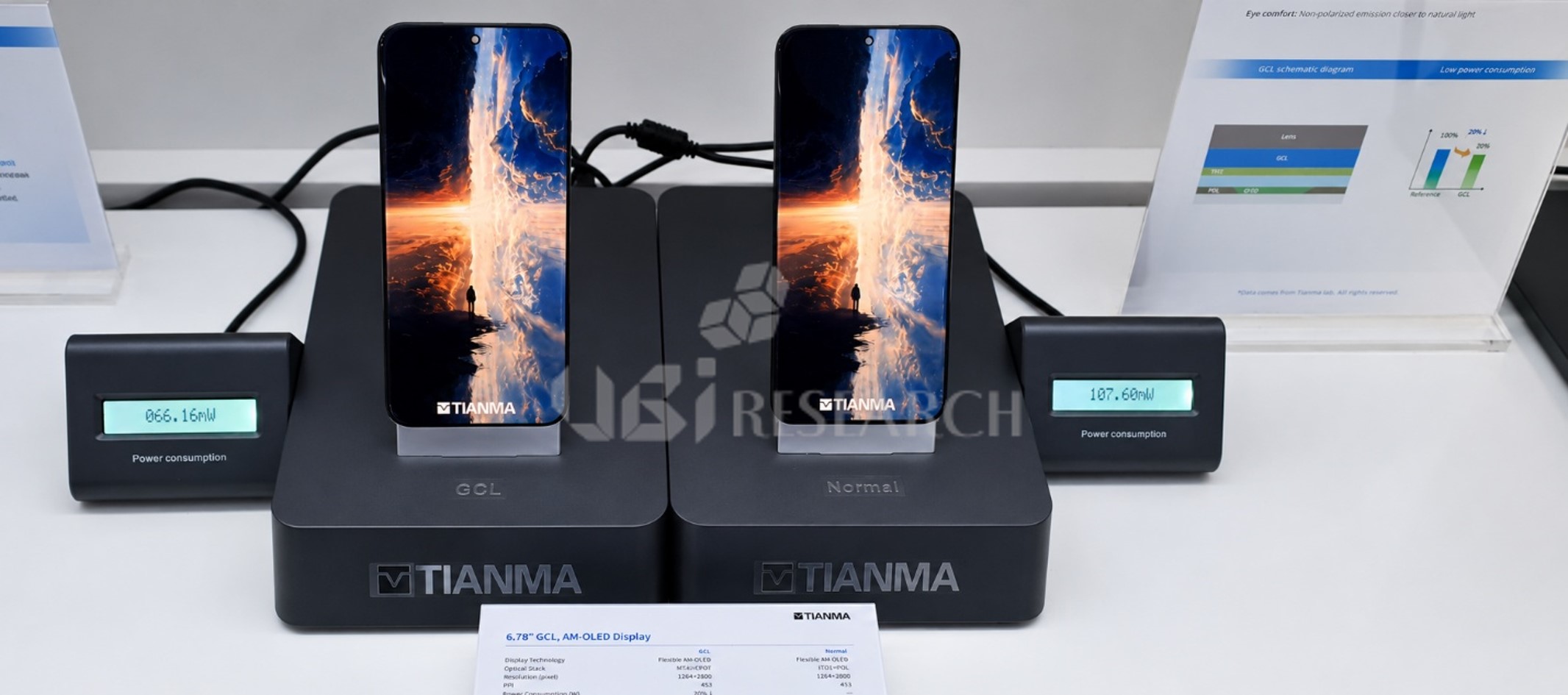
A smartphone featuring Tianma’s GCL exhibited at SID 2026. It demonstrates a power consumption reduction of 20% compared to products using conventional polarizers. (Source: UBI Research)
According to analysis by UBI Research, Tianma’s new GOC-based BM-Free COE technology represents an approach aimed at simultaneously reducing manufacturing costs and optimizing performance for next-generation OLED panels.
Simply reducing the number of masks through process simplification alone makes it difficult to satisfy product-specific requirements for chromaticity and reflectance. However, Tianma’s approach is significant because it adjusts both the GOC and R/B color filter thicknesses together, shifting from a “material-determined performance” model to a “structure- and process-engineered performance” model.
Changho Noh, Senior Analyst at UBI Research (chnoh@ubiresearch.com)
▶2026 Analysis Report on China’s OLED Supply Chain Management
▶2026 Small OLED Display Annual Report
▶2026 Medium & Large Size OLED Display Annual Report
※ This article is produced by UBIResearchNet.
Unauthorized reproduction or citation without source attribution is prohibited.
When quoting, please clearly indicate the source (UBIResearchNet) and provide a link.