
Written by Chang-ho Noh, Senior Analyst
Soaring memory prices are reshaping the smartphone bill of materials (BOM). Only a year ago, the application processor (AP), display and camera accounted for the bulk of component costs; today, memory has become the most expensive part. As smartphone makers try to absorb rising memory costs through other components, OLED panels, which are in ample supply, have become a primary target for cost reduction.
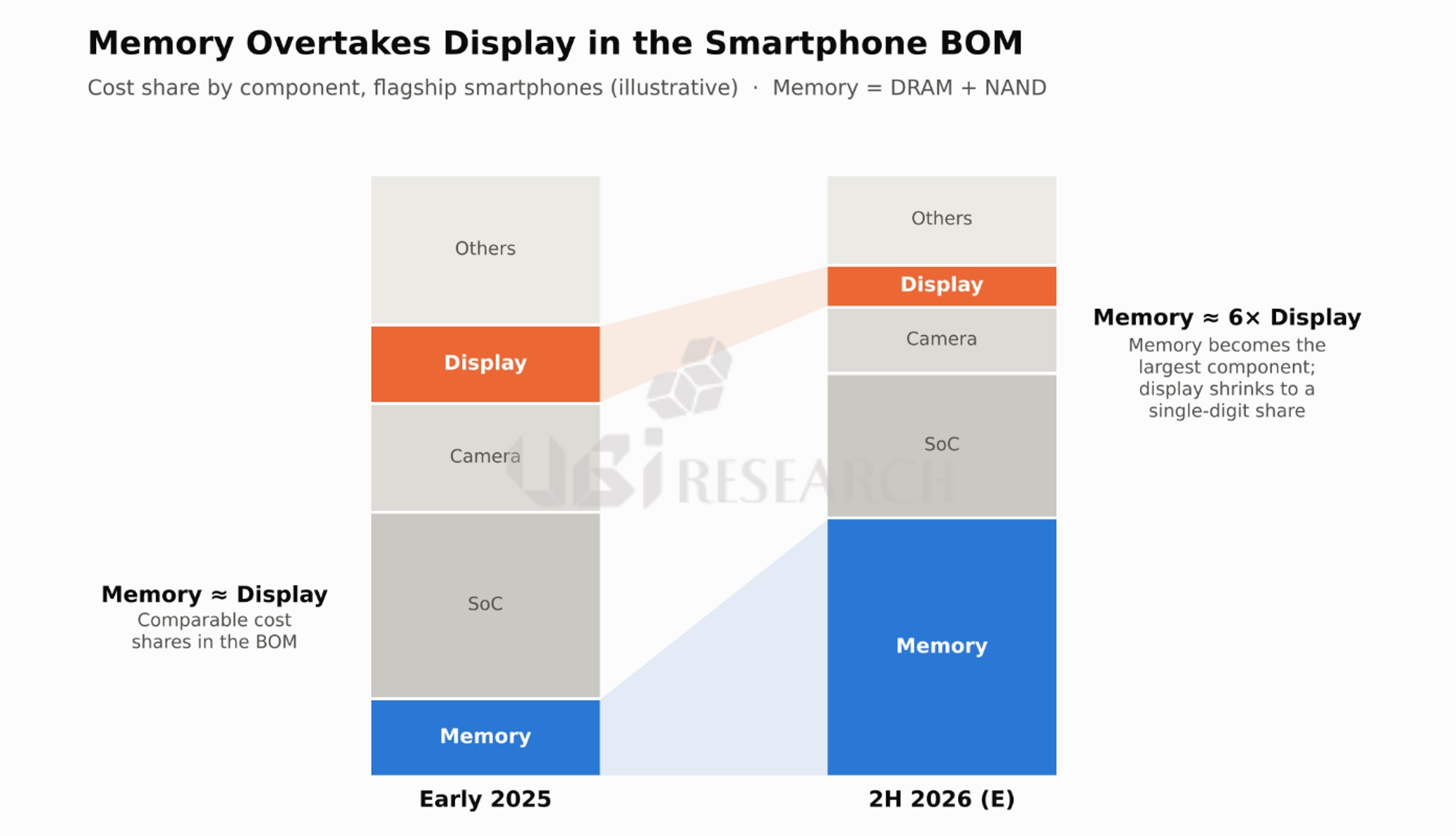
Changes in flagship smartphone BOM structure driven by rising memory prices. Memory is expected to account for a substantially larger cost share than the display in the second half of 2026. (Source: UBI Research)
Smartphone memory prices have risen sharply quarter after quarter this year. In low-end phones, memory accounts for most of the increase in component costs, while in mid-range phones memory is estimated to represent around 40% of the BOM. Some analyses suggest that memory exceeds half of the BOM in phones priced below $400. Even in flagship models, DRAM has overtaken the AP as the single most expensive component. According to the Chinese industry, the purchase price of a 12GB + 256GB memory combination has more than quadrupled in a year. Apple is no exception: memory’s share of the component cost of its latest Pro models is estimated to have grown from around 10% a year ago to the 30% range.
For flagship smartphones, memory and display accounted for similar shares of component cost in early 2025. By the second half of 2026, however, memory is expected to grow to the 40% range while the display falls to a single-digit share, widening the gap between the two to nearly six times. The shares of the AP and camera have also declined. While part of this shift reflects a dilution effect from the surge in memory costs, the price-cut pressure on panels is clearly real. Memory supply is tight, leaving smartphone makers little room to negotiate, whereas AMOLED panels, with production capacity still expanding, are an easy component on which to demand price cuts. Indeed, prices of general-purpose 6.7-inch flexible OLED panels have reportedly fallen to about half of their early-2023 level. Specification adjustments are also emerging. Some Chinese smartphone makers have switched certain high-end models from LTPO back to LTPS OLED, saving a few dollars per unit, and are reserving LTPO mainly for their top-tier models.
Smartphone makers are responding to rising costs in two ways. The first is raising retail prices. Launch prices are rising, led by flagship models, and Apple is also reported to have passed part of the cost increase on to the prices of its new iPhones. Even so, because memory costs have risen so steeply, flagship profitability this year is expected to fall below last year’s level. The second is adjusting the specifications of non-memory components. In mid-range phones, AP and camera specifications are increasingly being lowered, while for displays, costs are being cut by adjusting refresh rate or backplane specifications. Because memory capacity cannot easily be reduced due to AI features, the remaining components end up sharing the burden of higher memory costs.
The shrinking share of the display in the smartphone BOM presents panel makers with a two-sided challenge. In the low- and mid-range segments, specification downgrades and price-cut pressure, such as the reversion from LTPO to LTPS, are likely to continue. On the other hand, as demand shifts toward high-end products, panel makers that win high-end models with differentiated specifications such as LTPO, tandem, foldable and new emitter materials will be relatively better able to defend prices. Material suppliers likewise face both price pressure on materials for commodity panels and growing demand for new materials for premium panels. Until memory prices stabilize, the profitability of the display industry will ultimately depend on the share of premium products.