
How single-panel development is changing full-color AR displays
Achieving full color with Micro-LED technology is a key challenge in expanding the applications of AR glasses. Moving beyond monochrome text and information to display video, maps, and graphics naturally requires red, green, and blue emission within a very small pixel. Recent developments in stacked RGB devices by Sanan Optoelectronics, Tsinghua University, and Xiamen University, together with JBD’s single-panel full-color development, represent efforts to enable more compact AR optics through stacked full-color Micro-LED technology.
Large Micro-LED displays form each color pixel by placing RGB chips side by side. AR microdisplays, however, must accommodate RGB emitters and electrodes within a pixel pitch of just a few micrometers. Arranging them laterally further reduces the size of each emitting region, increasing the challenges associated with sidewall losses, electrode space, fine patterning, and integration precision. A planar RGB structure is not inherently impossible, but achieving both manufacturability and efficiency becomes more difficult at ultrahigh resolution. One established approach to full-color Micro-LED displays for AR combines images from three monochrome RGB panels using an X-cube prism. JBD’s Hummingbird II uses three 0.1-inch RGB panels. In this case, the cube is an optical structure that combines light, rather than a stack of RGB emitters.
Stacked RGB Micro-LEDs vertically integrate light-emitting layers of different colors. Generating RGB light at the same pixel position makes more efficient use of the available lateral space.
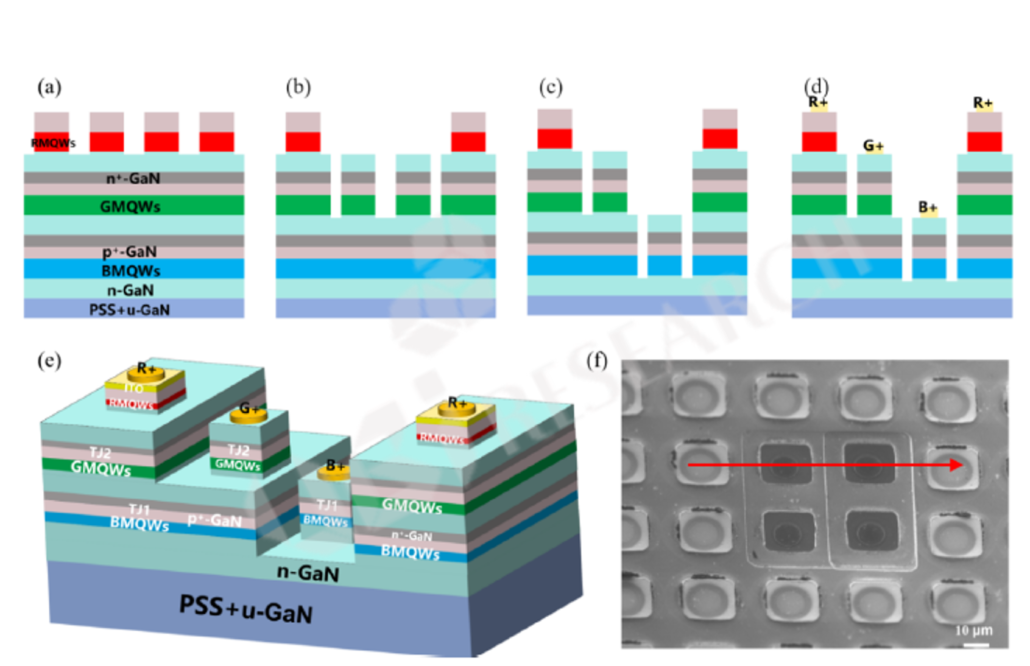
Schematic process flow for the full-color monolithic InGaN micro-LED: (a) red micro-LED mesa fabrication; (b) green micro-LED mesa fabrication; (c) blue micro-LED mesa fabrication; (d) p/n-electrode formation; (e) schematic of the three-dimensional structure; and (f) SEM image. The arrow indicates the viewing direction of the structural schematic.
Full-color monolithic InGaN micro-LED structure developed by Tsinghua University and Sanan
Source: Optics Express, Vol. 33, No. 13, 30 June 2025, p. 28799.
In a 2025 paper published in Optics Express, researchers at Tsinghua University described a device in which InGaN-based RGB epitaxial layers are connected through tunnel junctions, with the entire structure grown by MOCVD. The team fabricated 20 × 20 μm² mesa devices for each RGB color. The red emitter, which incorporates a quasi-quantum-well structure, exhibits a peak wavelength of 650 nm at 1 A/cm². Its dominant wavelength, which characterizes the perceived hue of the red light, is about 620 nm. The work demonstrates red emission in a nitride-based stacked RGB structure.
Sanan and Xiamen University developed devices using a new tunnel-junction structure to improve carrier injection and reduce photon transmission losses. The devices achieved external quantum efficiencies of 32% for blue, 20% for green, and 3% for red. The emission spectra have full widths at half maximum of 42 nm for red, 27 nm for green, and 17 nm for blue. Further improvements target more than 95% coverage of the BT.2020 color gamut. The results demonstrate operation and process feasibility for all three RGB colors, including red, for which achieving high efficiency remains particularly challenging in stacked RGB structures.
JBD has been developing its Phoenix platform, which vertically integrates semiconductor light-emitting layers. A prototype unveiled in 2023 stacked nitride-based blue and green emitters with a phosphide-based red emitter along the same optical axis, connecting them through wafer bonding and multilayer interconnects. JBD reported a combined RGB color pixel pitch of 5 μm and a total stack thickness of less than 5 μm. While commercializing its existing X-cube light engines, JBD is also advancing Phoenix stacked panels and regards the stacked approach as the ultimate solution for its future full-color products.
Another full-color approach uses quantum-dot color conversion, patterning red and green quantum dots over an array of blue Micro-LEDs. This can reduce the burden of integrating different LED materials for each RGB color. However, intense blue excitation and elevated temperatures can accelerate quantum-dot degradation. Declining conversion efficiency and differences in degradation among RGB channels can reduce brightness and shift the color balance. Fine-pattern uniformity, residual blue light, and optical leakage between adjacent pixels must also be controlled.
Stacked RGB technology is an important development direction for increasing the resolution of AR Micro-LED displays while reducing light-engine size. Its industrial competitiveness will depend on RGB efficiency and panel uniformity at a given color pixel pitch, brightness and power consumption after integration with the optics, long-term reliability, and manufacturing yield. If stacked structures meet these requirements, they are expected to broaden the design options available for full-color AR glasses.