
Automotive displays are evolving beyond the race to simply increase screen size, moving toward solutions that blend naturally into the vehicle interior. As minimalist cockpits with reduced or eliminated instrument clusters gain traction, the Panoramic Head-Up Display (PHUD), which uses the windshield as a wide information display area, is emerging as a next-generation Human-Machine Interface (HMI) technology.
BMW has introduced its next-generation Panoramic iDrive interface, which displays driving information along the lower section of the windshield. Xiaomi’s YU7 has also adopted a panoramic HUD to create a driver-centric digital cockpit without a separate instrument cluster. While conventional HUDs project information onto a limited area directly in front of the driver, PHUDs provide a broader display area for a wider range of information, improving both driving safety and interior design.
In response to this market trend, Tianma has unveiled a 43.7-inch panoramic windshield display under its proprietary automotive display brand, IRIS PHUD. The system minimizes the complex mirror-based optical structure of conventional HUDs and directly displays images along the lower section of the windshield. By reducing the driver’s need to shift focus, Tianma aims to enable a next-generation smart cockpit without a conventional instrument cluster.
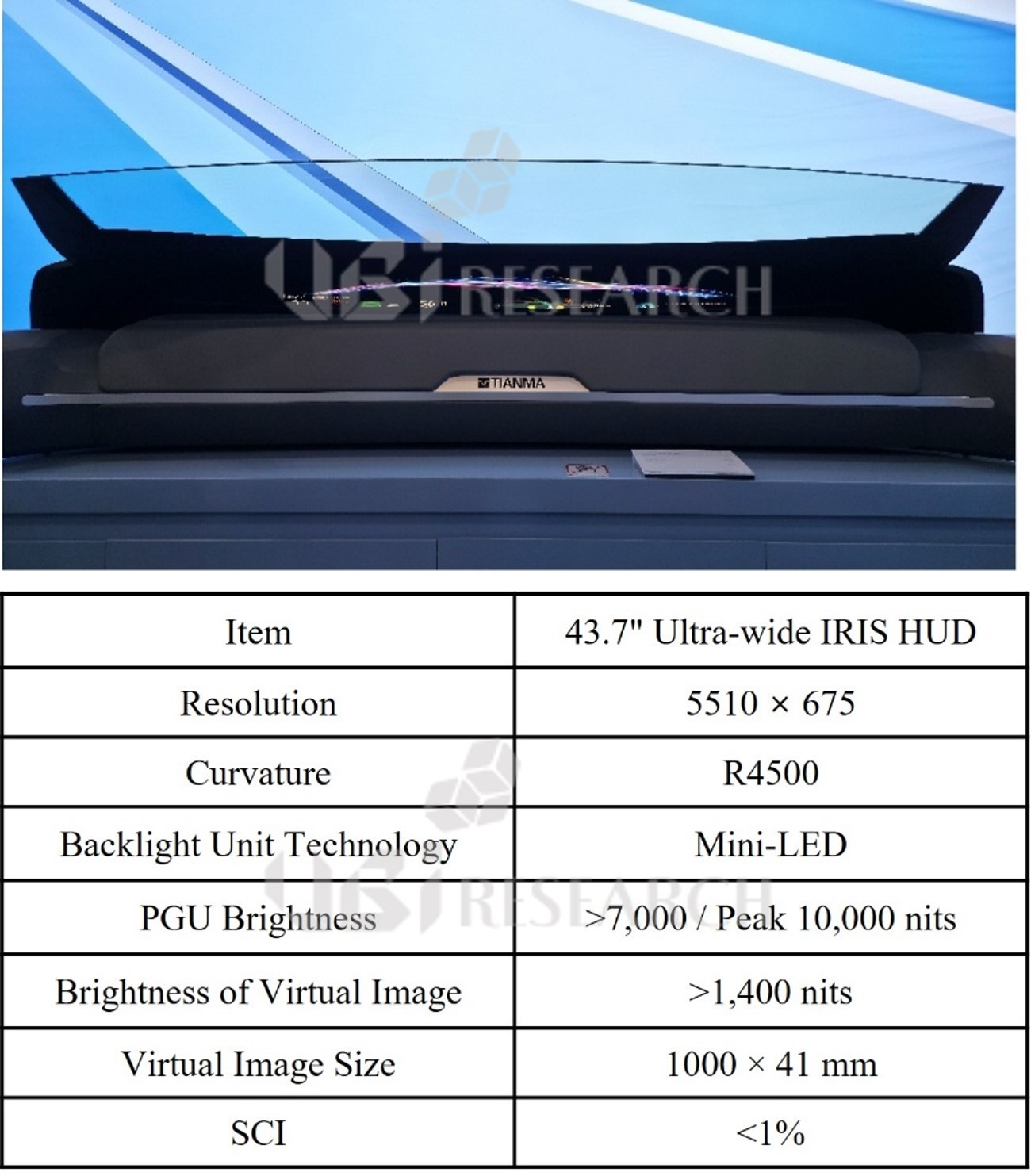
Tianma 43.7-inch IRIS PHUD specifications (Source: UBI Research)
The 43.7-inch ultra-wide display spans the lower section of the windshield, allowing the driver to naturally view essential information such as vehicle speed, navigation guidance, and traffic updates. The front passenger can also share navigation and travel information, further enhancing usability. When the screen is turned off, the black panel blends seamlessly into the interior, preserving a premium cabin design while enabling a minimalist interface in which information appears only when needed.
Its hardware capabilities are equally notable. Tianma has adopted Corning’s ColdForm™ cold-formed glass to create a large curved display that precisely matches the curvature of the windshield. The module delivers a maximum brightness of 10,000 nits, while Dynamic Local Dimming maintains the virtual image brightness at a stable level of 1,200–1,400 nits and can temporarily exceed 2,000 nits. This ensures excellent visibility even under strong direct sunlight.
Tianma has also applied its proprietary ultra-low-reflection coating technology, reducing reflectance to approximately 1%. With an 85% NTSC color gamut and 90% luminance uniformity, the display delivers vivid colors and consistent image quality across a screen measuring more than one meter in width. These technologies help present navigation guidance and other visual information in a more natural and comfortable manner.
The next generation of smart cockpits is no longer focused on increasing the number of displays, but on delivering necessary information in the most natural and intuitive way. Tianma’s 43.7-inch IRIS PHUD represents a leading example of the latest automotive HMI trend, integrating the display into the vehicle architecture to improve safety, design, and the overall user experience.
Changwook Han, Executive Vice President/Analyst at UBI Research (cwhan@ubiresearch.com)
▶2025-2026 Automotive Display Technology and Industry Trends Analysis Report
※ This article is produced by UBIResearchNet.
Unauthorized reproduction or citation without source attribution is prohibited.
When quoting, please clearly indicate the source (UBIResearchNet) and provide a link.