
Visionox (维信诺) has announced mass production of the world’s first smartphone OLED panel combining 2K resolution with a 185Hz refresh rate. The panel will be used in all models of the Honor (荣耀) WIN2 series, launching on October 21, and in the iQOO Neo12, scheduled for release at the end of October. Honor named Visionox on its poster as the “sole strategic supply partner” for the WIN2 display, while iQOO highlighted the emitting material co-developed by Visionox and Tsinghua University. With a single panel, Visionox has effectively secured two competing brands at once.
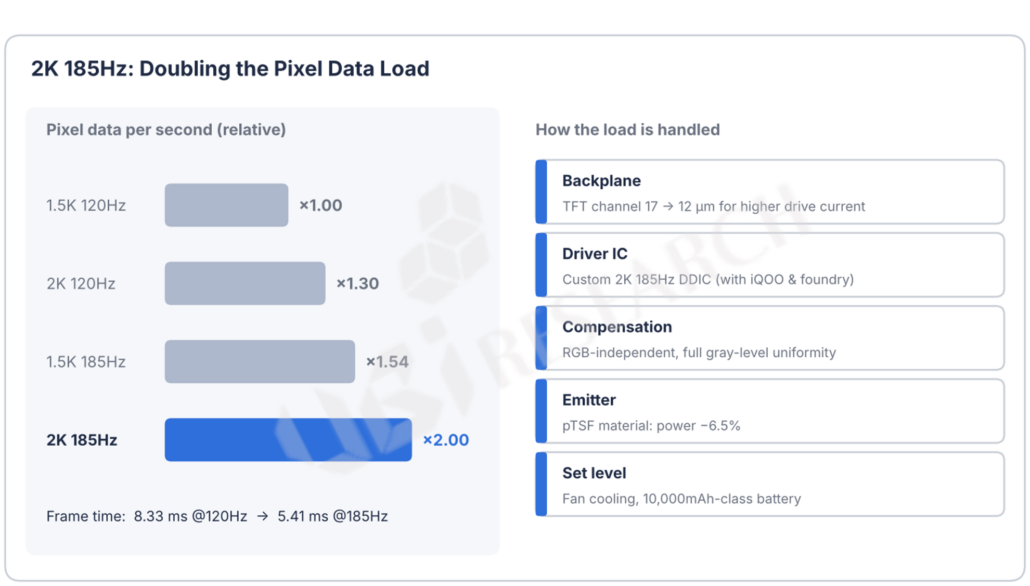
Data load of a 2K 185Hz panel and the technologies that address it (Source: UBI Research)
185Hz itself is not a new specification. Honor’s first-generation WIN adopted 1.5K 185Hz, and Tianma (天马) announced mass production of a 185Hz AMOLED in December 2025. The fourth-generation Oriental Screen (东方屏) from BOE (京东方) and OnePlus (一加) runs at 165Hz by default and supports 185Hz in certain games. Samsung Display supplied a 2K 165Hz panel for the iQOO 16. Until now, smartphone displays have had to choose between high resolution and high refresh rate, and Visionox’s “world first” refers to the combination of the two.
Combining the two specifications is no small task. 2K has about 30% more pixels than 1.5K, and 185Hz refreshes the screen about 54% more often per second than 120Hz. Compared with 1.5K 120Hz, the pixel data to be processed per second roughly doubles, and the time available for each frame is only 5.41ms. Visionox shortened the TFT channel length from 17µm to 12µm to raise current drive capability, and developed a dedicated 2K 185Hz driver IC together with iQOO, a driver IC vendor, and a foundry. It also applied RGB-independent compensation across low, mid, and high brightness and all gray levels. Honor handles the computational load of 2K 185Hz with its in-house WIN Display chip.
Set-level measures are also notable. The Honor WIN2 carries what the company calls an industry-first dual-fan cooling structure and a 10,100mAh battery, while the higher-end WIN RT2 adopts a 12,070mAh battery. This means that fully exploiting a 2K 185Hz panel requires cooling, battery, and game optimization to come together. Competition over panel specifications is extending into competition over the design of the entire device.
The problem is power consumption. As the data volume doubles, driver IC and panel driving power rise, and the SoC must render 185 frames at 2K resolution. Visionox said its pTSF-based emitting material cut power consumption by 6.5%, and iQOO claimed the Neo12 consumes 27% less power than its predecessor. As the expansion of on-device AI intensifies competition for the smartphone power budget, display power is becoming an increasingly important evaluation metric.
The market environment must also be considered. This year, surging memory prices led Chinese smartphone makers to cut shipment plans, and both demand for flexible AMOLED for smartphones and panel prices fell. For Visionox, whose OLED revenue declined in the first half, high-spec panels such as 2K 185Hz can command higher prices than standard panels, offering a way to improve profitability by raising the share of high-value products in its sales.
The announcement is also meaningful in terms of supplier competition. 2K high-refresh-rate panels have been an area where Samsung Display has shown an edge by supplying Chinese flagships such as the iQOO 16. Chinese panel makers have used refresh rates of 165Hz and above as a differentiator, and Visionox has won customers with a package that combines 2K and 185Hz and bundles a dedicated driver IC and emitting material. Designing the driver IC, emitting material, and compensation algorithm together, rather than the panel alone, is becoming the way Chinese panel makers compete in high-spec products.
For the time being, the 2K 185Hz OLED panel is likely to remain a differentiating specification for gaming-focused models. Mainstream flagships such as the Galaxy S26 Ultra and iPhone 18 Pro still adopt a maximum of 120Hz. For Visionox, the significance of this announcement lies more in technological credibility and customer diversification than in shipment volume. Whether the technology spreads will be determined less by peak specifications than by real-world power consumption at 185Hz, the number of games supporting high refresh rates, and the sales performance of the Honor WIN2 and iQOO Neo12.