
On October 14, Visionox (维信诺), together with Tsinghua University (清华大学) and iQOO, held a technology briefing themed “The Light of Chinese Screens: Daring to Compete” (国屏之光 敢争锋) and unveiled ‘Sky Mirror’ (天空之镜), an OLED panel based on pTSF (phosphor-assisted TADF-sensitized fluorescence), a fourth-generation OLED emitting material. The panel will debut in the 2K 185Hz iQOO Neo12, scheduled for release at the end of October. Compared with the previous-generation material, Visionox cited an 8% gain in luminous efficiency, a 10% increase in peak brightness, a 6.5% reduction in power consumption, a 50% improvement in lifetime, and a 40% reduction in color shift at a 75° viewing angle.
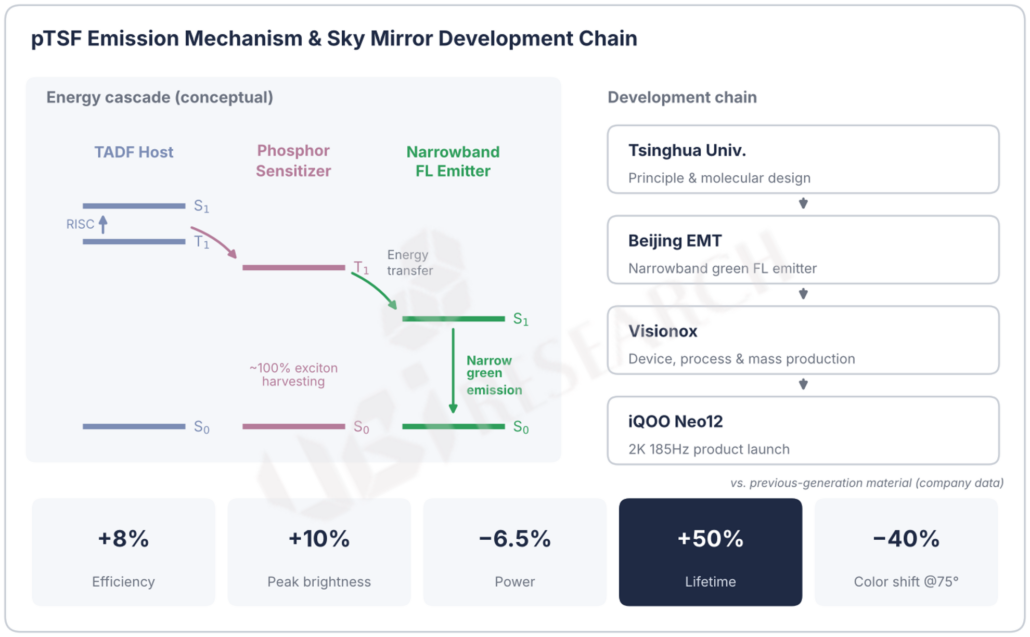
pTSF emission mechanism and Sky Mirror development chain (Source: UBI Research)
pTSF was developed by the team of Professor Duan Lian (段炼) at Tsinghua University and consists of three components: a TADF host, a phosphorescent sensitizer, and a narrowband fluorescent dopant. The structure harvests all excitons through the high internal quantum efficiency of the phosphorescent material, while actual light emission is handled by a fluorescent dopant with high color purity, achieving an energy transfer efficiency close to 100%. Visionox announced the mass-production adoption of pTSF in December 2025.
The development of Sky Mirror illustrates a division of labor between academia and industry. Tsinghua University was responsible for the emission principle and molecular design, Visionox handled material screening, deposition equipment optimization, and mass-production processes, and iQOO defined the product specifications. On the materials side, Beijing Eternal Material Technology (北京鼎材科技, EMT) is indispensable. Working with the Tsinghua University research team, EMT developed the narrowband green fluorescent material that serves as the final emitter in pTSF to commercial, mass-producible specifications, and it continues joint research with Visionox and Tsinghua University on high-performance pTSF devices. If Tsinghua University provides the principle and Visionox the panel process, EMT is the key link that turns pTSF into a mass-production material. The partners said it took more than ten years to go from the original technology to mass production, which also reflects Visionox’s origins in Tsinghua University’s OLED research group. Visionox said the material could be extended to tablets and notebooks, leaving open the possibility of applying pTSF to IT OLED products from its Hefei 8.6-generation ViP line after 2027.
Among the figures, the 50% lifetime improvement deserves more attention than the 8% efficiency gain. A 2K resolution has about 30% more pixels than 1.5K, which reduces the emitting area per subpixel and raises the current density needed to reach the same luminance. Adding a global peak brightness of 2,200 nits increases the burden of emitting-layer degradation and burn-in. In a high-resolution, high-brightness panel, lifetime headroom is equivalent to design headroom for raising brightness. This is also the context for the remark by Huang Genmao (黄根茂), General Manager of Visionox’s Product Engineering Center, that “a good emitting material must excel across multiple parameters simultaneously, not in just one metric.”
The improved viewing-angle characteristics are also linked to the strengths of the PSF structure, which uses a narrowband fluorescent dopant. Visionox said color shift was reduced by 18% at 30° and by 40% at 75°. The narrower the emission spectrum, the easier it is to suppress angle-dependent color change in the microcavity of a top-emission structure.
Currently commercialized pTSF is known to be applied mainly to the green subpixel, while red and blue remain under development. The key issues going forward are expansion to red and blue subpixels, the mass-production readiness of China’s materials supply chain centered on domestic suppliers such as EMT, and the relationship with sensitized-fluorescence patents held by UDC, JNC, and others. If the 50% lifetime improvement is confirmed by real-world data, pTSF could become a key card for Chinese panel makers in the high-brightness race.