
Chung-Chun Lee, Head of Visionox’s V5 Program, presented the company’s photolithography-based VIP (Visionox Intelligent Pixelization) OLED technology at the K-Display 2026 Business Forum, while also outlining the construction progress and mass-production plans for the V5 manufacturing line.
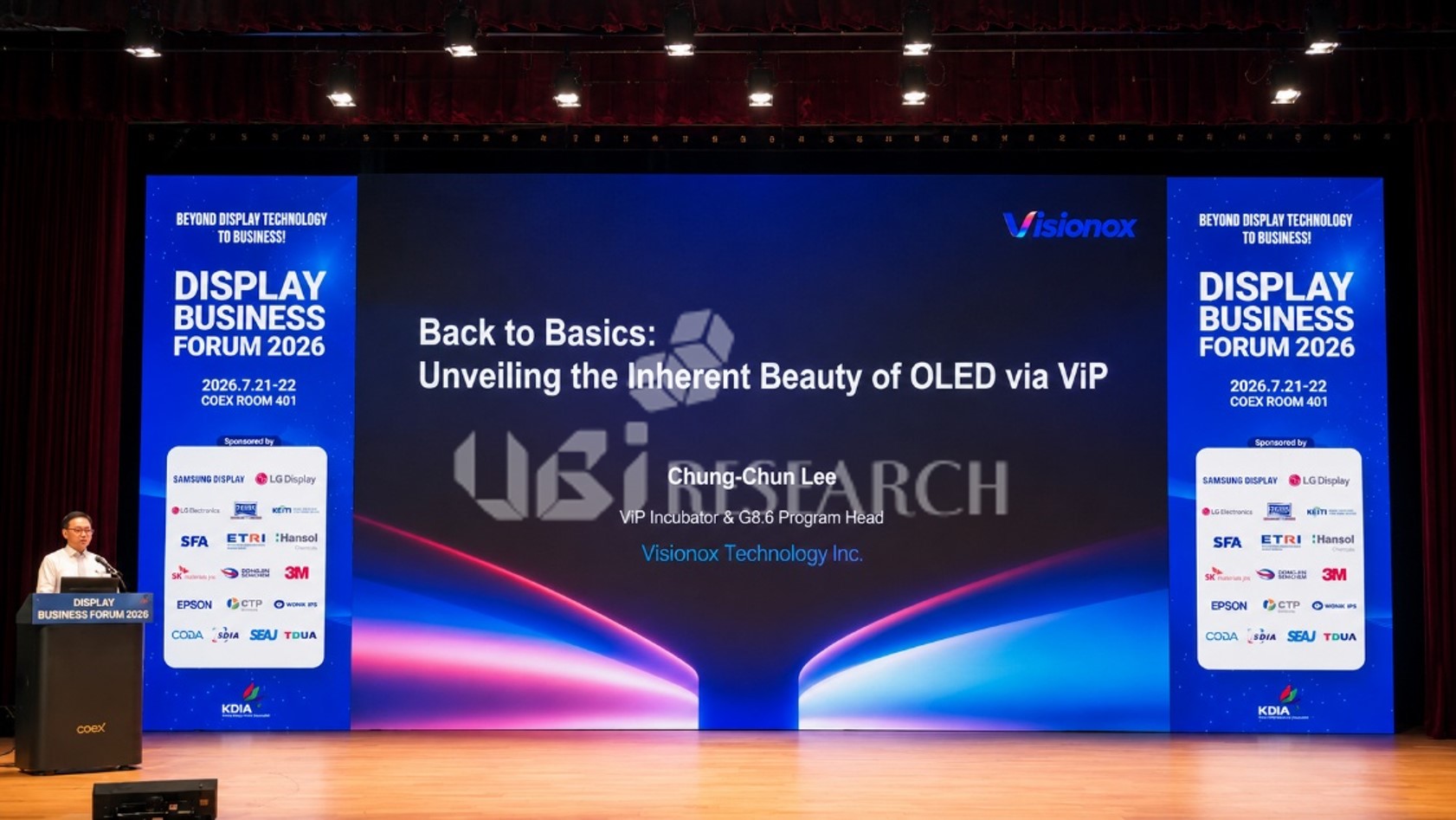
Visionox V5 Program Head Chung-Chun Lee presents the company’s ViP-based OLED development strategy. (Source: UBI Research)
A key focus of the presentation was the readiness of ViP for mass production. C.C. Lee stated that the ViP process yield had reached 85% for Gen. 6 wearable products. He added that Visionox had begun shipping wearable products and was applying ViP technology to mobile OLED panels. He also said that the major equipment for the V5 production line had been installed and was currently undergoing calibration, with mass production scheduled to begin in 2027.
ViP is a technology that forms red, green, and blue subpixels individually through a photolithography process without using a fine metal mask (FMM). Visionox explained that the emissive layers and certain common layers can be independently designed for each RGB subpixel, enabling the materials, layer thicknesses, and driving voltages for each color to be optimized separately.
In conventional FMM-based OLEDs, RGB subpixels share some common layers, meaning that changes to the driving conditions of one color can affect the others. In ViP OLEDs, however, the electrical characteristics of each color can be separated, Visionox emphasized. This enables different driving architectures to be applied to individual RGB subpixels and allows new pixel designs that minimize resolution loss in privacy mode.
Visionox also presented specific advantages for large-area production. As substrate sizes and the number of OLED stacks increase, FMM-based production faces greater challenges related to mask sagging, alignment accuracy, and mask costs. By contrast, Visionox said that changes in the OLED stack architecture do not significantly affect the number of core process steps required to form RGB subpixels using ViP. The company also emphasized that panels of different sizes and form factors can be produced on the same substrate, enabling the line to support a wide range of applications, including wearables, smartphones, automotive displays, and monitors.
During the question-and-answer session, major issues raised included alignment margins in the photolithography process, damage to organic materials, increased material consumption from repeated deposition, and production yield. In response, C.C. Lee explained that Visionox was jointly developing dedicated equipment, chemical materials, and process modules to improve process stability. He also stressed that the distance between the evaporation source and the substrate had been reduced to improve material utilization efficiency, allowing the total material cost to remain lower than that of the conventional FMM process even when common layers are deposited repeatedly.
Regarding the product strategy for the Gen. 8.6 V5 line, Lee said that Visionox plans to manufacture smartphone OLED panels in addition to IT OLED panels. The company intends to expand its product portfolio and improve line utilization by producing both IT and smartphone panels on large-generation substrates. Visionox also stated that it has secured more than 3,000 patents related to ViP technology, including approximately 500 overseas patents.
The progression of ViP OLED from the research and development stage to applications in wearable and mobile devices, followed by planned production of IT and smartphone panels at the Gen. 8.6 V5 line, represents a potentially significant new chapter in OLED manufacturing technology.
Changwook Han, Executive Vice President/Analyst at UBI Research (cwhan@ubiresearch.com)
▶2026 Analysis Report on China’s OLED Supply Chain Management
▶China Display Industry Trends Report
※ This article is produced by UBIResearchNet.
Unauthorized reproduction or citation without source attribution is prohibited.
When quoting, please clearly indicate the source (UBIResearchNet) and provide a link.