
Visionox Technology Co-CEO Jullia Yan introduced ViP, or Visionox intelligent Pixelization, during her SID keynote speech, presenting a commercialization path for next-generation OLED manufacturing that does not rely on FMM, or Fine Metal Mask.
ViP is a maskless RGB OLED pixelization technology designed to form RGB pixels without using an OLED fine metal mask. The technology is fabricated through a 2D metal network around each subpixel, combined with IJP and CVD processes.
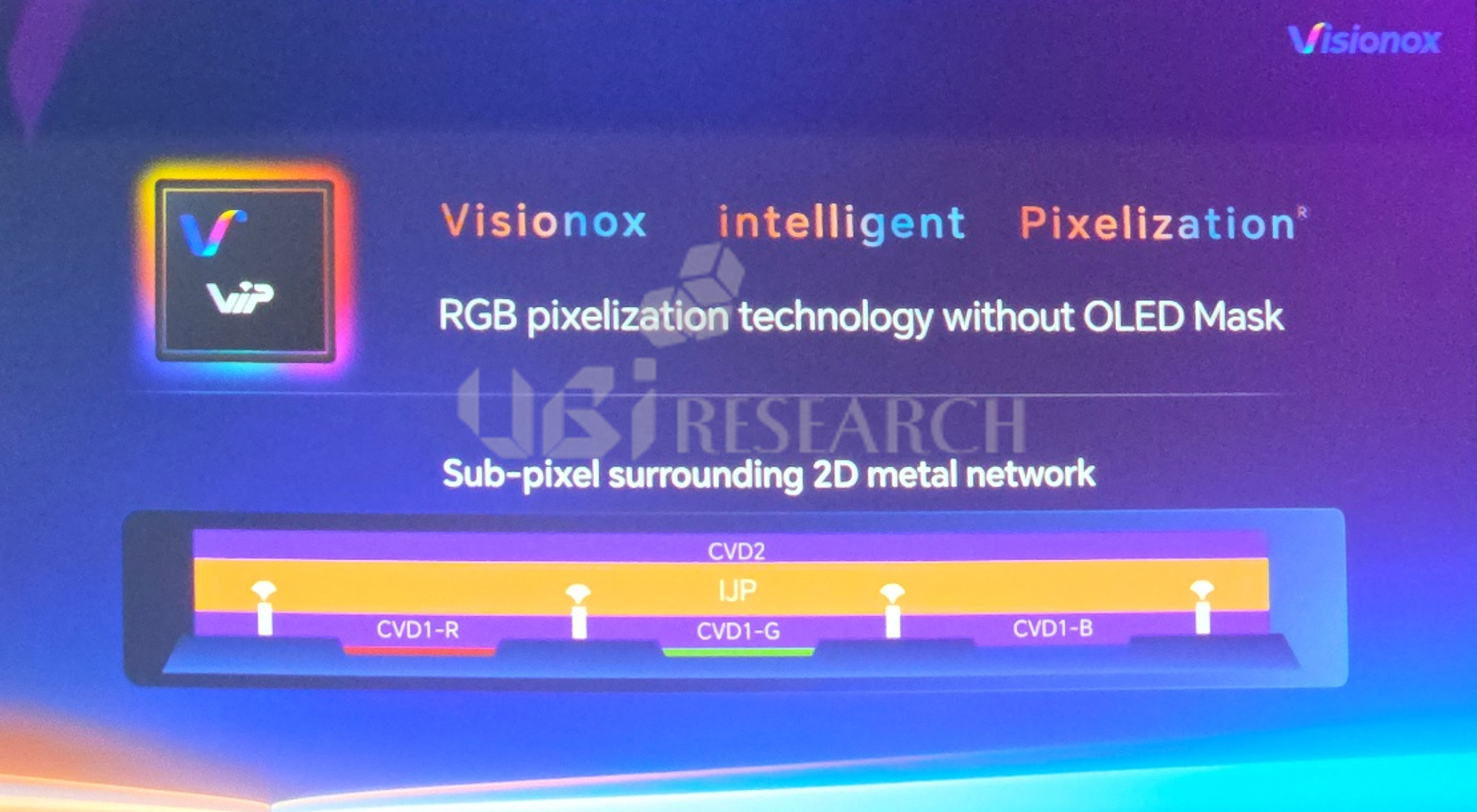
Visionox’s ViP technology presented at the SID 2026 Keynote. As a next-generation OLED manufacturing process without FMM, it maximizes resolution and aperture ratio using a 2D metal network. (Source: UBI Research)
Visionox described ViP as a platform technology designed to overcome the limitations of FMM-based OLED manufacturing in resolution, aperture ratio, transmittance, substrate utilization, and scalability for large-area applications. The company summarized ViP under the concept of SENSE+, presenting Super-real, Embedded, Neo-boundless, Sustainable, and Enduring as its core values.
According to the presentation, ViP can improve PPI by up to three times through high-precision photolithography and increase brightness by up to four times by improving the aperture ratio. As an independent microcavity OLED structure, it was also described as being capable of improving color gamut by 25% and reducing color shift depending on viewing angle to a level of JNCD < 1. These characteristics are expected to become important differentiators in smartphones, XR, and IT OLED markets, where both high resolution and high brightness are required.
Visionox also emphasized the advantages of ViP in sensor integration. The ViP structure can be designed so that EL materials and cathode materials are not positioned in the optical path, making it favorable for embedded displays such as under-screen cameras. In addition, compared with FMM, ViP offers greater layout flexibility within the substrate, expanding its potential application range from wearables, smartphones, and foldable devices to medium-sized and large-sized OLED panels.
Low power consumption and lifetime improvement were also highlighted as key points. Visionox stated that ViP can reduce cathode impedance and ELVSS signal resistance, enabling power consumption reductions of 6% for a 7.9-inch panel and 20% for a 14.2-inch panel at 800 nits. The company also explained that, compared with FMM, ViP can more than double the aperture ratio and improve lifetime by more than three times.
Visionox also disclosed its mass-production roadmap for ViP. The G6 V3-E line is undergoing mass-production optimization and integrated verification for OLED panels used in smartphones and wearables, while the G8.6 V5 line is targeting mass production of medium-sized OLED panels in 2027. The keynote showed that ViP is emerging as an alternative technology capable of overcoming the limitations of FMM-centered OLED manufacturing. In particular, whether G8.6 mass production begins in 2027 will likely become a key milestone for validating the commercial viability of ViP.
Changwook Han, Executive Vice President/Analyst at UBI Research (cwhan@ubiresearch.com)
▶2026 Analysis Report on China’s OLED Supply Chain Management
▶2026 Small OLED Display Annual Report
▶2026 Medium & Large Size OLED Display Annual Report
※ This article is produced by UBIResearchNet.
Unauthorized reproduction or citation without source attribution is prohibited.
When quoting, please clearly indicate the source (UBIResearchNet) and provide a link.