
Chinese Micro-LED manufacturer Vistar is expanding beyond large commercial displays into home cinema, automotive head-up displays (HUDs), and transparent wearables. In 2026, the company unveiled new products and secured funding for mass production equipment as it advanced its strategy to bring glass-based TFT Micro-LED displays to a wider range of applications.
Vistar unveiled ten new products on November 4 at the World Display Industry Innovation and Development Conference in Chengdu. Its flagship 308-inch 8K cinema display consists of 864 modules with seams measuring less than 20 μm. The 108-inch home cinema display uses 13.55-inch modules to streamline assembly and simplify installation in residential spaces. With TFT-based modules and active-matrix (AM) driving, Vistar is targeting cinemas and the premium home cinema market.
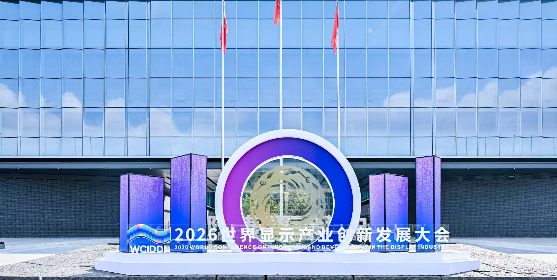
2026 World Display Industry Innovation and Development Conference, Chengdu, China (Source: Internet)
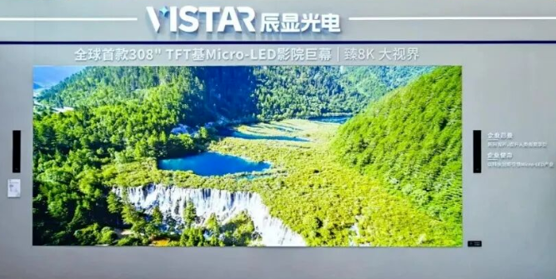
308-inch 8K Micro-LED display prototype on exhibit (Source: Internet)
Automotive and transparent displays are also major areas of development. Vistar’s 4.8-inch automotive augmented reality HUD (AR HUD) delivers a peak luminance of 200,000 nits. A 9.4-inch transparent display demonstrated how journey information could be shown on high-speed train windows. Other exhibits included a 1.85-inch transparent wristwatch, an 18.8-inch transparent touchscreen, a 14.5-inch transparent display case, and a prompter.
In July, Vistar closed a Series B funding round worth several hundred million yuan. The company plans to use most of the proceeds to build a mass production line. At its September supply chain event, Vistar announced plans to raise RMB 800 million to RMB 1 billion in a Series B+ round to purchase equipment and expand production capacity. The company also identified opportunities to work with suppliers of chip transfer and packaging equipment and anisotropic conductive film (ACF) as it scales production.
Vistar’s strongest opportunities are in markets where buyers are willing to pay a premium for larger screens or transparency. In the near term, cinema, control room, exhibition, and premium home cinema installations can help the company build a track record and gain production experience. Over the medium to long term, transparent wristwatches and train-window displays could enable applications that are difficult to implement with conventional screens. Progress will depend on customer adoption and validation of system integration. Automotive products will also need to demonstrate long-term reliability and secure vehicle manufacturer approval.
Vistar is moving from expanding its range of products and screen sizes to winning customers in each application and demonstrating cost competitiveness. If further investment enables the company to expand capacity and sustain reliable shipments, it could become a major player in the commercialization of TFT-based Micro-LED displays.