
September and October 2026 brought a string of major announcements in the XR industry. Valve disclosed pricing for the Steam Frame on September 14. Meta unveiled Meta VR Glasses at Connect 2026, and on October 7 XREAL confirmed the price of Aura, its Android XR-based AR glasses. Two trends run through these announcements. One is the rise of the glasses form factor with the compute unit split off into a separate puck. The other is the growing adoption of silicon-wafer-based Micro-OLED as the display of choice for high-end XR headsets.
The most visible change is in form factor. Glasses-type devices that offload the compute unit and battery into a puck, cutting the weight on the face to around 100 g, have moved into the mainstream. Meta VR Glasses pack a 2,412×2,288-per-eye Micro-OLED and pancake lenses into roughly 100 g, priced at $1,299.99 with launch slated for spring 2027. XREAL Aura achieves a 70° field of view (FoV) using Sony Micro-OLED (1,920×1,200 per eye) and prism optics, weighing 95 g and priced at $1,279. Both products house a Qualcomm Snapdragon Reality Elite in the puck. Apple is also reportedly considering a puck-tethered design as one of the concepts for its next Vision Pro, targeted for 2028 or later. However, 100 g is still roughly twice the 50 g often cited as the threshold for all-day wear. The current generation is better understood as ‘session-based’ devices, used for a set period of time, such as watching movies or in-flight use.
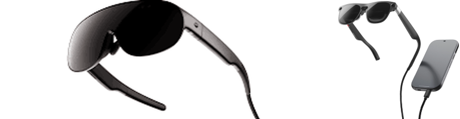
Figure 1. Meta VR Glasses (left) and XREAL Aura with compute puck (right)
Images: Meta, XREAL
Prices are converging in the $1,000–1,300 range. Even the Steam Frame, which retains an LCD, came in at $1,059, missing Valve’s original pledge to price it below the Valve Index ($999). Soaring memory and storage prices are the common cause, and this trend is likely to persist for some time.
Optical approaches diverge according to device type. On the VR side, Meta VR Glasses and the Steam Frame use pancake lenses. The optical see-through XREAL Aura gains a 70°-class FoV and sharp image quality from its prism optics, but at a cost. The 16:10 panel makes the vertical FoV feel narrow, and because full external transmittance cannot be secured, the real world always appears dimmed. Ultimately, even the same panel can deliver a very different user experience depending on the optical system it is paired with.
On the display side, the spread of Micro-OLED is unmistakable. Meta has abandoned LCD for Micro-OLED for the first time since 2019. Meta VR Glasses adopt a 0.91-inch Micro-OLED from Seeya (视涯科技), while XREAL Aura and Samsung Galaxy XR use Sony panels, with Samsung Display participating as the second-source supplier for Galaxy XR. Samsung Display’s large-scale RGB Micro-OLED line, by contrast, is targeting mass production in 2028, leaving Chinese makers ahead in the early volume race.
Pico, a subsidiary of ByteDance (字节跳动), has joined the same trend. Its next-generation flagship, Space Pro, uses Micro-OLED at about 4,000 PPI to deliver an average of 40 PPD and more than 45 PPD at the center. A dual-chip architecture combining an in-house XR chip with a flagship SoC brings latency down to 12 ms. Although Pico canceled its September launch event and pushed the release to Q4, the device has already passed FCC certification. A clear split is thus taking shape: Micro-OLED for premium XR devices and LCD for cost-oriented VR. Valve’s choice of a 2,160×2,160-per-eye LCD for the Steam Frame is likewise seen as a move to hit the $1,000 price point. Valve, however, is not expected to stay with LCD. Traces of a Micro-OLED successor (codename Plano) were recently found in the Steam Frame source code. Its per-eye resolution of 3,552×3,840 matches that of the 1.3-inch Micro-OLED in Samsung Galaxy XR.
Table 1. Display & Optics of Key XR Devices
| Device | Display | Res. / eye | Optics | Weight | Price (USD) |
| Meta VR Glasses | Micro-OLED (Seeya) | 2412×2288 | Pancake | ~100 g | 1,299.99 |
| XREAL Aura | Micro-OLED (Sony) | 1920×1200 | Prism | 95 g | 1,279 |
| Samsung Galaxy XR | Micro-OLED 1.3″ | 3552×3840 | Pancake | 545g | ~1,800 |
| Pico Space Pro | Micro-OLED (~4,000 PPI) | ~40 PPD | Pancake | 270g | TBA |
| Valve Steam Frame | LCD | 2160×2160 | Pancake | 440g | 1,059 |
| Valve Steam Frame OLED (Plano)* | Micro-OLED* | 3552×3840 | n/d | n/d | TBA |
Source: company announcements and press reports (compiled by UBI Research). n/d = not disclosed.
Notably, the axis of competition is shifting from panel specifications to system efficiency. Even the 40,000-nit-class RGB Micro-OLED showcased by Samsung Display delivers only a fraction of that luminance to the user once light passes through pancake lenses or waveguides. The 1,050 nits disclosed by XREAL likewise comes without a stated measurement point. Going forward, the competitiveness of XR displays will hinge on how well optical losses can be compensated, and a reporting convention that distinguishes measurement points — panel, module, and eyebox — needs to take hold as well. For the Korean display industry, the next tasks will be to accelerate mass production of high-luminance RGB Micro-OLED and to build system-level optimization capabilities that encompass the optics.