
1. Growth of AR Glasses and the Importance of Waveguides
AR glasses are evolving into personal computing devices. Applications are expanding from viewing brief information, such as translated subtitles, navigation directions and messages, to placing multiple screens and virtual objects in real-world space. In this evolution, the waveguide is a key optical component that delivers display images to the eyes while retaining a form factor close to everyday glasses.
Shipments of AI glasses with optical see-through displays are expected to grow from approximately 500,000 units in 2026 to more than 10 million units in 2030. The strong growth potential of products with displays supports an expansion in demand for optical components over the medium to long term.
Table 1. Changes in optical requirements by user experience
| Product category | Key user experiences | Waveguide needs and optical requirements |
| AI glasses without displays | Voice queries, photography and audio | Broader wearing habits and distribution channels; no direct need for waveguides |
| AI glasses for information display | Subtitles, navigation and notifications | Compact light engines and thin, lightweight waveguides; low power consumption |
| Spatial AR glasses | Spatially anchored screens and 3D interaction | Wide field of view, binocular display and precise alignment |
2. Waveguide Types and Key Features of SiC
A waveguide is an optical component that guides images from a light engine near the temple through a thin lens and then out toward the eye. The main approaches are reflective arrays using internal mirrors and diffractive waveguides using fine gratings to guide light.
Table 2. Comparison of waveguide types. (SRG: Surface Relief Grating; VHG: Volume Holographic Grating)
| Main type | Operating principle | Key advantages and development challenges |
| Reflective array | Guides images through an array of small mirrors inside the lens | Favorable color reproduction; precise assembly and lens thickness control are important |
| SRG diffractive | Controls light direction using fine surface structures on the lens | Suitable for thin lenses and replication; brightness, color uniformity and rainbow artifacts need improvement |
| VHG diffractive | Uses optical gratings recorded within a material | Selectively guides light by wavelength and angle; full color and a wide field of view remain challenges |
■ SiC as a Material for Wider Images and Thin Full-Color Lenses
Silicon carbide (SiC) is an emerging waveguide substrate material. Its high refractive index allows image light to propagate over a wider angular range, making it advantageous for delivering full-color images through a single lens or expanding the field of view. Meta’s Orion and exhibition products from Chinese companies have demonstrated this potential with different fields of view and light engine combinations.
The field of view (FOV) is the angular range of the image displayed in front of the eyes. A wider FOV makes it easier to present multiple pieces of information simultaneously, but also makes uniform brightness and color across the lens harder to maintain. In actual products, lens thickness, weight and the brightness reaching the eye are important alongside FOV.
■ Differences in Pattern Fabrication Methods
Table 3. Simplified comparison of fabrication routes.
| Main fabrication route | Key distinction | Related companies |
| Fine-pattern replication followed by etching | Replicates patterns like a stamp, then processes the SiC. Repeatability and replication accuracy are important | Moldnano, LLVision, SCIVAX |
| Optical lithography followed by etching | Defines patterns using light, then processes the SiC. Exposure precision and production stability are important | SEEV; OMedaSemi processing services |
The strength and thermal conductivity of SiC can support thinner lenses and heat spreading. However, optical-grade material costs and processing difficulty are high, and thin lenses also require coatings and prescription lens bonding. Commercialization depends less on material performance alone than on repeatedly supplying thin, lightweight lenses with consistent image quality and cost.
3. Comparison of Company Exhibits and Development Status
Since Meta unveiled Orion in 2024, SiC waveguide development has expanded to system demonstrations, lens samples, optical modules and manufacturing services. At SPIE AR|VR|MR and CIOE in 2026, Chinese companies particularly emphasized wider full-color fields of view and thinner designs.
Table 4. Publicly disclosed developments at major companies.
| Company | Exhibition or disclosure | Highlights and current disclosure stage |
| Meta | Meta Connect 2024 Orion unveiling | Approximately 70° FOV; Micro LED and SiC; internal prototype |
| Moldnano China | SPIE Photonics West 2026 January exhibition | 30° and 50° full-color SiC samples; light engine demonstrations and production line announcement |
| Goeroptics China | SPIE AR|VR|MR 2026 CIOE 2026 | F50Se 50° full-color module and thin F30Se SiC module |
| SEEV China | CIOE 2026 September exhibition | C30CE Pro and prescription-bonded lenses; Coray Air2 finished-product application |
| LLVision / Zhejiang China | Photonics 2025 paper | 55° single-layer full-color SiC research prototype and glasses demonstration |
| OMedaSemi China | December 2025 processing service materials | SiC lithography and etching services; a supply-chain company supporting lens development |
Meta’s Orion combined SiC lenses with Micro LED to achieve an FOV of approximately 70°. The disclosed Orion was an internal prototype rather than a commercially available product. It demonstrated an AR experience that overlays information on the real world using voice, eye and hand tracking, and a wrist-worn input device.
Moldnano presented 30° and 50° full-color SiC samples at its January 2026 exhibition. For the improved 50° version, it announced luminance efficiency exceeding 1,000 nit/lm and system brightness above 3,000 nit when combined with a light engine.
Goeroptics showcased its F50Se 50° full-color SiC module at SPIE AR|VR|MR 2026, alongside the F30Se with a stated thickness of 0.65 mm. The F50Se used a compact LCoS microdisplay and was announced to deliver brightness above 1,500 nit at the eye. At CIOE in September, the company presented a combination with its in-house 0.75 cc light engine, emphasizing its supply scope covering both lens and light engine. At the same exhibition, it also introduced thinner glass-based products and improvements in transmittance and image quality.
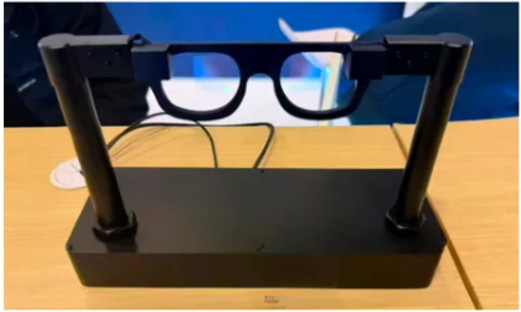
(SiC optical waveguide display module F50Se) (Source: Goeroptics)
SEEV exhibited the C30CE Pro at CIOE 2026, announcing twice the optical efficiency of the previous C30CE, thickness below 0.6 mm and a monocular lens weight below 3 g. It also presented prescription-bonded SiC lenses, addressing requirements for use like everyday glasses.
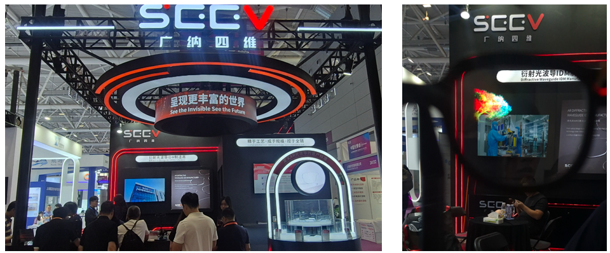
(SEEV exhibition booth and SiC optical waveguide display modules) (Source: CIOE 2026)
Table 5. Major exhibited products.
| Company and product | Exhibition | Key disclosures | Product development focus |
| Goeroptics F50Se | SPIE 2026, CIOE 2026 | 50° full color; above 1,500 nit; 0.75 cc light engine at CIOE | Integration of a wide image and compact light engine |
| Goeroptics F30Se | SPIE 2026 | Etched SiC module; 0.65 mm thick | Thinner optical modules |
| SEEV C30CE Pro | CIOE 2026 | Below 0.6 mm and 3 g; improved efficiency over the previous generation | Thin, lightweight full-color lenses |
| SEEV prescription-bonded SiC | CIOE 2026 | Integrated bonding with prescription lenses; customized specifications | Vision correction and everyday wear |
| SEEV Coray Air2 case | CIOE 2026 | Introduced by the company as a finished product using full-color SiC lenses | Expansion from components into finished products |
4. Research and Manufacturing Partners
LLVision and Zhejiang University Research Single-Layer Full Color
In a 2025 paper, researchers from LLVision and Zhejiang University presented a single-layer SiC lens and a prototype pair of glasses incorporating it. They reported a lens thickness of 0.5 mm, weight of 2.12 g, transmittance of 87% and FOV of 55°. The research focused on delivering full-color images through one thin lens and suppressing rainbow artifacts. It demonstrated the potential of SiC lenses for lightweight designs and color imaging.
SCIVAX Supports Lens Manufacturing with Equipment and Foundry Services
Japan’s SCIVAX provides process services and equipment, including high-refractive-index resin patterning and etching of inorganic substrates such as SiC. Its proprietary Dyad® equipment uses low-distortion replication technology to reduce pattern placement and pitch errors. The company offers foundry services up to 8 inches and equipment configurations for 8-inch and 12-inch substrates.
OMedaSemi Provides Contract SiC Lithography and Etching Services
China’s OMedaSemi offers combinations of optical lithography, electron-beam lithography and etching for SiC diffractive waveguide fabrication. Its stated processing capabilities include a minimum linewidth of 150 nm.
Table 6. Comparison by disclosure stage.
| Disclosure stage | Examples | Disclosed information |
| AR system prototype | Meta Orion | User experience combining a wide image with input functions |
| Lens and optical module exhibits | Moldnano, Goeroptics, SEEV | FOV, brightness, thin designs and product configurations |
| Finished-product application | Coray Air2 introduced by SEEV | Company description of a SiC lens application in a product |
| Research prototypes in papers | Moldnano/Westlake, LLVision/Zhejiang | Lens characteristics measured under test conditions and image demonstrations |
| Process and equipment supply | SCIVAX, OMedaSemi | Scope of services and equipment supporting lens manufacturing |
5. Product Development Directions and Industry Outlook
Two Development Directions Wide FOV and Everyday Wear
SiC waveguides are developing in two directions: wider images and thinner, lighter designs. Meta demonstrated a wide image at the system level, while Moldnano and Goeroptics expanded their range of lenses and modules in the 30°–50° class. SEEV emphasizes lens thickness and weight, prescription bonding and finished-product applications. Competition is expanding from demonstrating technical feasibility to developing products that meet real wearing requirements.
For early information-display glasses, brightness, battery life and price are important for comfortably viewing subtitles and navigation. For AR experiences that place screens in space, a wide FOV and binocular display become more valuable. SiC is well suited to the latter, but it can also differentiate products with a medium FOV through thin, single-layer full-color lenses. Product categories tailored to specific uses are therefore likely to emerge, rather than all products pursuing the same maximum FOV.
From Exhibition Performance to Reliable Product Supply
The next stage of industrialization is likely to emerge through light engine integration, a wider range of prescription lens options, repeatable production and adoption in customers’ products. For the high brightness of exhibited components to translate into long battery life in finished products, light engine power consumption and heat generation must also improve. Thin lenses must retain image quality after coating and bonding, so wearability and image quality in finished products will determine adoption more than component specifications alone.
In the near term, glass-based waveguides are expected to expand the market using their cost advantages and established supply base, while SiC adoption grows in products that benefit substantially from full color and a wide FOV. Greater participation by module suppliers and manufacturing support companies is broadening the options for SiC lens development. Evidence of the industry’s future expansion will come from product launches, continuity of supply and actual lens shipments, as well as specifications disclosed at subsequent exhibitions.
Key References
[1] Chen et al., SiC diffractive waveguides, eLight 5, 21, 2025
[2] Meta, Official technical introduction to Orion
[3] Moldnano, SPIE Photonics West 2026 exhibition results, January 22, 2026
[4] Goertek, F50Se and F30Se unveiling at SPIE, February 6, 2026
[5] Goertek, CIOE 2026 exhibited product announcement, September 9, 2026
[6] SEEV, CIOE 2026 products and finished-product application cases, September 30, 2026
[7] Li et al., Single-Layer Full-Color SiC Diffractive Waveguide AR Glasses with Large FOV and Rainbow Effect Suppression, Photonics 12, 952, 2025
[8] OMeda, Silicon carbide etching processing, December 23, 2025