
Apple iPhone Duo Resets the Competitive Standard for Foldable OLED
Supply chain execution matters more than shipment recovery
Conclusion at a glance
Apple’s first foldable iPhone shifts competition away from screen size and hinge novelty. Crease visibility, surface reflection, thickness, weight, durability, and app continuity will now be judged as one user experience.
UBI Research forecasts foldable OLED shipments to increase from 21.99 million units in 2025 to 35.24 million units in 2026. The increase depends on early iPhone Duo demand, panel, UTG, and hinge yields, and the absence of supply interruptions.
The first generation will test production stability more than mass-market demand. If quality remains stable, Apple can expand the product line and diversify suppliers in 2027.
Published September 14 2026
Analysis UBI Research
© 2026 UBI Research. All rights reserved.
1 Key Conclusions
iPhone Duo changes how foldable OLED products and their supply chains will be evaluated.
1. A new basis for competition Consumers will judge the crease and reflection when the device is open, thickness and weight when it is closed, durability after repeated use, and continuity between displays.
2. Conditions for market recovery Foldable OLED shipments may rebound in 2026. First-half shipments and revenue nevertheless fell, while average selling prices declined. Apple’s entry alone does not yet establish a structural growth cycle.
3. Higher value in the supply chain A 3,000-nit display, lower reflection, and a thinner and lighter structure require progress in UTG, OCA, backplates, hinges, emissive materials, inspection, and lamination as well as the panel itself.
4. The role of the first generation The first year will establish production stability and product quality. Reliable mass production would support more models and lower price points in 2027.
Impact by time horizon
| Period | Key variables | Industry impact |
|---|---|---|
| Immediately after launch | Preorders, early defects, repair cost, supply interruptions | Tests demand strength and initial manufacturing yield |
| Within six months | Panel, UTG and hinge yields, component cost, competitor response | Determines production increases and specification upgrades |
| 2027 | Follow-on models, price changes, supplier diversification | Expands the market and reshapes the supplier base |
The first-quarter sales result should therefore be read together with defect rates, repair costs, component yields, and the 2027 model and sourcing plan.
2 The New Standard Set by Apple
The important change is how Apple combines components and processes into one product experience.
| Area | Published specification | Industry significance |
|---|---|---|
| Displays | 7.6-inch inner and 5.4-inch outer Super Retina XDR displays | Aspect ratios and app continuity determine usability across both modes |
| Brightness and drive | ProMotion, Always-On and peak brightness of 3,000 nits | Requires more efficient emitters, lower-power driving and thermal control |
| Surface optics | Nanotexture surface | Reduces reflections and perceived crease visibility. It does not remove the mechanical crease |
| Structure | More than 100 hinge parts, 3D-printed hinge cover and titanium | Tolerance control and assembly yield directly affect cost, delivery and durability |
| Durability | IP68 and Ceramic Shield protection | Raises expectations for an area long viewed as a foldable weakness |
| Price and timing | $1,999, preorder October 16 and launch October 23 | Initial demand will be premium-led, making quality more important than volume |
Nanotexture does not eliminate the crease
Nanotexture reduces surface reflections so that the center curvature is less visible. The physical crease is set by the hinge path, backplate stress, OCA recovery, UTG thickness, and bending radius. Early reviews should therefore examine off-axis reflection, change after repeated folding, and recovery at high and low temperatures.
Three thousand nits tests materials and thermal design
High peak brightness improves outdoor visibility but affects emitter lifetime, power consumption, and panel temperature. The key questions are how long peak brightness is sustained in normal use and how power limits operate on the larger display. The answer depends on emitter efficiency, TFT driving, heat spreading, and battery design.
Differences between market expectations and the final product
The market had expected an “iPhone Fold” with an inner display near 7.8 inches and an outer display near 5.5 inches. The official product uses the iPhone Duo name and 7.6-inch and 5.4-inch displays. The name and dimensions changed, while the roughly $2,000 price, thin structure, and lower crease visibility remained consistent with the expected development direction.
3 Market Recovery Comes with Greater Supply Concentration
Shipment growth is encouraging, but profitability and supply stability require separate evaluation.
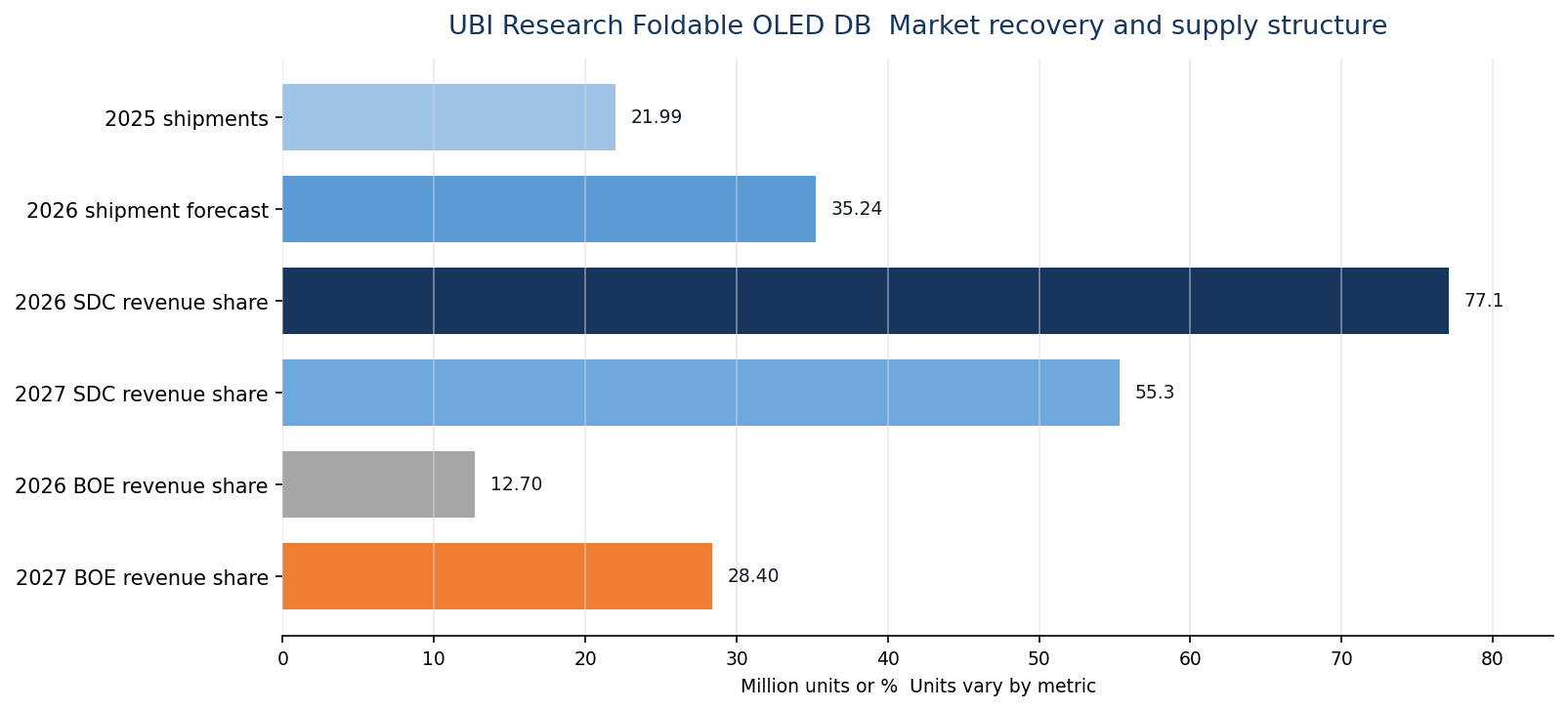
Figure 1 Foldable OLED shipment outlook and revenue-share changes for leading panel makers Shipments in million units and shares in percent
UBI Research forecasts foldable OLED shipments to rise from 21.99 million units in 2025 to 35.24 million units in 2026, an increase of about 60%. The forecast assumes that iPhone Duo shipments and critical component yields meet plan.
The current market remains under pressure. First-half 2026 shipments were 9.97 million units, down 11.4% year over year. Revenue fell 17.6%, and average selling price declined from $154 to $143. Shipment growth and profit recovery may therefore proceed at different rates.
| Metric | Observation | Interpretation |
|---|---|---|
| 2025 to 2026 shipments | 21.99 million to 35.24 million units | Potential rebound led by Apple entry and new products |
| First half 2026 | 9.97 million units, down 11.4% year over year | Existing foldable demand weakened before the expected annual rebound |
| Revenue and ASP | Revenue down 17.6%, ASP from $154 to $143 | Price competition and product mix continue to pressure profitability |
| Top-two concentration | 71.2% to 87.7% | Apple-related volume may concentrate at selected suppliers |
| Foldable premium | 2.6 times to 3.8 times bar OLED | High value remains, alongside higher cost and yield risk |
Samsung Display’s revenue share may fall from 77.1% in 2026 to 55.3% in 2027, while BOE may rise from 12.7% to 28.4%. BOE’s increase should not be treated as proof of entry into Apple supply. Higher Chinese OEM demand and technology gains could produce the same result.
4 Competitive Landscape and User Experience
Apple, Samsung, Chinese OEMs, and bar OLED products have different advantages and constraints.
| Platform | Strengths | Constraints and indicators |
|---|---|---|
| Apple iPhone Duo | iOS continuity, matched display experience, 3,000 nits, nanotexture | $1,999 price, first-generation yield and repair cost. Watch preorders and early defects |
| Samsung Galaxy Z Fold8 | 201 g weight, multiple generations of manufacturing and service, Flex Titanium | Direct competition with Apple ecosystem. Watch price, panel mix, hinge and UTG gains |
| Huawei and Chinese OEMs | Large and wide displays, tri-folds, silicon-carbon batteries, rapid form-factor trials | Regional and component constraints. Watch Chinese pricing and BOE volume |
| Bar OLED | Lower price, mature yield, thinner and lighter construction | Limited screen expansion and multitasking. Watch the foldable price premium |
Samsung leads in manufacturing experience while Apple leads in integration
Samsung reduced the Galaxy Z Fold8 to 201 g and applied a titanium-alloy film measured in tens of micrometers with a support structure about 0.2 mm thick. Its review of roughly 270 parts and more than 180 auxiliary parts shows that weight reduction requires system redesign rather than a single component substitution.
Samsung benefits from repeated manufacturing and service experience. Apple’s advantage is its ability to connect hardware specifications with the operating system and app ecosystem. In 2027, the stronger product will be the one that makes foldable compromises less noticeable in daily use.
Four dimensions of competition
1. Crease Hinge path, backplate stress, OCA recovery and surface optics work together.
2. Weight The display module, titanium structure, circuits, thermal system and battery must be reduced and rearranged together.
3. Durability Designers must balance the stability of thicker UTG against the portability of a thinner module.
4. Usability App continuity, multitasking and aspect-ratio optimization turn hardware differences into user value.
5 Supply Chain Impact
Benefits will concentrate at suppliers that meet both specification and yield requirements.
| Area | Opportunity | Principal risk |
|---|---|---|
| OLED panels | Two high-ASP displays and broader premium specifications | Initial yield, Apple dependence and supplier diversification in 2027 |
| UTG and cover | Central to crease, reflection and durability improvements | Conflict among thickness, bending properties, processing yield and cost |
| OCA | Demand for low-modulus, high-recovery adhesives and multilayer lamination | Long-term creep, delamination and temperature reliability |
| Backplate | Laser-processed titanium and lighter support structures | Flatness, processing yield and material cost |
| Hinge | More precision MIM, liquid metal and composite materials | Tolerance accumulation and assembly yield across more than 100 parts |
| Emissive materials | Higher-efficiency materials for 3,000 nits and lower power | Trade-offs among lifetime, heat and power consumption |
| Inspection and lamination | More crease, delamination and microdefect control | Model-specific investment and volatile initial utilization |
Requirements for potential beneficiaries
A company should be treated as a confirmed beneficiary only when a supply agreement, customer approval, or mass-production yield is verified. Panel, UTG, titanium processing, OCA, hinge, inspection, and lamination-equipment suppliers are candidates, but technology ownership alone does not confirm commercial benefit.
Suppliers that stabilize yield during the initial build may gain bargaining power even at modest volumes. Second-tier suppliers face the opposite risk when they depend on one customer or model and cannot recover yield costs through pricing.
What panel-maker share changes imply
Samsung Display’s high 2026 share likely reflects early Apple supply and its ability to meet premium specifications. The projected decline in 2027 points to additional suppliers and higher Chinese foldable demand rather than a market contraction. Suppliers need separate plans for single-customer growth in 2026 and customer diversification in 2027.
Companies at greater risk Companies face greater risk when early defects increase rework and warranty expense, approval schedules slip, or dedicated equipment fails to reach planned utilization. Weak iPhone Duo sales could delay both 2027 capacity expansion and supplier diversification.
6 Twelve Month Outlook
Sales, product quality, production yield and sourcing plans should be evaluated together.
| Scenario | Conditions | Market and supply-chain impact | Next signal |
|---|---|---|---|
| Upside | Strong preorders, stable yield, no supply disruption | Higher utilization for high-ASP panels, UTG and hinges. More follow-on models | Additional orders, more suppliers, capacity expansion |
| Base | Limited premium early-adopter demand | Market rebound with limited substitution for bar OLED | Price adjustment and thinner, lighter second generation |
| Downside | Crease, durability, repair-cost or yield problems | Delivery delays, higher inventory and warranty costs, investment changes | Part reselection, lower shipment target, fewer launch markets |
Near-term outlook
Supply stability and user experience will matter more than unit sales in the fourth quarter of 2026. Strong demand will not translate into shipments if panel or hinge yield is unstable. Limited sales can still support a broader second generation if defects and repair issues remain low.
If Apple reduces crease visibility, surface reflection, and durability concerns to an acceptable level, competitors are likely to accelerate specification upgrades and component redesigns in 2027. Growth would then appear in high-value materials and precision processes as well as finished-product shipments.
Counterarguments and uncertainty
1. High price $1,999 is not a mass-market price. Even strong first-generation sales may have limited effect on the wider smartphone market.
2. Limits of crease reduction Nanotexture can reduce optical visibility, but it cannot eliminate the mechanical deformation caused by repeated folding.
3. Conditional forecast The 35.24 million-unit forecast assumes Apple volume and production yield. Delays or component shortages would require a lower estimate.
4. Interpreting BOE growth Higher share may reflect Chinese OEM demand and technical progress. It must be separated from Apple supplier approval.
Indicators to track Track preorder lead times during the first eight weeks, early quality reports on the crease, hinge, delamination and repair cost, actual panel, UTG and hinge orders and yields, and the 2027 follow-on model and second-source approval schedule.
7 UBI Research Conclusion
The first iPhone Duo may change industry standards before it changes the size of the foldable market.
iPhone Duo is designed to reset the quality standard for premium foldables. Its 3,000-nit display, nanotexture, hinge with more than 100 parts, and titanium structure operate as a connected system. Brightness affects power, surface optics affect perceived crease visibility, structure affects weight and durability, and each choice affects production yield.
The central question for 2026 is whether shipment recovery produces a recovery in profitability. Lower first-half ASP and greater supply concentration show that volume growth may not improve conditions across the industry. Demand for high-value components can rise, but commercial benefits will concentrate at suppliers that secure customer approval and stable mass-production yields.
Two developments may proceed together in 2027. Apple and its competitors may expand their product ranges and raise specifications, while panel and critical-component sourcing becomes more diverse. Company analysis should therefore examine initial yield, customer approval, capacity, customer concentration and readiness for the next product generation.
First-year performance should not be judged by unit sales alone. Product quality, component yields, supply continuity and the second-generation plan must all be confirmed before concluding that foldable OLED has entered structural growth.
Principal sources
Apple Newsroom Apple unveils iPhone Duo September 9 2026
UBI Research 2026 Foldable Display Report August 2026
UBI Research AMOLED Display Market DB and Forecast DB July 2026
UBI Research Samsung Display Business and Product Strategy and Medium-Term Outlook 2027 to 2030 September 2026
Forecasts combine public announcements with UBI Research data and may change with actual shipments, yields and customer approval schedules.