
From low-power operation to stable image quality with oxide driving TFTs
LTPO smartphone panel shipments reached 385 million in 2025, with the two Korean suppliers holding a 70.2% share.
The role of oxide TFTs is expanding from low-leakage switching to emission-current driving.
The next challenge is to improve low-gray-level image quality and driving stability alongside large-area mass production and manufacturing costs.
1. Market Status and Supply Structure
LTPO smartphone panel shipments totaled 384.96M in 2025, including foldable panels. Samsung Display accounted for 53.7% with 206.59M, followed by LG Display and BOE at 63.61M and 59.46M, respectively.[1]
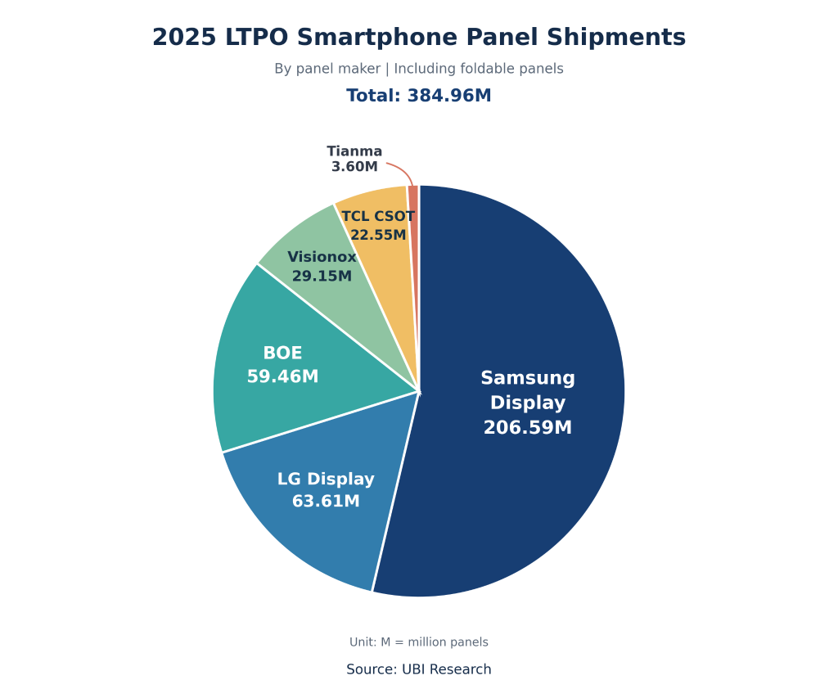
Figure 1 LTPO Smartphone Panel Shipments by Supplier in 2025
Samsung Display and LG Display shipped a combined 270.20M panels, representing 70.2% of the total. Chinese suppliers, led by BOE and including Visionox, TCL CSOT, and Tianma, supplied 114.76M panels. Chinese companies have thus secured approximately 30% of shipments within a supply structure led by Korean manufacturers.
LG Display and BOE ship similar volumes of LTPO smartphone panels, but their customer mixes differ. For the iPhone 17 series, Samsung Display and LG Display supplied approximately 99% of all panels through October 2025.[2] Future shifts in the supply structure are likely to depend on how far each supplier expands its product and customer base, and when it brings next-generation technologies such as oxide driving TFTs into mass production.
2. Adoption History and Drivers of Expansion
LTPO combines low-temperature polycrystalline silicon (LTPS) and oxide TFTs on the same substrate. By combining the current-driving capability of LTPS with the low leakage current of oxide TFTs, it provides a foundation for adjusting the refresh rate to the content on the screen.
Early applications were smartwatches with limited battery capacity. In a 2019 SID paper, Apple researchers described the use of LTPO in Apple Watch Series 4. Series 5, released in 2019, combined LTPO with low-power driving circuits to enable an always-on display (AOD).[3,4]
| Year | Representative Products and Milestones | Application Focus |
| 2018 | Apple Watch Series 4 | Low-power backplane for wearables |
| 2019 | Apple Watch Series 5 | AOD and power management |
| 2020 | Galaxy Note20 Ultra | Content-adaptive 10–120 Hz refresh rate |
| 2021 | iPhone 13 Pro | 10–120 Hz ProMotion |
| 2022 | iPhone 14 Pro | AOD at 1 Hz |
| 2024 | Apple Watch Series 10 OLED iPad Pro |
LTPO3 adoption LTPO + tandem OLED adoption in tablets |
| 2025 | Standard iPhone 17 | 1–120 Hz variable refresh rate and AOD |
| 2026 | BOE Gen 8.6 AMOLED mass production | Expansion of LTPO and tandem OLED into IT |
In smartphones, the technology evolved to combine high refresh rates for moving images with power savings for static content. Applications expanded through content-adaptive refresh rates and further reductions in update frequency for AOD.[5–7] In 2024, Apple Watch Series 10 adopted LTPO3, while the OLED iPad Pro adopted LTPO and tandem OLED.[8,9]
The range of products using LTPO has recently broadened. In 2025, the standard iPhone 17 also gained a 1–120 Hz variable refresh rate and AOD, extending low-power display features previously concentrated in Pro models to the standard model. High refresh rates for content with substantial motion and reduced update frequency for static images have thus begun to reach a wider range of products.[10]
LTPO expertise developed in smartphones is also extending to OLEDs for IT products such as tablets and notebooks. When BOE announced Gen 8.6 AMOLED mass production in June 2026, it stated that the line used LTPO and tandem OLED.[11] IT products often display content with limited visual changes, such as documents or web pages, for extended periods, making refresh-rate control useful for reducing power consumption. However, ensuring uniformity and managing manufacturing costs become more important as displays and substrates grow larger.
3. Improvements in Image Quality and Manufacturing Processes
■ Low-Leakage Switching and Driving Compensation
A lower refresh rate requires the pixel voltage to be retained longer until the next data write. In conventional LTPS circuits, leakage current could alter the stored voltage. By placing oxide TFTs in major leakage paths, LTPO improved data retention and enabled low-refresh-rate operation.
Subsequent efforts focused on reducing luminance differences between the data-writing and holding periods by adjusting the reset voltage, compensation time, and driving-TFT bias conditions. In 2025, researchers from LG Display and Yonsei University analyzed how slow charge release in oxide TFTs and hysteresis in driving TFTs jointly cause flicker, and mitigated it by adjusting the reset voltage during the holding period.[12]
| Improvement Target | Main Approach | Effect |
| Stored voltage | Use of oxide switching TFTs | Data retention at low refresh rates |
| Luminance variation | Adjustment of reset and bias conditions | Reduced flicker and better transition quality |
| Hydrogen ingress | Barrier-layer and dielectric-process optimization | More stable oxide-device characteristics |
| Underlying layer topography | Improved etch selectivity and uniformity | Reduced threshold-voltage variation |
| Process burden | Shared layers and simpler layer stacks | Potential reductions in masks and process steps |
■ Reliably Integrating Different Processes
The hydrogenation process used to reduce LTPS defects can introduce excessive hydrogen into the oxide channel, altering threshold voltage and leakage current. Optimizing hydrogen barriers, passivation layers, dielectric deposition, and annealing conditions has been a major focus in co-fabricating the two device types. Research has also reported improved hydrogen resistance in oxide devices.[13]
Process topography also affects image quality. A 2026 study by LG Display and Yonsei University identified how protrusions in an underlying layer formed during LTPS processing were transferred to the oxide channel. An improved etching process reduced protrusion height from 5.1 nm to 1.6 nm, while the panel-level threshold-voltage deviation after reliability testing decreased from 0.92 V to 0.15 V. The study demonstrates the effectiveness of controlling underlying-layer uniformity alongside circuit compensation.[14]
Process simplification is another route to lower manufacturing costs. A 2020 study implemented LTPO devices and CMOS inverters with six photomasks using a coplanar structure and dielectric design. This demonstrated a reduction in TFT fabrication steps.[15]
4. The Shift to Oxide Driving TFTs
The low leakage current of oxide TFTs helps retain the stored voltage. Even at the same stored voltage, however, the emission current can vary with the previously applied voltage and charge-trapping state of the LTPS driving TFT. This hysteresis contributes to luminance changes at low refresh rates and delayed responses immediately after gray-level transitions.[16]
■ Expanding the Role from Switching to Current Driving
Extending oxide technology to the driving TFT focuses on reducing history-dependent current variation. Following n-type LTPS driving in LTPO1 and p-type LTPS driving in LTPO2, LTPO3/LTPO+ uses an oxide driving TFT. LTPS remains in some emission-control and switching devices. Actual product configurations may differ. For example, the iPhone 17 series reportedly uses oxide only in certain switching TFTs while retaining LTPS driving TFTs.[17]
| Representative Type | LTPO1 | LTPO2 | LTPO3 / LTPO+ |
| Driving TFT | n-type LTPS | p-type LTPS | n-type oxide |
| Role of Oxide | Switching | Switching and compensation paths | Switching and current driving |
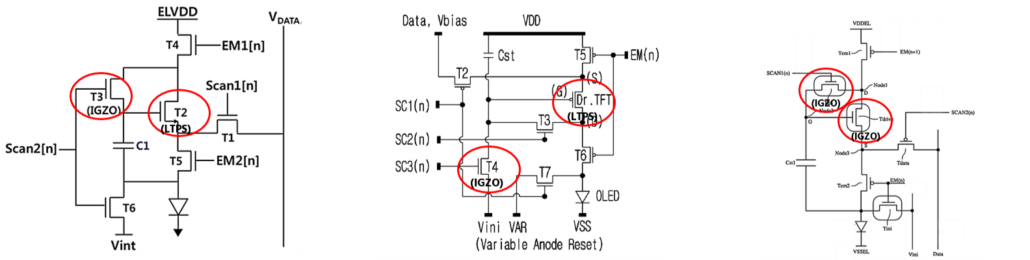
Figure 2 Representative Pixel Circuits with Different Oxide TFT Locations (Sources: Apple SID 2019, SDC Patent, Apple Patent)
In a 2025 study, SEL demonstrated high-mobility crystalline InOₓ TFTs and reported no observable hysteresis under the measurement conditions. It also fabricated an OLED prototype using these devices, providing one example of the potential of oxide driving TFTs.[18]
Adoption began in smartwatches. Apple Watch Series 10 adopted LTPO3 in 2024.[8] In smartphones, reports indicate that the iPhone 18 Pro, released in September 2026, adopted LTPO+, which extends oxide technology to the driving TFT.[19]
According to reports, Samsung Display and LG Display are the main panel suppliers for the iPhone 18 Pro, while BOE is expected to struggle to meet quality and yield requirements.[20] Although LG Display and BOE have similar shipment volumes, their pace of adapting to next-generation driving architectures could change the supply structure.
■ Circuit Design Matched to the Driving Device
When the source of an n-type oxide driving TFT is connected to the OLED side, changes in the OLED operating voltage can affect the source potential. With a fixed gate voltage, this changes the gate-to-source voltage (Vgs), affecting the emission current. The storage-capacitor connections and compensation design accounting for OLED voltage changes therefore become important.
If LTPS no longer handles precise emission-current driving, there may also be room to optimize its process for its remaining roles. However, any cost benefit must be assessed together with the remaining LTPS processes and the additional structures required for oxide driving TFTs.
5. Remaining Challenges and Mass Production Requirements
■ Oxide Devices for Stable Low-Gray-Level Reproduction
Oxide driving TFTs must produce small current differences consistently. If current changes too sharply with gate voltage, the voltage range available for reproducing dark gray levels narrows. Subthreshold swing (SS) describes the current response in this region; driving TFTs require an appropriate value and uniformity for gray-level control.
A 2026 Full-Oxide AMOLED study proposed asymmetric dual gates to give driving TFTs a gradual response and switching TFTs a steep response. The key is to achieve current characteristics suited to each device’s role, alongside higher mobility.[21]
| Challenge | Key Control Parameters | Impact on Products |
| Current stability | Bias, temperature, and light stress | Long-term luminance and gray-level stability |
| Low-gray-level control | SS and threshold-voltage variation | Uniformity in dark images |
| Circuit compensation | TFT and OLED voltage changes | Transition response and emission current |
| Driving range | Holding and data-writing times | Support for low and high refresh rates |
| Large-area processing | Crystallization, deposition, and etching uniformity | Mura and mass production yield |
| Manufacturing economics | Masks, process time, and equipment load | Cost and production capacity |
■ Residual Power Consumption Beyond the Pixel
Reducing the refresh rate does not stop all peripheral circuit activity. A SID 2025 study by Samsung Display and Konkuk University noted that clock charging and discharging continue during the holding period in certain gate-driver circuits, and proposed a circuit to reduce this activity. This approach reduces gate-in-panel (GIP) circuit power alongside pixel data retention.[22]
In the same year, Tianma presented a driving scheme that applies different refresh rates to different screen regions. While it can reduce updates in static regions, luminance differences between regions operating at different refresh rates require compensation. Expanding regional power savings therefore requires joint consideration of driving control and image quality at region boundaries.[23]
■ Uniformity and Process Burden at Gen 8.6
For large-area LTPO, it is important to achieve uniform LTPS and oxide TFT characteristics across the substrate. In LTPS crystallization using excimer laser annealing (ELA), grain structure and electrical characteristics can vary with laser irradiation conditions. Oxide TFTs are also affected by channel and dielectric thickness, composition, and etching conditions. These variations can cause luminance nonuniformity, making process uniformity for both device types a major challenge in scaling to larger areas.
The shift to oxide driving TFTs also affects manufacturing. Sharing an existing oxide layer may limit additional processing, whereas structures that introduce separate oxide layers, electrodes, or dielectrics may increase the number of steps. Industry sources indicate that extending oxide technology to driving TFTs requires panel makers to add TFT process equipment, with the scale of supplementary investment varying accordingly.[17] The impact on manufacturing costs and productivity is therefore likely to depend on the actual additional processes, equipment throughput, and mass production yield, rather than the number of oxide TFTs.
6. Outlook and Competitive Landscape
■ Broader Smartphone Adoption and an IT Production Base
In smartphones, both the range of models using LTPO and the role of oxide TFTs are expanding. The transition to oxide driving TFTs appears to be moving from smartwatches into premium smartphones. The pace of expansion into standard models will depend on customer image-quality requirements and mass production conditions.
A Gen 8.6 production base is being established for IT OLEDs. BOE has applied LTPO and tandem OLED to its Gen 8.6 line,[9] while Samsung Display’s first-phase Gen 8.6 investment used an oxide approach.[24] The choice between LTPO and oxide backplanes for IT products may vary according to product-specific image-quality requirements and costs.
Gen 8.6 substrates offer the potential to lower manufacturing costs by improving panel production efficiency. Realizing those savings, however, requires the large-area uniformity and mass production yields discussed in Section 5.
| Technology Path | Key Competitive Factors | Representative Public Examples and Status |
| LTPO with LTPS driving TFTs | Established production base and driving compensation | Smartphone supply base of Samsung Display, LG Display, BOE, and others |
| LTPO with oxide driving TFTs | Hysteresis and low-gray-level current control | LTPO3 in Apple Watch Series 10; LTPO+ in iPhone 18 Pro (reported) |
| All-oxide | Process simplification and device stability | Oxide backplanes in LG Display’s large OLEDs; SEL prototypes |
■ Competition with All-Oxide Backplanes Varies by Product
All-oxide backplanes are already used in large OLEDs.[25] Expansion into high-resolution products such as smartphones requires sufficient current from small TFTs while maintaining stable control of low-gray-level luminance. SEL’s high-mobility devices and Full-Oxide research focus on achieving this performance.[18,21]
LTPO combines the high mobility of LTPS with the low leakage current of oxide TFTs. All-oxide backplanes offer the advantage of fewer manufacturing steps by eliminating LTPS crystallization. Their future adoption in small and medium-sized OLEDs will likely depend on achieving driving performance and reliability, and on translating process reductions into lower mass production costs.
■ Changing Requirements for Equipment and Materials
For LTPO using LTPS, crystallization uniformity in ELA remains important. Extending oxide technology to the driving TFT increases the importance of processes that stabilize emission current by controlling oxide composition, the interface with the dielectric, and hydrogen ingress.
Lines that switch to all-oxide backplanes do not require ELA for LTPS crystallization. The impact on equipment and materials therefore differs by technology path. LTPO advancement continues to require process optimization for both device types, while all-oxide approaches center on oxide deposition, annealing, and dielectric processes.
Conclusion
The focus of LTPO competition is shifting from enabling low refresh rates to stable control of emission current. The ability to translate oxide driving-TFT characteristics into mass production yield and manufacturing cost performance is likely to influence future supply structures across product categories.
References
[1] UBI Research, 2025 LTPO Smartphone Panel Shipments. Including foldable panels.
[2] OLED-Info, UBI: Samsung and LG Display shipped almost 99% of Apple’s iPhone 17 AMOLED panels, 2025.10.
[3] Chang et al., LTPO TFT Technology for AMOLEDs, SID 2019.
[4] Apple, Apple Watch Series 5 announcement, 2019.
[5] Samsung Display, Variable Refresh Rate Technology, 2020.
[6] Apple, iPhone 13 Pro announcement, 2021.
[7] Apple, iPhone 14 Pro announcement, 2022.
[8] Apple, Watch Series 10 technical specifications, 2024.
[9] Apple, tandem OLED iPad Pro announcement, 2024.
[10] Apple, iPhone 17 announcement, 2025.
[11] BOE, Gen 8.6 AMOLED mass production and introduction of LTPO and tandem technologies, 2026.
[12] Sim et al., Improvement of flicker phenomenon at low frequencies in AMOLED displays by applying compensation scheme of variable reset voltage, Scientific Reports, 2025.
[13] Compact Integration of Hydrogen–Resistant a–InGaZnO and Poly–Si Thin–Film Transistors, 2022.
[14] Jun et al., Reliability Enhancement of Oxide Thin-Film Transistors via Suppression of a-IGZO Protrusions for Improved Image Quality in LTPO AMOLED Displays, 2026.
[15] Jeong et al., Low-Temperature Polysilicon Oxide Thin-Film Transistors with Coplanar Structure Using Six Photomask Steps, Advanced Engineering Materials, 2020.
[16] Sim et al., Enhancing luminance response during gray-level transitions at low frequencies in AMOLED displays, Journal of Information Display, 2026.
[17] 9to5Mac, The iPhone Air may get a new battery-saving display, but not this year (citing TheElec), 2025.06.18.
[18] Shima et al., Normally-off top-gate self-aligned field-effect transistor using crystal InOₓ with field-effect mobility of around 100 cm²/Vs, JSID, 2025.
[19] 9to5Mac, iPhone 18 Pro and Pro Max: Two new display upgrades (citing TheElec), 2026.09.03.
[20] iClarified, BOE to miss out on iPhone 18 Pro OLED orders due to LTPO challenges (citing TheElec), 2026.05.
[21] Yang et al., Full Oxide TFT Technology for AMOLED Displays, ICDT 2026 / SID Digest.
[22] Oh et al., Low-Power Gate Driver Circuit with Variable Pulse Width for LTPO-Based AMOLED Displays, SID 2025.
[23] Zhang et al., A New Design of AMOLED Screen with Multi-Frequency-Display and Compensation Methods, SID 2025.
[24] Electronic Times, Samsung Display targets smartphones with Gen 8.6 OLED and orders LTPO equipment, 2026.05.07. Report on equipment investment.
[25] LG Display, 2025 Form 20-F, filed in 2026. Description of oxide backplanes for large OLEDs.