
Apple’s IT Display Strategy: LCD Demand, OLED Specs, and Initial Volumes
Apple is expected to expand its OLED adoption from the iPad Pro to the MacBook Pro and iPad Mini. The company’s tablet OLED transition, which began with the 2024 iPad Pro, is moving into notebooks and small tablets. Although the two products are expected to arrive around the same time, their current display quality, retail prices, and purchase purposes differ. Their post-transition volumes therefore need to be assessed within each product category.
Apple announced plans to unveil new MacBook Pro and iPad Mini models on October 27, U.S. local time. November 6 has been cited as the sales launch date for the OLED MacBook Pro, but Apple has yet to make an official product announcement, and reports suggest that an OLED model may launch alongside an M6 MacBook Pro retaining the current design. It is therefore not appropriate to treat every MacBook Pro announced this time as an OLED product.
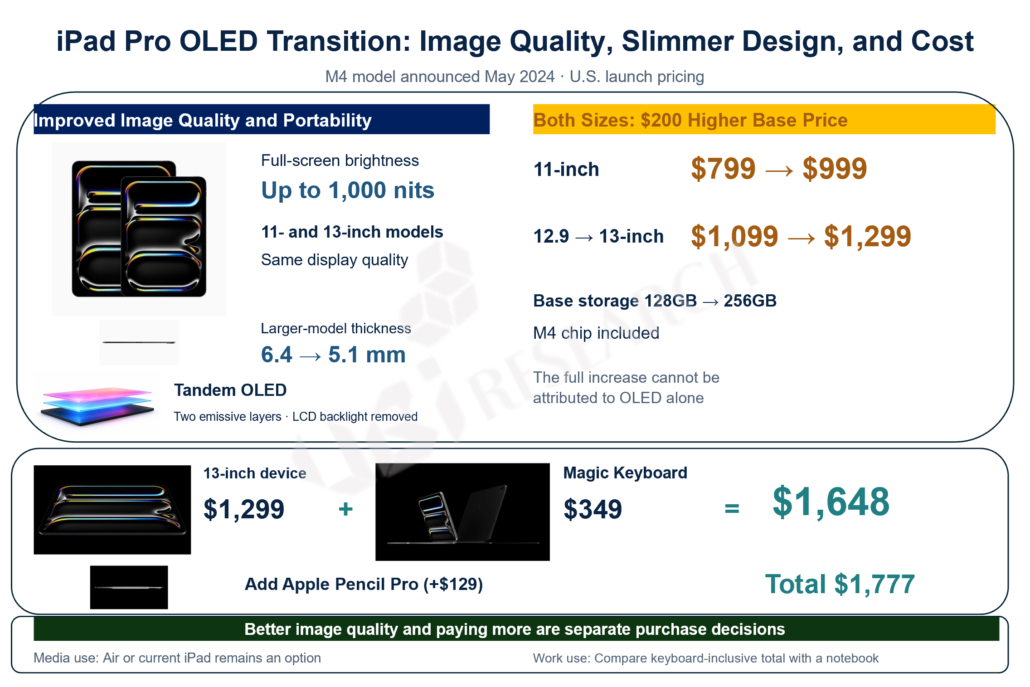
The improvements Apple highlighted when it moved the iPad Pro to OLED were clear. The M4 model unveiled in May 2024 used tandem OLED, stacking two emissive units to deliver up to 1,000 nits across the full screen. The 11-inch model gained a display of the same class as the 13-inch model, while the larger model’s thickness fell from 6.4 mm to 5.1 mm. By eliminating the LCD backlight, Apple improved both image quality and portability.
Image quality and portability improved, but buyers also faced a higher price. For the base Wi-Fi models in the United States, the 11-inch price rose from $799 to $999, while the 13-inch successor to the 12.9-inch model increased from $1,099 to $1,299. Because base storage doubled from 128GB to 256GB and the M4 chip was also added, the full $200 increase cannot be attributed to OLED. Even so, the amount required to buy into the Pro lineup increased.
Adding the then-$349 Magic Keyboard to the 13-inch model brought the total to $1,648. With Apple Pencil Pro, it reached $1,777. Buyers who mainly view content can continue using an iPad Air or an existing iPad, while those buying for work will compare the keyboard-inclusive total with a notebook. Recognizing OLED’s visible image-quality improvement and paying extra for that difference are separate purchase decisions.
| Item | 11-inch M2 2022 |
11-inch M4 2024 |
12.9-inch M2 2022 |
13-inch M4 2024 |
| Display | IPS LCD | Tandem OLED | Mini-LED backlit LCD |
Tandem OLED |
| Resolution | 2,388×1,668 | 2,420×1,668 | 2,732×2,048 | 2,752×2,064 |
| Max. SDR brightness | 600 nits | 1,000 nits | 600 nits | 1,000 nits |
| HDR brightness | No XDR specification | 1,000 nits full-screen / 1,600 nits peak |
1,000 nits full-screen / 1,600 nits peak |
1,000 nits full-screen / 1,600 nits peak |
| Refresh rate | ProMotion Up to 120Hz |
10–120Hz | ProMotion Up to 120Hz |
10–120Hz |
| Thickness / Weight | 5.9mm / 466g | 5.3mm / 444g | 6.4mm / 682g | 5.1mm / 579g |
| Base storage | 128GB | 256GB | 128GB | 256GB |
| U.S. launch price | $799 | $999 | $1,099 | $1,299 |
Volumes Fell Short of Expectations, but an OLED Market Remains
Actual panel volumes fell short of initial expectations. According to UBI Research, OLED shipments for the 2024 iPad Pro totaled about 6.3 million units. Samsung Display supplied 2.8 million 11-inch panels, while LG Display supplied 700,000 11-inch panels and 2.8 million 13-inch panels. The total was about 30% below the initial forecast of 9 million units.
Panel makers gained several million units of new OLED demand, but did not convert all the volume expected at the start of the year into sales. Demand, however, did not disappear. The iPad Pro OLED market has remained at roughly 6–7 million units annually and is expected to reach about 7 million units in 2026.
When LCD products move to OLED, the impact of higher prices on demand must be considered alongside expectations for better image quality. The iPad Pro started below its initial volume plan, but annual OLED demand of several million units continued, creating a new market for panel makers. It is likewise difficult to assume that existing LCD sales of the MacBook Pro and iPad Mini will translate directly into OLED volumes. The scale of demand shifting to OLED will depend on how much the screen and portability improve over current products and how much more consumers are willing to pay for those differences.
The OLED Transition of MacBook Pro and iPad Mini
MacBook Pro starts from a different position than iPad Mini. The conventional LED-backlit LCD used through the 13-inch M2 model delivered about 500 nits. However, the 14- and 16-inch M1 Pro and Max models introduced in 2021 had already adopted mini-LED backlights and ProMotion up to 120Hz. The comparison for the new OLED model is therefore not an old conventional LCD, but Liquid Retina XDR, whose brightness and reflection characteristics have been improved over several years.
| Model / Year | Display Size and Resolution | Brightness and Refresh Rate | Changes in This Generation |
| 13-inch M2 2022 | 13.3-inch IPS LCD 2,560×1,600 / 227ppi |
500 nits No ProMotion |
Standard LED backlight P3 · True Tone |
| 14/16-inch M1 Pro·Max 2021 | 14.2-inch 3,024×1,964 16.2-inch 3,456×2,234 254ppi |
SDR 500 nits HDR 1,000 nits full-screen / 1,600 nits peak Up to 120Hz |
Mini-LED backlight Liquid Retina XDR Notch added |
| M3 Series 2023 | 14.2 / 16.2-inch Same resolution and 254ppi |
SDR 600 nits HDR 1,000 / 1,600 nits Up to 120Hz |
Higher SDR brightness Base M3 also gets 14-inch XDR |
| M4 Series 2024 | 14.2 / 16.2-inch Mini-LED LCD |
SDR up to 1,000 nits outdoors HDR 1,000 / 1,600 nits Up to 120Hz |
Nano-texture option 12MP Center Stage camera |
| M5 Pro·Max 2026 | 14.2 / 16.2-inch Mini-LED LCD |
SDR up to 1,000 nits outdoors HDR 1,000 / 1,600 nits Up to 120Hz |
XDR display retained M5 Pro/Max and connectivity updated |
The key difference expected from OLED is pixel-level emission control. When a small bright object appears against a dark background, OLED can reduce blooming from mini-LED local-dimming zones and improve motion rendering through faster response. The absence of a backlight also supports a thinner display module.
How the space freed by removing the backlight is used will shape the product. Apple could make the chassis thinner or allocate more room to the battery and cooling system. Dark-scene rendering and response speed may drive purchases for video work, while thickness and weight may matter more for mobile workflows. For customers who mainly use documents or spreadsheets, battery life on bright screens and the price difference may be more important. The OLED MacBook Pro therefore needs to demonstrate benefits across work environments, not only better image quality.
Expected OLED MacBook Pro Specifications
| Item | Current LCD MacBook Pro Specifications | Expected Next-Generation OLED MacBook Pro |
| Display size | 14.2 / 16.2-inch | 14 / 16-inch class; panel roadmap lists 14.3 / 16.3-inch |
| Display | Mini-LED-backlit LCD | RGB Tandem OLED |
| Substrate / Encapsulation | LCD cell + separate backlight module | Hybrid OLED Glass substrate + thin-film encapsulation |
| TFT / Touch structure | Detailed TFT structure undisclosed by Apple No direct touch support |
Oxide TFT; touch over thin-film encapsulation Electrode structure expected Touch support reported |
| Resolution / Density | 14.2: 3,024×1,964 16.2: 3,456×2,234 / 254ppi |
Not officially disclosed |
| Brightness | SDR up to 1,000 nits outdoors HDR 1,000 nits full-screen / 1,600 nits peak |
Not officially disclosed |
| Contrast / Color gamut | 1,000,000:1 / P3 / True Tone | Product figures undisclosed 95% BT.2020 is a later-roadmap item |
| Refresh rate | ProMotion up to 120Hz | Variable refresh rate expected Official maximum/minimum undisclosed |
| Front design | Top notch / 12MP camera | Punch-hole and Dynamic Island reported Camera/biometric details undisclosed |
| Surface treatment | Nano-texture option | Option / reflectance undisclosed |
| Thickness | 14-inch 15.5 / 16-inch 16.8mm | Thinner design reported / figure undisclosed |
| Weight | M5 Pro: 14-inch 1.60kg, 16-inch 2.14kg M5 Max: 1.62kg, 2.15kg |
Lighter design reported / figure undisclosed |
| Processor | M5 / M5 Pro / M5 Max | Latest reports suggest M5 Pro/Max retained Apple chip configuration undisclosed |
| Memory / Storage | M5 Pro up to 64GB; Max up to 128GB Pro base 1TB / Max base 2TB |
Official configuration/capacity undisclosed |
| Ports / Connectivity | M5 Pro/Max: Thunderbolt 5, HDMI · SDXC · MagSafe 3, Wi-Fi 7 |
Official configuration undisclosed |
| Battery life | Up to 24 hours, depending on configuration Apple video-streaming test |
Comparable figure under the same conditions undisclosed |
| Price | March 2026 U.S. launch price for M5 Pro 14-inch $2,199 / 16-inch $2,699 |
Official price undisclosed Reports suggest LCD may remain and OLED may sit above it |
Assuming about 1 million OLED MacBook Pro units in 2026, the first year will be more about testing demand for a new premium product than transforming the overall market. A year-end launch leaves only a short sales window. Panels ship before the product announcement, and some remain in finished-goods and channel inventory.
Demand for 14- and 16-inch LCD MacBook Pro panels has been rising year on year since 2024. OLED may create entirely new notebook demand, but it may also absorb customers who would otherwise buy LCD models. If LCD models remain on sale, OLED’s share within the Pro lineup is likely to change before Apple’s total MacBook sales do.
Expected 2027 volume will depend on follow-on orders after launch. The initial inventory from the 1 million-unit production run must be depleted, and panel orders must continue at the same price level. In particular, if the Pro and Max models launch with M5 chips, the OLED model will have to justify its higher price through differences in the display, touch support, and portability rather than relying on a major gain in chip performance.
iPad Mini Will Be Judged in a Different Market.
The 2024 A17 Pro iPad Mini upgraded the chip, storage, and Pencil support, but retained an 8.3-inch, 500-nit LCD. If it moves to OLED, the visual change may feel greater than on today’s mini-LED MacBook Pro. The accompanying question is whether Apple can maintain a price appropriate for a small tablet.
| Item | Mini 6 (2021) | Mini A17 Pro (2024) | Expected Next OLED Mini |
| Announcement / Sales | 9/14 / 9/24 | 10/15 / 10/23 | Reported unveiling: Oct. 27–28, 2026 |
| Display | 8.3-inch IPS LCD | 8.3-inch IPS LCD | 8.4-inch-class OLED expected |
| Resolution / Density | 2,266×1,488 326ppi |
2,266×1,488 326ppi |
Not officially disclosed |
| Brightness / Color gamut | 500 nits / P3 True Tone |
500 nits / P3 True Tone |
Brightness/color-gamut figures undisclosed |
| Refresh rate | No ProMotion | No ProMotion | 60 / 120Hz expected |
| OLED structure | N/A | N/A | Hybrid · single RGB · LTPS expected |
| Chip | A15 Bionic | A17 Pro | A20 Pro rumored |
| Storage | 64 / 256GB | 128 / 256 / 512GB | Base capacity/configuration undisclosed |
| Thickness / Weight | 6.3mm / 293g Wi-Fi model |
6.3mm / 293g Wi-Fi model |
Not officially disclosed |
| Pencil | 2nd-gen Pencil · USB-C | Pencil Pro · USB-C Hover support |
Official compatibility undisclosed |
| Connectivity / USB | Wi-Fi 6 USB-C up to 5Gb/s |
Wi-Fi 6E USB-C up to 10Gb/s |
Not officially disclosed |
| Front camera / Speakers | 12MP Center Stage Landscape stereo |
12MP Center Stage Landscape stereo |
Landscape front camera and speaker redesign reported |
| Water resistance | No official IP rating | No official IP rating | Improved water resistance reported IP rating/test conditions undisclosed |
| Battery | Wi-Fi web/video Up to 10 hours |
Wi-Fi web/video Up to 10 hours |
Not officially disclosed |
| U.S. base Wi-Fi price | Launch: $499, 64GB | Launch: $499 / Current: $599 | Not officially disclosed |
The current A17 Pro iPad Mini costs $599 in the U.S. Apple Store. According to industry sources, the OLED iPad Mini is expected to be priced at $749–799. At $799, it would be 33.4% more expensive than the current base model. OLED could provide a replacement reason for customers who strongly prefer the compact size, but price-sensitive buyers will also compare it with larger LCD tablets or the existing Mini. Forecasting OLED Mini volume requires first confirming the final price and refresh-rate combination.
New-Line Performance Hinges on Follow-on Production After Launch
Samsung Display, which supplies panels for both MacBook Pro and iPad Mini, is expected to broaden its business scope. Mass production of iPad Mini OLED panels had already begun in June, and MacBook Pro panels are being produced on the Gen 8.6 line. Samsung Display is the sole supplier for both products. Even if the volume shifting from LCD to OLED does not translate entirely into incremental Apple device sales, Samsung Display may gain Apple notebook panel revenue that it did not previously have.
The two products are expected to expand OLED demand among different customer groups. For MacBook Pro, the key variable is the share of premium-notebook demand shifting to OLED; for iPad Mini, it is how many buyers accept a higher price for a small tablet. Even with limited first-year volume, continued follow-on orders would give suppliers a long-term growth base. Conversely, high initial shipments followed by weak reorders could repeat the iPad Pro volume adjustment. In 2027, IT OLED growth will hinge on inventory sell-through and reorders, not year-end launch counts.