
This Focus Pro summarizes the AR waveguide patent (US 2026/0349260 A1) that Meta published on November 5, 2026, and reviews the status of wide-FOV waveguides by implementation approach, together with trends among key companies and in materials, light sources, and academic research. The patent claims a field of view (FOV) of 50° or more on standard glass with a refractive index of 1.52 or less. The performance figures presented in the application are monochrome simulation results; no information on full-color performance or mass-production processes has been disclosed.
1. Overview of the Meta Patent
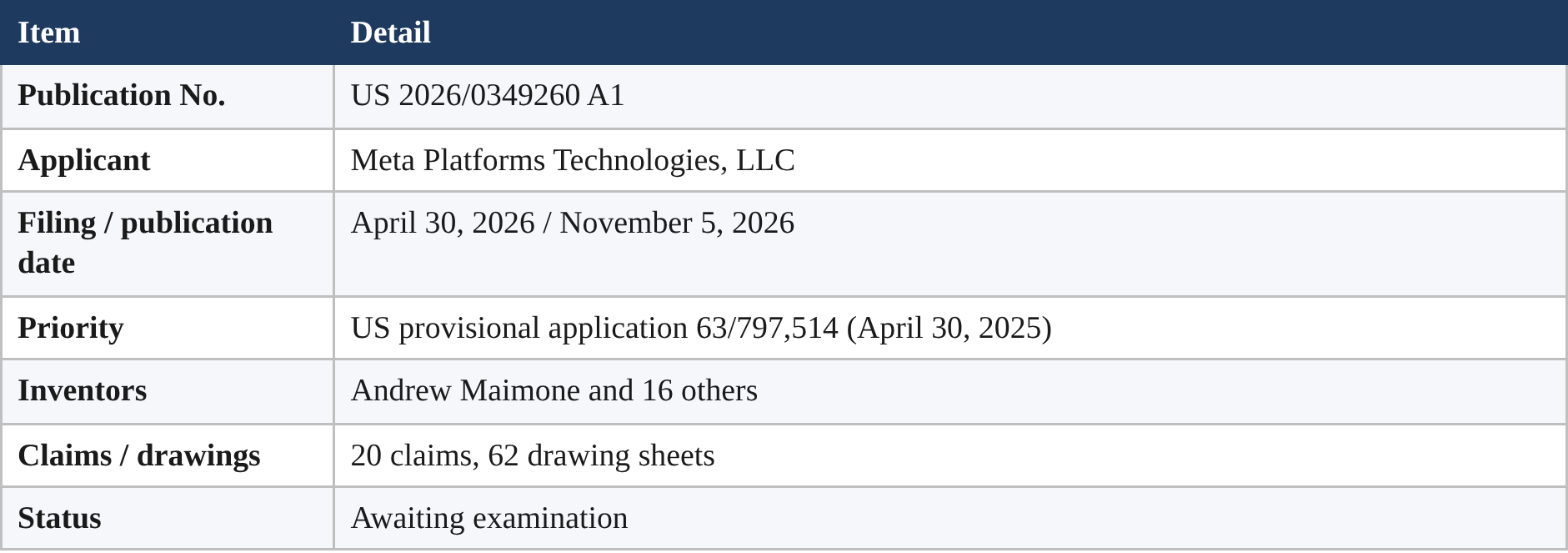
On November 5, 2026, Meta Platforms Technologies published a patent for an AR waveguide using a standard glass substrate (Table 1). Wide-FOV diffractive waveguides typically use SiC or high-index glass substrates. This application addresses a way to widen the FOV by changing the grating structure rather than the substrate material.
Table 1. Bibliographic data of Meta US 2026/0349260 A1
Source: Patentlyze
The main claims are as follows.
The grating elements are tilted inside the waveguide medium so that no grating is parallel to the outer faces (Claim 1).
An FOV of 50° or more is specified for glass with a refractive index of 1.52 or less. The monochrome simulation value in the application is about 90°, while a planar-grating comparison design using the same glass reaches about 27°.
The same waveguide is also used as the optical path for eye tracking, and the number of eye-tracking measurement points increases from four in the planar design to eight.
A prism backlight film with non-uniform spacing that reduces LCD interference patterns, and a process for printing lenses on a transparent adhesive layer, are also included as independent claims.
The core of this patent is a structure in which grating elements are placed inside the glass at a fixed tilt angle. A waveguide carries the projector’s image through a thin glass plate by total internal reflection and displays it in front of the eye, and the range of light angles the glass can carry narrows as the refractive index decreases. For this reason, the conventional approach of placing the light-bending micro-grating parallel to the glass surface limits the FOV to about 27° on standard glass with a refractive index of 1.52. This is also why Meta used a SiC substrate with a refractive index of about 2.65 to achieve about 70° in the Orion prototype.
The tilted gratings in the Meta patent compress the wide-angle light entering from the projector into the narrow angular range that standard glass can carry, send it into the glass, and then spread it back out to wide angles when the light is emitted toward the eye (Figure 1). Rather than raising the substrate’s refractive index, the approach adjusts the angular range through the grating structure; in the application’s monochrome simulation, it showed an FOV of up to about 90° on the same standard glass.
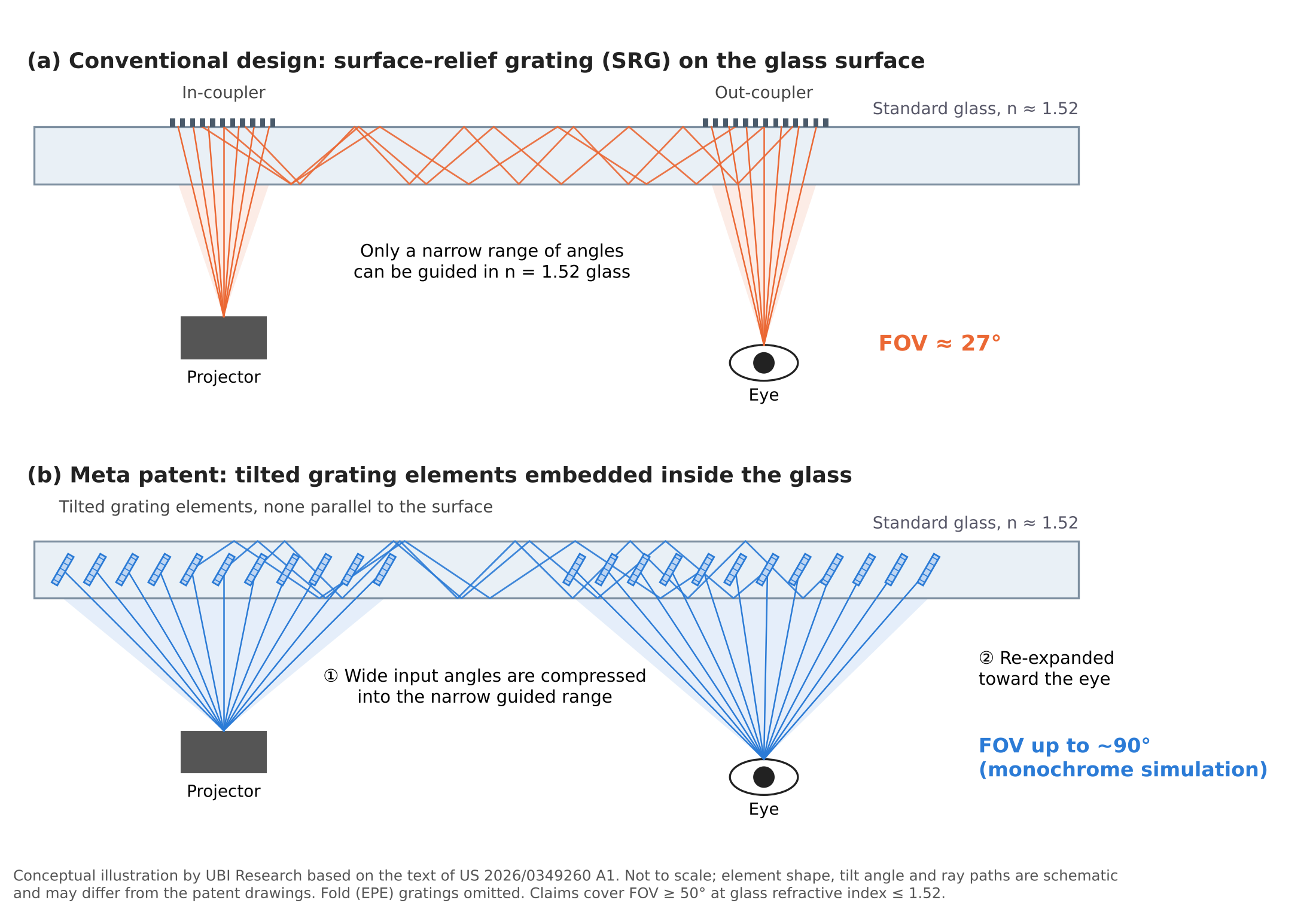
Figure 1. Planar surface grating vs. Meta's tilted embedded grating (conceptual)
Source: Based on the description in US 2026/0349260 A1. Conceptual illustration; actual proportions, element shapes, and tilt angles may differ from the patent drawings.
The eye-tracking function is configured to send light reflected from the eye through the same waveguide to a small camera. Proposed methods for fabricating the tilted gratings include stacking and then cutting, molding two parts, and exposing photosensitive material.
Besides the waveguide, the patent also covers several other headset optics technologies, such as a backlight film and a lens process, so divisional applications may be filed during examination. The FOV values of 90° and 27° are both monochrome simulation values. The application contains no data on full-color performance, optical efficiency, uniformity, or manufacturing processes.
2. Technical Background: Substrate Refractive Index and FOV
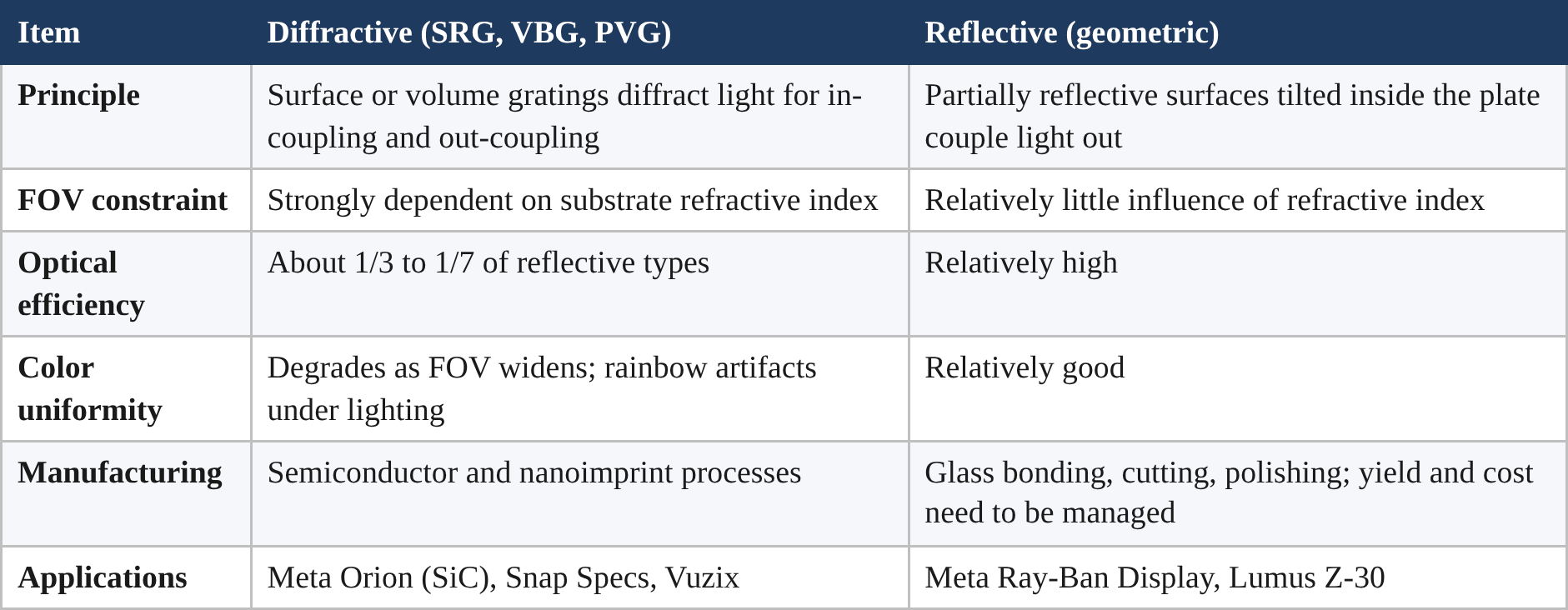
In AR glasses, the waveguide is the component that carries the image from a microdisplay built into the frame through a thin plate and displays it in front of the user’s eye. Waveguides are classified as diffractive or reflective according to how light is coupled in and out (Table 2). Diffractive types use semiconductor and nanoimprint processes and are suited to mass production, while reflective types offer higher optical efficiency and color uniformity but require glass bonding and polishing processes.
Table 2. Diffractive vs. reflective waveguides
Source: KGOnTech, company announcements
Diffractive waveguides confine and carry light by total internal reflection (TIR). Every field angle of the image must therefore fall between the critical angle and the maximum propagation angle (about 75°), and this angular range widens as the substrate refractive index n increases. The monochrome, single-axis FOV of a planar grating can be approximated as FOV ≈ 2 arcsin[(n sin θmax − 1)/2], with θmax ≈ 75°.
According to this equation, the theoretical FOV is about 27° for standard glass (n = 1.52), about 56° for high-index glass (n = 2.0), and about 100° for SiC (n = 2.65). The roughly 27° for standard glass matches the planar comparison design in Meta’s application. In full color, the angular range differs by wavelength, so the FOV becomes narrower; the full-color FOV of a single-layer high-index glass waveguide has been reported at about 35°.
The refractive index of glass tops out at about 2.0; higher indices require SiC (about 2.65–2.7) or lithium niobate (about 2.3). Density and transmittance are cited as issues for high-index glass, and brittleness, workability, and price for SiC. As explained in Section 1, the Meta patent adjusts the angular range by tilting the gratings and does not use a high-index substrate.
3. Comparison of Wide-FOV Approaches
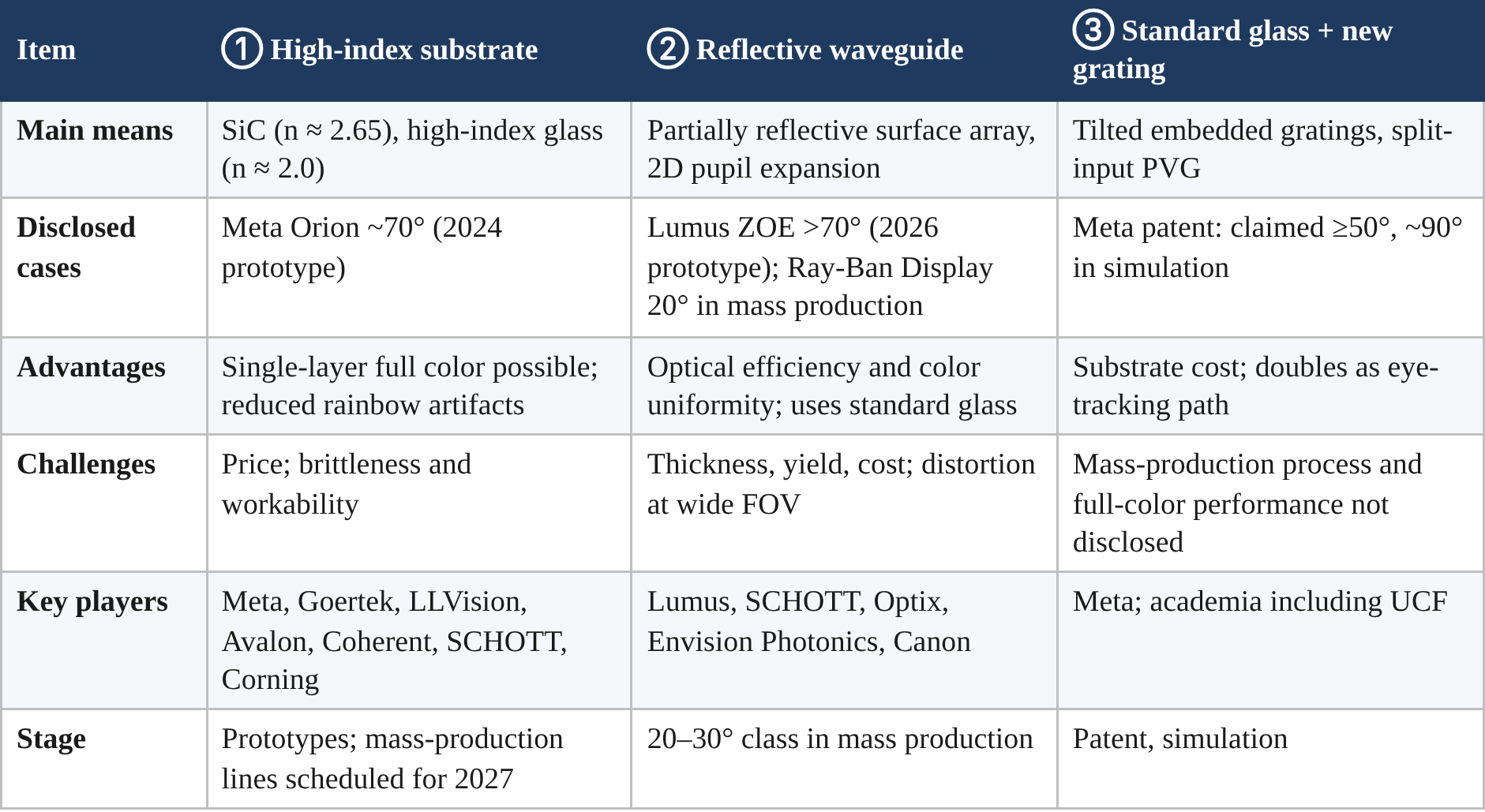
Wide-FOV waveguides are being developed along three approaches: changing the substrate material (①), using reflective optics (②), and changing the grating structure on standard glass (③) (Table 3). As of November 2026, 70°-class prototypes have been shown for ① and ②, while ③ is at the patent and simulation stage.
Table 3. Three approaches to wide-FOV AR waveguides
Source: Company announcements, KGOnTech, Patentlyze
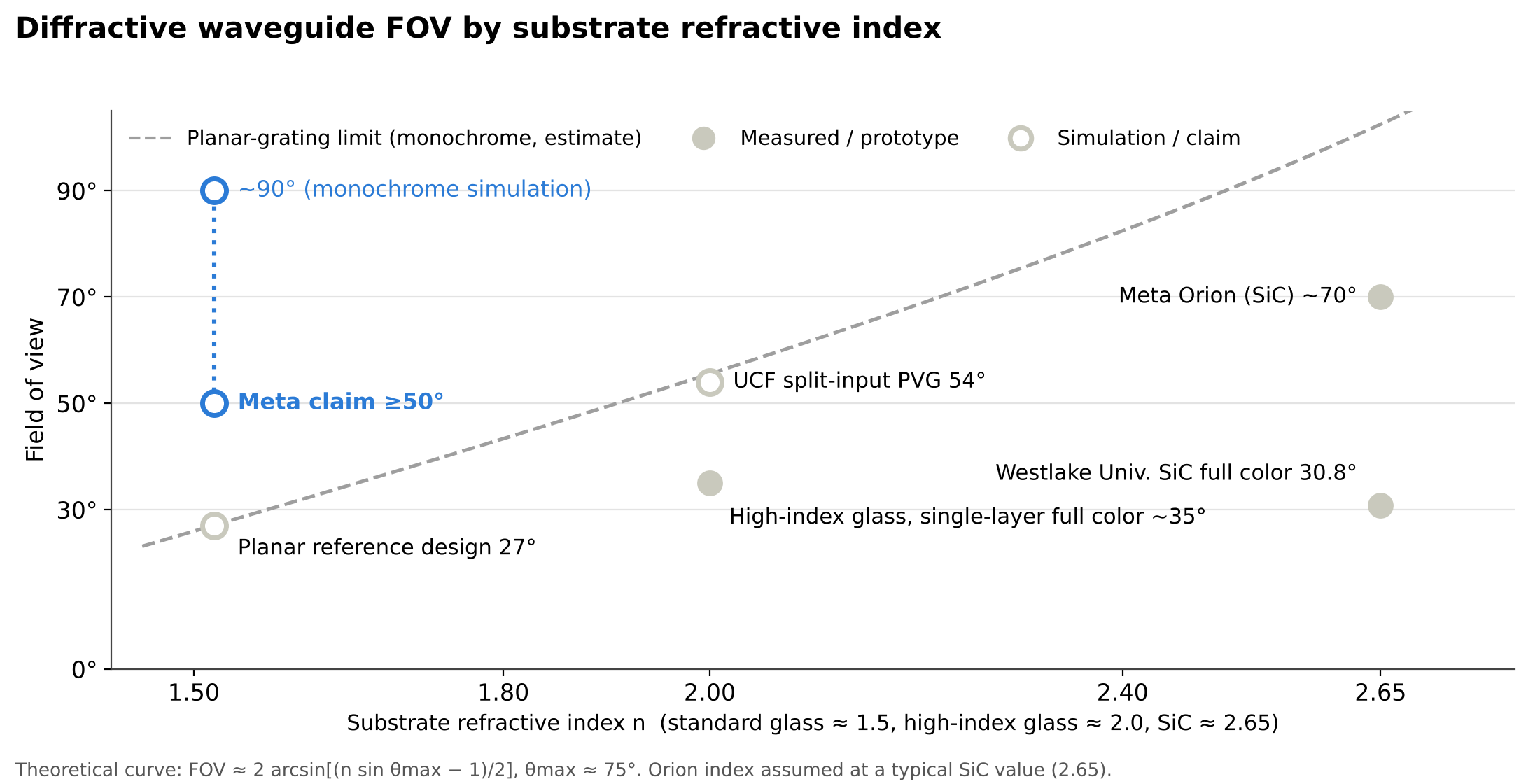
Figure 2. Diffractive waveguide FOV by substrate refractive index
Source: Patentlyze, Road to VR, TechTimes, J. SID (2024); compiled by UBI Research. The theoretical curve is an estimate based on the equation in the text, and a typical SiC value (2.65) is applied for Orion’s refractive index.
The dashed line in Figure 2 is the monochrome theoretical FOV of a planar grating. Most full-color measurements fall below this line. Among the cases shown, the one presenting an FOV above this line at n = 1.52 is the content of Meta’s patent application, and those values are the claimed range and monochrome simulation values. Reflective waveguides (②) follow a different relationship between refractive index and FOV and are therefore not included in the figure.
Meta holds all three approaches. Orion is a SiC diffractive design at about 70°, Ray-Ban Display is reflective at 20°, and this application is a standard-glass diffractive design. If the standard-glass approach is realized, the substrate cost burden will decrease, but the manufacturing process for forming tilted grating elements inside the glass becomes a new challenge.
4. Key Company Trends
In 2026, following the unveiling of Meta Orion, announcements of SiC diffractive waveguides continued, led by Chinese companies, and after Ray-Ban Display entered mass production, more companies announced reflective 2D waveguides (Table 4).
Table 4. Wide-FOV waveguide status by company
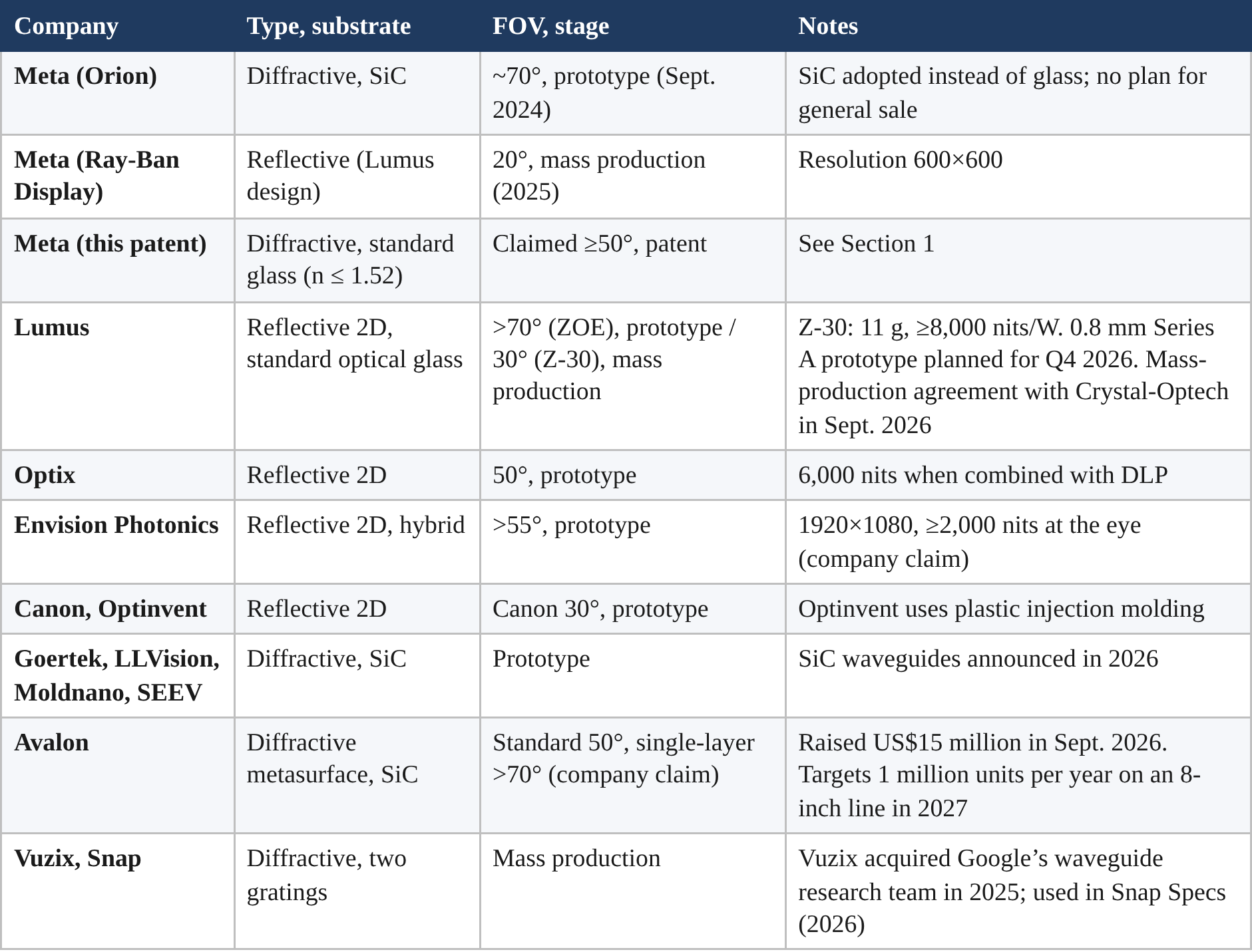
Source: Road to VR, Lumus, The Ghost Howls, TechTimes, KGOnTech
Trends among substrate material suppliers are as follows. SCHOTT supplies the high-index glass RealView (n ≈ 2.0, density below 4 g/cm³) as well as reflective waveguides, with cumulative wafer shipments of 500,000. Its Malaysian plant targets an annual output of 5 million units, and the target specifications for its next-generation reflective product are an FOV above 70° and a thickness below 1 mm. SCHOTT has stated that diffractive types suit narrow-FOV, monochrome applications, while reflective types suit wide-FOV, full-color applications. Corning supplies high-index glass with n = 1.8, 1.9, and 2.0 as 150–300 mm wafers and launched its n = 2.0 product in 2022. Coherent supplies SiC (n ≈ 2.7) and lithium niobate (n ≈ 2.3) and explains that SiC can achieve about twice the FOV of high-index glass.
Source: LEDinside (SCHOTT interview), Display Daily, Coherent
5. Related Trends: XR Patents, Light Sources, and Academic Research
Among XR-related patents published in 2026, Meta has the most, spanning optics, light sources, batteries, and input devices across AR glasses (Table 5). In October, Meta also published a patent for a low-stress scanning mirror for laser-scanning light sources. Apple published patents on input devices and eye tracking, Samsung Electronics on headset miniaturization, and Samsung Display on near-eye OLED panel structures.
Table 5. Selected XR patents published in 2026
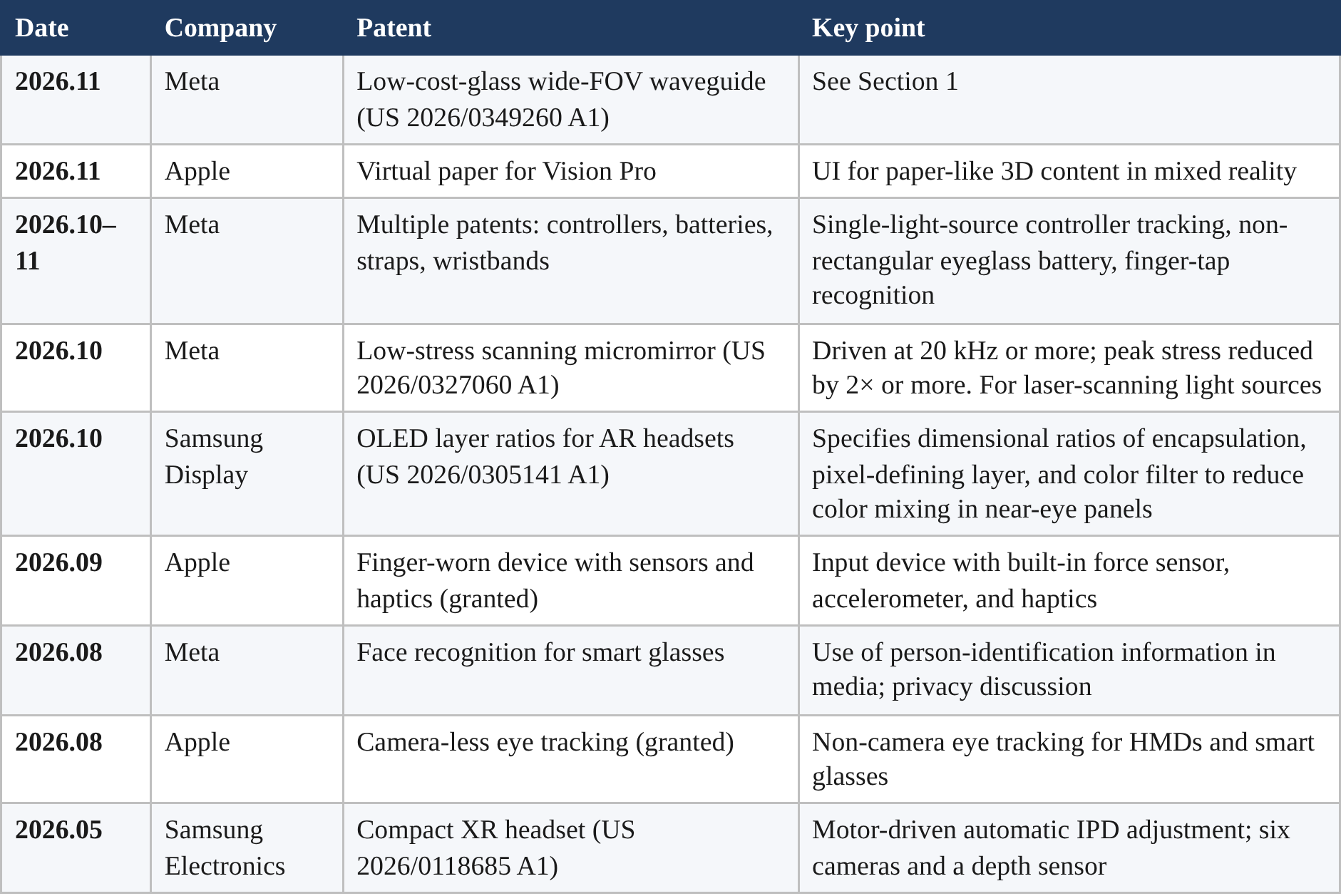
Source: Patentlyze, AppleWorld.Today, Digital Trends, SammyGuru
In eye tracking, Meta has secured patents for a waveguide-integrated approach and Apple for a camera-less approach; both configurations reduce the number of separate components.
As the waveguide FOV widens, the light-source resolution must also increase to maintain the same pixel density. Ray-Ban Display uses a 600×600 resolution (about 30 pixels per degree) for a 20° FOV. Achieving 70° at the same density requires about 2,100 pixels per side (Figure 3). In addition, as the FOV widens, the same amount of light is spread over a larger area, so the required luminance also rises. Lumus has stated that no display suited to its 70° prototype is yet available on the market.
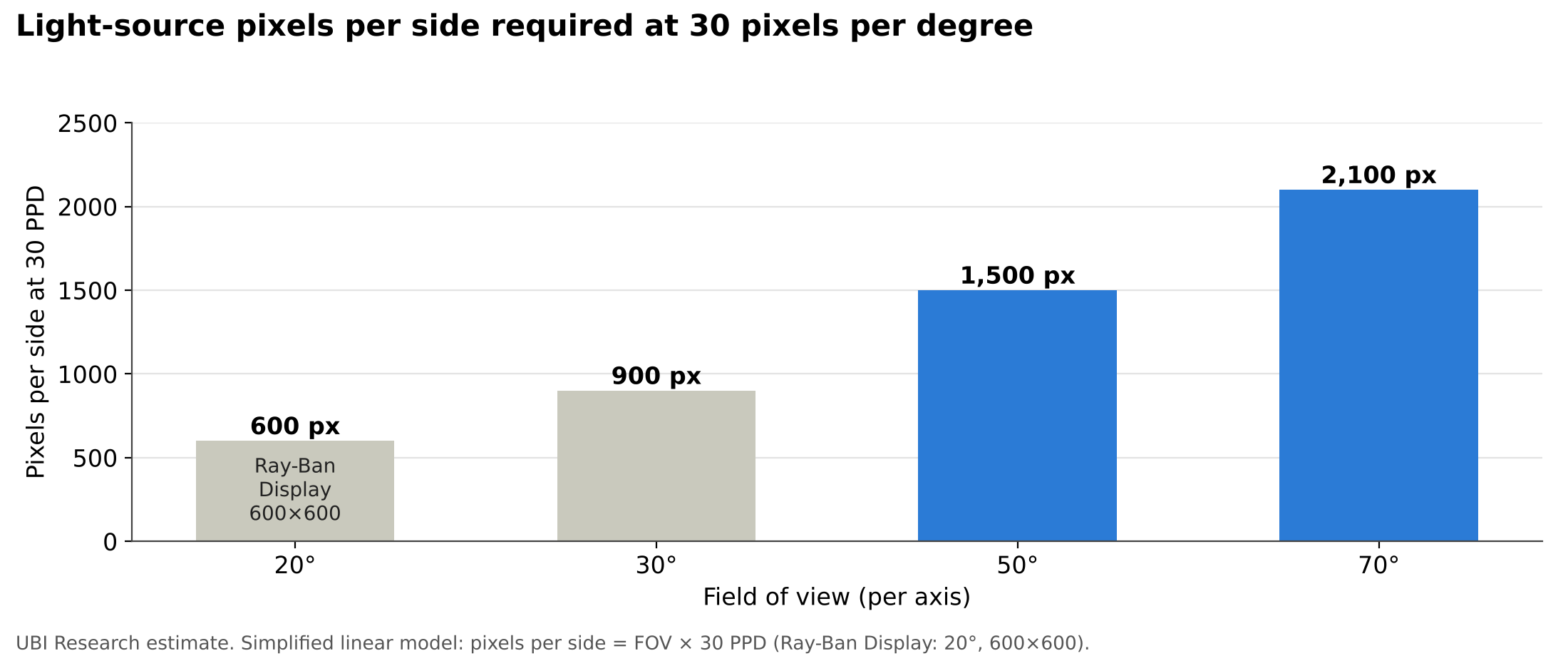
Figure 3. Light-source resolution required at 30 PPD, by FOV
Source: UBI Research estimate. Simple linear model multiplying FOV by pixel density (30 PPD).
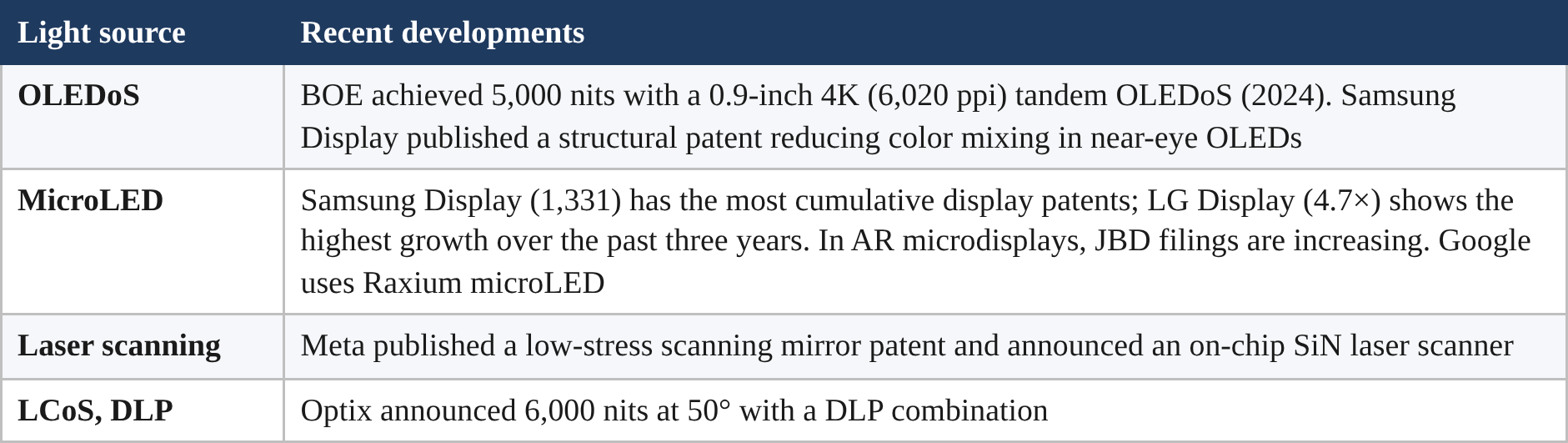
Table 6. Light-source developments for AR
Source: OLED-Info, Patentlyze, PatSnap, KGOnTech, The Ghost Howls
Because diffractive waveguides have low optical efficiency, they require high luminance from the light source, and wide-FOV products require high resolution and a small volume at the same time. Accordingly, the luminance of tandem OLEDoS and microLED, along with silicon backplane and pixel-miniaturization technologies, are cited as criteria for selecting light sources.
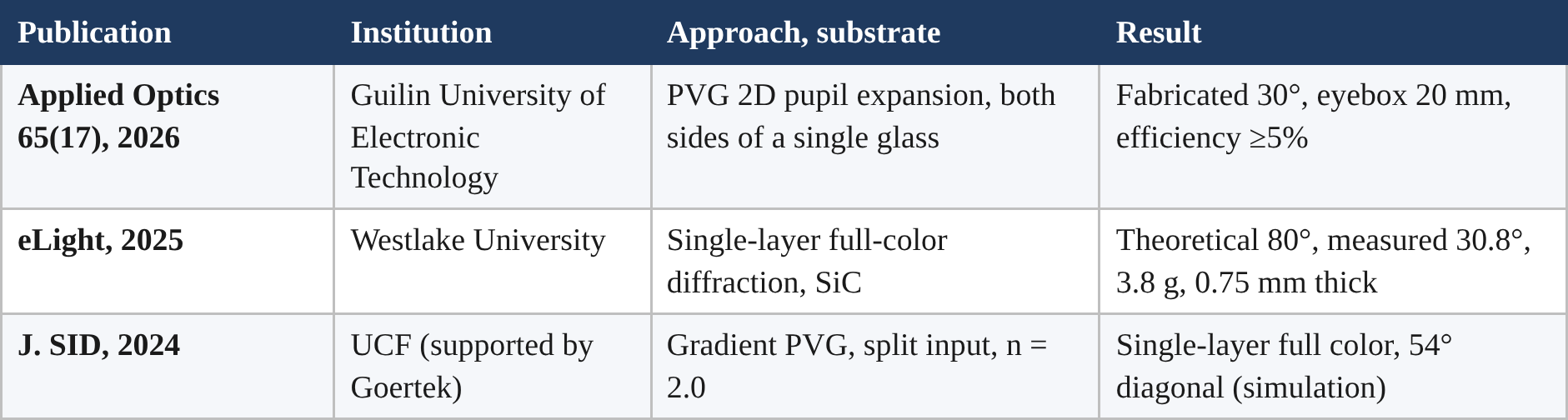
In academia, research is under way on widening the angular bandwidth by tilting or splitting gratings (PVG, split input) and on single-layer full-color SiC waveguides (Table 7). As of November 2026, no case has been reported of a diffractive waveguide on standard glass (n ≈ 1.5) achieving a measured FOV of 50° or more. Many studies cite optical efficiency and color uniformity as challenges; the efficiency of fabricated diffractive samples is lower than that of reflective types, and color uniformity tends to decline as the FOV widens.
Table 7. Selected research on wide-FOV waveguides
Source: Respective papers, TechTimes. Westlake University figures are as cited in media reports.
6. Outlook
In 2026–2027, reflective waveguides, which have a mass-production track record, are likely to be applied first to wide-FOV products, and the price of SiC diffractive waveguides is expected to depend on when mass-production lines in China start operating. Meta’s standard-glass approach could become a way to lower substrate costs if the mass-production process for tilted gratings inside glass and full-color performance are confirmed. For all three approaches, the resolution and luminance required of the light source rise together as the FOV widens.
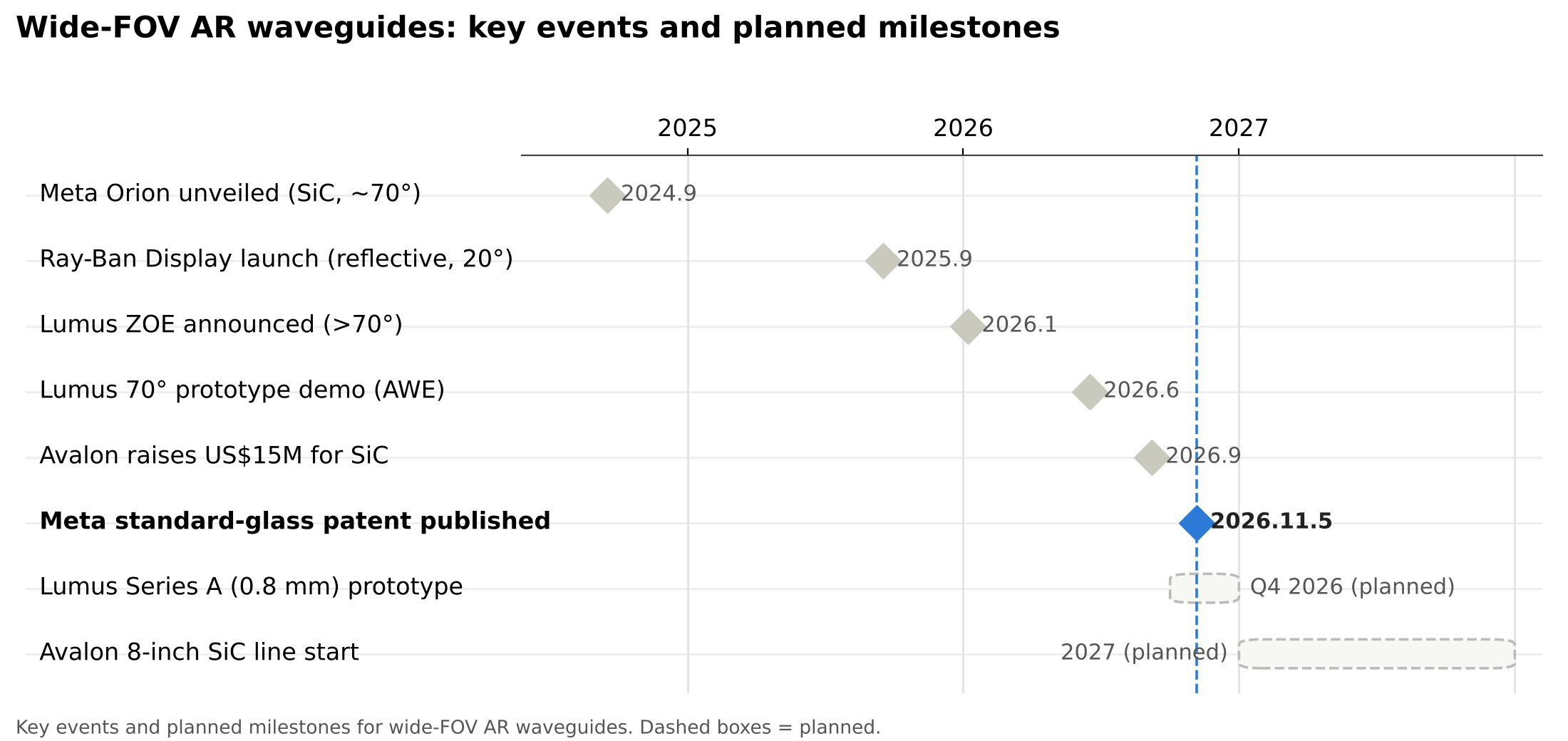
Figure 4. Key events and planned milestones for wide-FOV AR waveguides
Source: Road to VR, Lumus, The Ghost Howls, TechTimes, Patentlyze
Scheduled milestones include the unveiling of the Lumus Series A prototype in Q4 2026 and the start of operations of Avalon’s SiC mass-production line in 2027 (Figure 4).
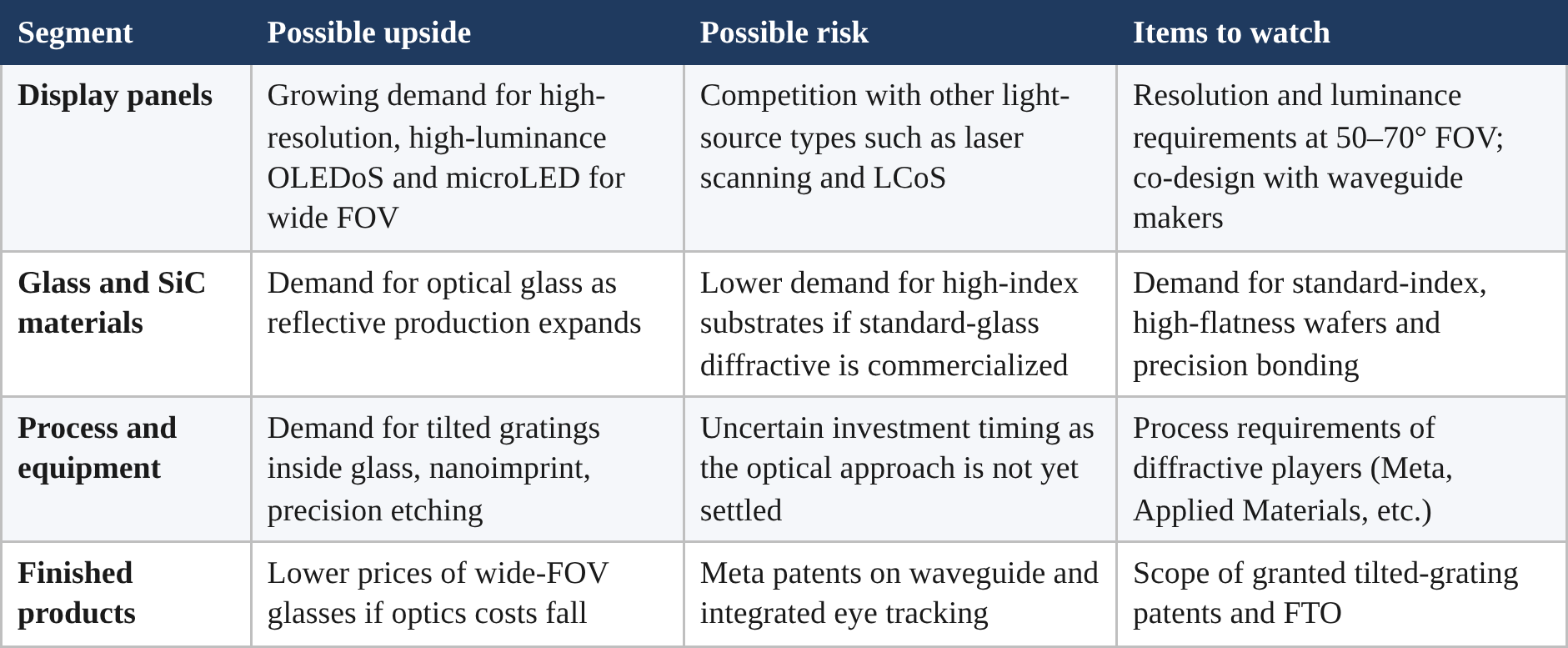
If the standard-glass diffractive approach is commercialized, the cost structure of optical components could shift from substrate materials toward grating design, manufacturing processes, and light sources. The expected effects by industry are shown in Table 8.
Table 8. Possible effects by industry segment
As of November 2026, wide-FOV AR waveguides are being developed along three approaches: high-index substrates, reflective optics, and grating designs based on standard glass. Mass-production products are in the 20–30° class, while 70°-class products are at the prototype stage. Because the performance values reported in Meta’s patent application are monochrome simulation values, commercial feasibility can be assessed once optical efficiency and mass-production process data have been verified.
Noh Chang-ho, chnoh@ubiresearch.com