
A Core Growth Engine for IT OLED
As OLED production on Gen 8.5 and Gen 8.6-class lines expands into monitors, LCD demand will contract directly. OLED monitors are emerging as a new growth engine for medium-sized OLED.
September 18, 2026 | Author: Choonghoon YI | Chief Analyst, UBI Research
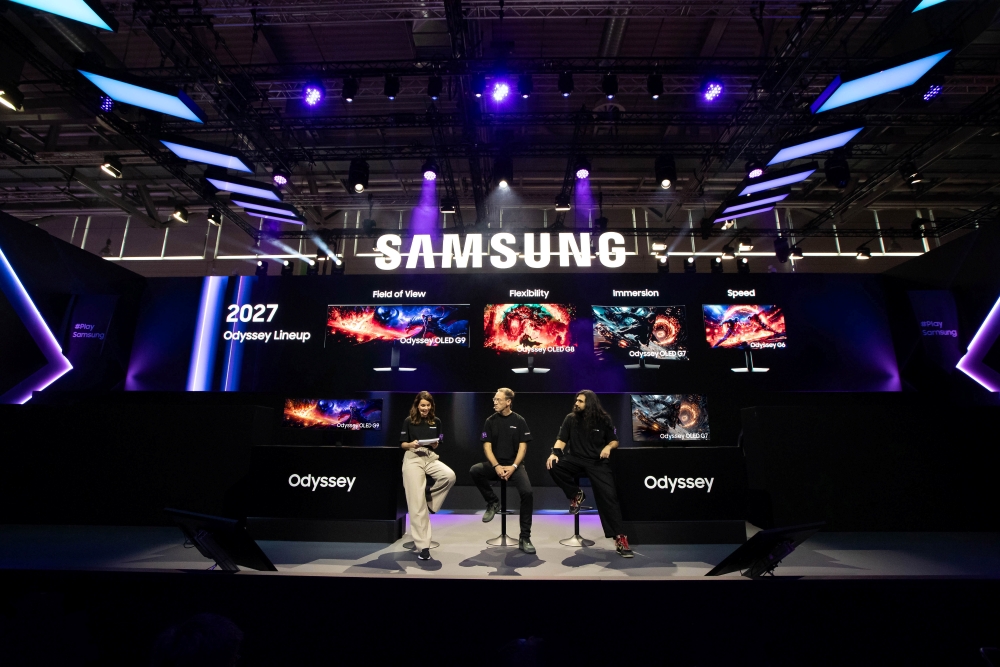
Samsung Electronics’ 2027 Odyssey OLED gaming monitor lineup unveiled at Gamescom 2026. Photo: Samsung Electronics, Gamescom 2026
OLED monitors are moving beyond a premium gaming niche to become a core demand segment for medium-sized IT OLED. According to the UBI Research OLED Display Market Tracker published in July 2026, combined OLED monitor panel shipments from Samsung Display and LG Display will rise from 5.17 million units in 2026 to 16.73 million units in 2030. Panel revenue is projected to increase from US$1.52 billion to US$4.68 billion over the same period.
The key point is that this is not simply new demand for OLED; it is replacement demand that displaces LCD. As OLED panels produced on Samsung and LG’s Gen 8.5 and Gen 8.6-class lines expand into the monitor market, the mature LCD monitor market will inevitably contract. Under a scenario in which the total monitor market remains at 140 million units annually, OLED penetration rises from 3.7% in 2026 to 12.0% in 2030.
| Key View | Quantitative and Business Implication |
|---|---|
| Market | Samsung and LG combined: 5.17M units in 2026 → 16.73M in 2030; CAGR about 34.1% |
| Penetration | Scenario assuming a stable 140M-unit monitor market: 3.7% in 2026 → 12.0% in 2030 |
| Product | 27- and 32-inch 4K and RGB-family pixel structures expand productivity and creator demand beyond gaming |
| Competition | Shift from a QD-OLED/WOLED duopoly to three technology platforms including IJP OLED |
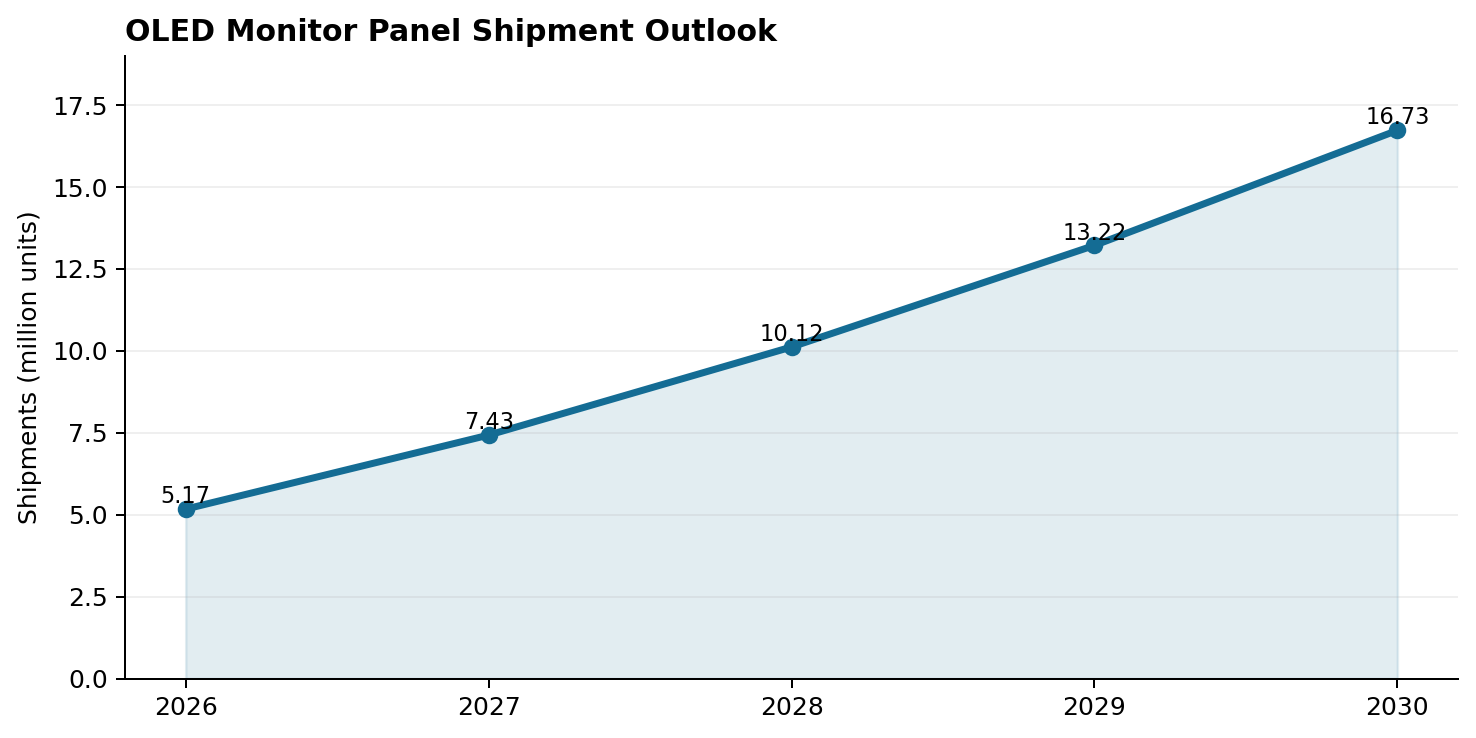
Figure 1. OLED monitor panel shipment forecast. Source: UBI Research OLED Display Market Tracker, published July 2026
Shipments are projected to increase 43.7% year on year to 7.43 million units in 2027 and reach 10.12 million units in 2028. This indicates that OLED monitors are entering a diffusion phase driven by a broader range of panel sizes and brands, rather than relying on a single hit product.
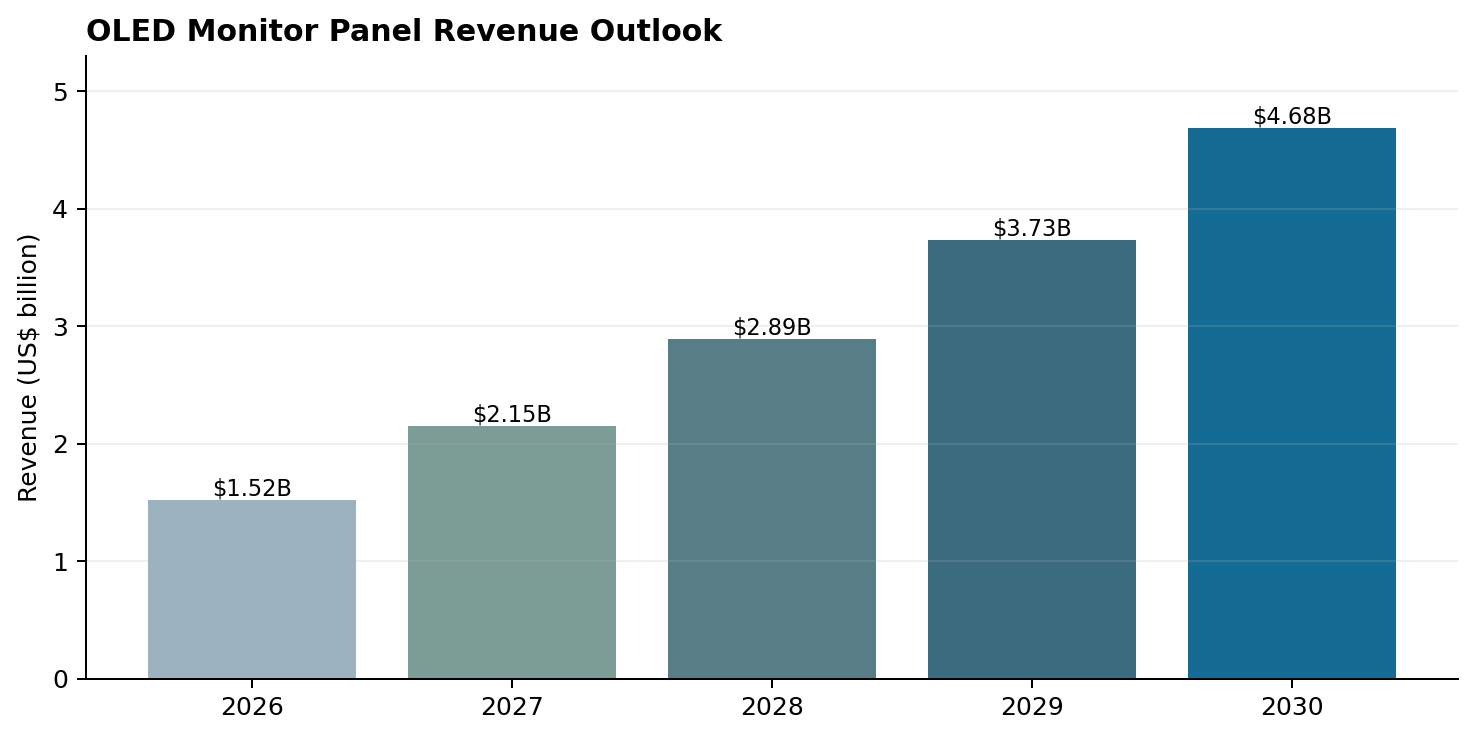
Figure 2. OLED monitor panel revenue forecast. Source: UBI Research OLED Display Market Tracker, published July 2026
While shipments increase 3.2-fold, revenue grows 3.1-fold. The similar pace of shipment and revenue growth reflects OLED monitors expanding beyond a limited range of high-priced products into broader size and price segments.
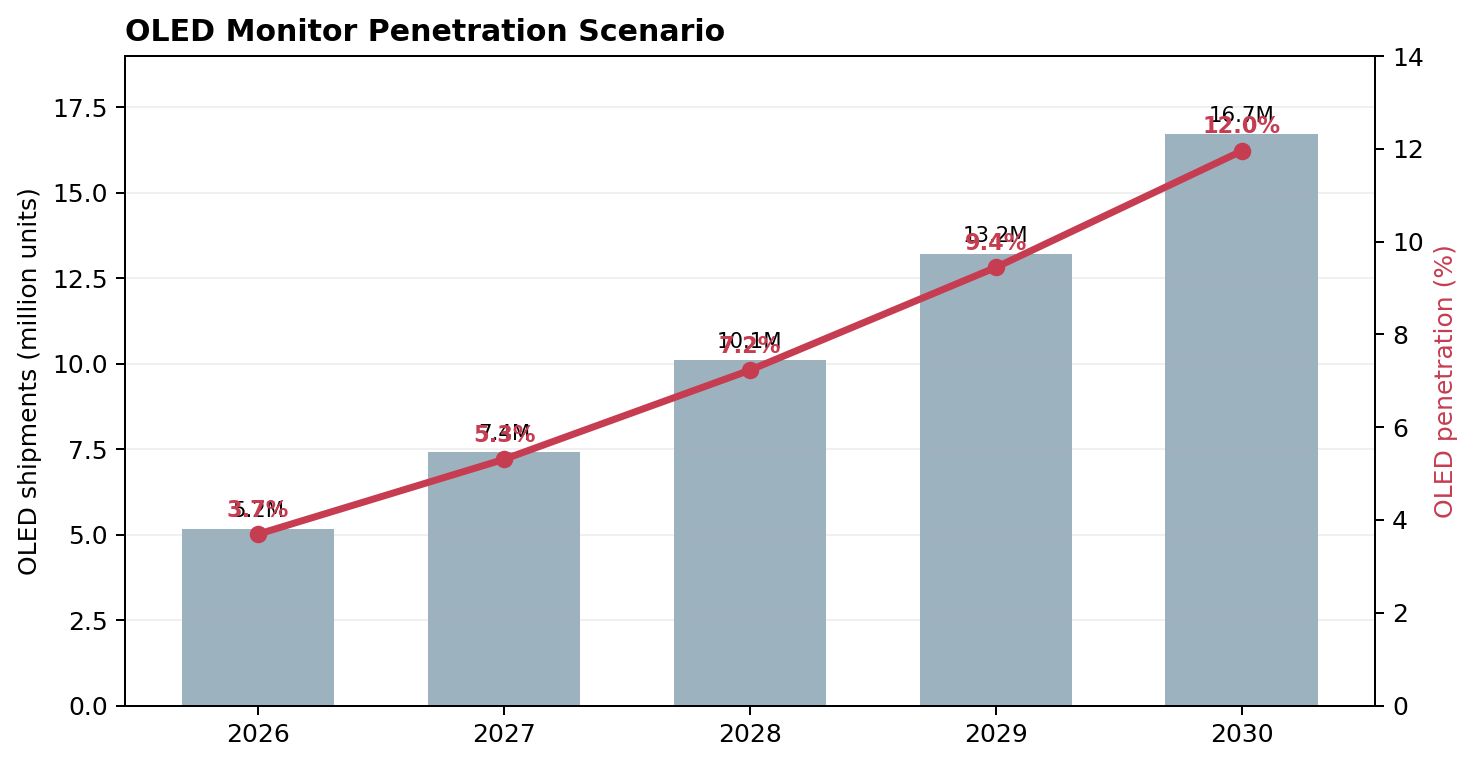
Figure 3. OLED monitor penetration scenario. OLED shipments: UBI Research OLED Display Market Tracker, published July 2026. Penetration: UBI Research analysis assuming a stable annual monitor market of 140 million units
A 12% penetration rate remains a minority of the overall market, but its impact is greater in the premium, gaming, and creator segments where replacement is concentrated. As OLED absorbs more of the upper price tiers, LCD monitors will become more concentrated in mid- and low-priced products and lose ground in the premium market.
Competition in OLED monitors is shifting from a race for peak specifications to one focused on expanding sizes, resolutions, and product ranges. As IJP OLED enters a market established by QD-OLED and WOLED, product strategies and the pace of customer expansion across the three technology platforms will shape the market structure.
| Technology | Current Strength | Key Constraint | 2027–2030 Priority |
|---|---|---|---|
| QD-OLED | Color gamut, high refresh rates, gaming brand base | Concentrated supplier and customer structure | Expand 27- and 32-inch 4K and diversify customers |
| WOLED | Large OLED mass-production experience and size portfolio | Balance TV-centered business with monitor expansion | Broaden products and shift the TV/monitor mix |
| IJP OLED | Real RGB, material efficiency, and Gen 8.6 potential | Initial yield and limited mass-production track record | Ramp the t8 line; validate qualification and uniformity |
Samsung Display has rapidly expanded the premium gaming monitor market on the strength of QD-OLED. The next step is to broaden the market by increasing the number of 27- and 32-inch 4K products and adopting brands, rather than repeatedly pushing only the highest refresh rates. For LG Display, OLED monitor expansion is a growth engine that diversifies its TV-centered large OLED portfolio. UBI Research forecasts LG Display’s monitor shipments to rise from 1.43 million units in 2026 to 6.99 million units in 2030.
TCL CSOT unveiled a 27-inch 4K 120 Hz IJP OLED, while MSI and Lenovo moved to adopt the product. This shows that IJP OLED is progressing from the prototype stage to customer implementation. Depending on actual shipments from 2027 and the mass-production ramp of the Gen 8.6 t8 line, the current QD-OLED and WOLED duopoly could develop into competition among three technology platforms.
OLED response time and contrast ratio are already recognized as differentiators in the gaming market. In the next growth phase, the priority is to broaden the product range around 27- and 32-inch 4K models and establish a supply structure that can compete with LCD and Mini-LED across a wider range of brands and price points.
| Purchase Criterion | Early Gaming Market | Expansion Market | Supplier Metrics |
|---|---|---|---|
| Resolution and Size | QHD, ultrawide, high refresh rate | Centered on 27- and 32-inch 4K | PPI, cutting efficiency, product yield |
| Image Quality | Response time, contrast, peak HDR | Resolution, color accuracy, full-screen luminance | Luminance by APL, color characteristics, uniformity |
| Product Range | High-priced gaming focus | Expand to productivity, creation, entertainment | Model count, size/resolution mix, adopting brands |
| Price | Early-adopter premium | Compared directly with LCD and Mini-LED | Panel ASP, set price, promotion intensity |
| Supply | Single-panel adoption possible | Multiple sourcing and long-term procurement | Customer qualification, lead time, supply share |
As more set brands and panel suppliers enter the market, consumers will gain more OLED monitor choices and prices can decline. For a market that began with high-priced gaming products to expand into productivity, creative work, and entertainment, its price coverage must broaden along with size and resolution options.
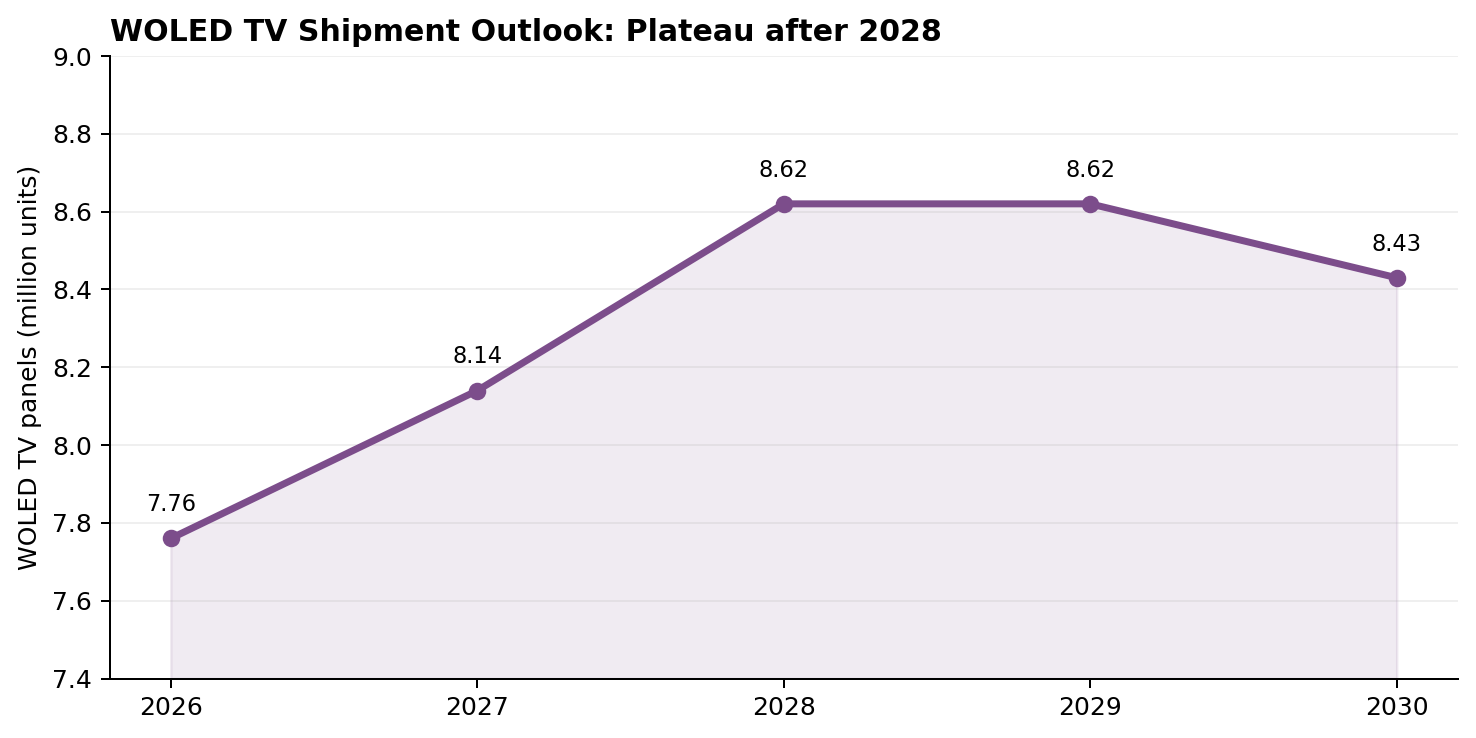
Figure 4. WOLED TV panel shipment forecast. Source: UBI Research OLED Display Market Tracker, published July 2026
UBI Research data show that WOLED TV panel shipments may rise from 7.76 million units in 2026 to 8.62 million units in 2028, remain flat in 2029, and then decline to 8.43 million units in 2030. This suggests that if OLED TVs cannot sufficiently narrow the price gap with LCD and Mini-LED, premium demand alone will not sustain growth. Monitors face the same risk. Even with a clear advantage in image quality, a persistent price premium could confine replacement demand to gaming and professional applications.
The OLED TV experience shows that product performance alone cannot sustain market expansion. The key to long-term growth for OLED monitors is whether they can narrow the price gap with LCD and Mini-LED and reach a broader consumer base.
The spread of OLED in smartphones resulted from the combined effects of premium-feature adoption, large-scale production, yield improvement, and component standardization, which narrowed the price gap. Monitors must create the same learning curve. The advantage of Gen 8.5 and Gen 8.6-class substrates is realized not merely through large-area production, but by optimizing layouts and cutting efficiency for target sizes to reduce unit panel cost.
| Cost Lever | Execution Priority | Key Metric |
|---|---|---|
| Substrate Productivity | Optimize MMG and cutting for 27-, 32-, and 34-inch combinations | Good panels per substrate, glass utilization |
| Yield and Cycle Time | Reduce high-PPI/high-refresh defects; automate inspection and compensation | Saleable yield, takt time |
| Materials and Components | Improve emissive-material utilization and shared driver/module designs | Material cost per area, common-component share |
| Fixed Cost | Stabilize utilization through the TV/monitor mix | Utilization, depreciation per panel |
| Quality Cost | Optimize inspection efficiency and outgoing quality control together | Defect, return, and field-failure rates |
Price reductions without cost reductions may expand the market but damage profitability. Conversely, if manufacturing costs fall sufficiently, OLED can displace LCD in the upper end of the monitor market and enter a virtuous cycle in which greater volume further improves yield and cost.
OLED monitors are the most promising growth engine for medium-sized OLED through 2030, and their growth is the other side of the contraction of the LCD monitor market. As Samsung and LG extend their Gen 8.5 and Gen 8.6-class production bases into monitors, premium LCD will lose ground rapidly. However, as the OLED TV experience shows, superior image quality alone cannot sustain market growth if prices do not fall.
If OLED monitors achieve price competitiveness, they can expand from the premium segment into a much broader share of the monitor market. The projected 12% penetration in 2030 is the starting point of that transition.
• UBI Research OLED Display Market Tracker, published July 2026: OLED monitor shipment and revenue forecasts and WOLED TV shipment forecast
• OLED monitor penetration is an analytical scenario assuming a stable annual monitor market of 140 million units; it is not a direct Market Tracker forecast
• UBI Research Global Display Intelligence 2026W36
• Public materials from TCL CSOT, MSI, and Lenovo, and IFA 2026 exhibition materials
• Cross-review of previous UBI Focus articles and medium- to long-term company analyses
The forecasts in this document represent UBI Research’s base-case scenario. Actual results may vary depending on demand, pricing, yield, customer qualification, and investment schedules. © 2026 UBI Research. All rights reserved.