
Mass-Production Readiness Advances, Set Adoption Still Under Validation
Publication of the “Perovskite Materials: Industry and Applied Technology Analysis Report”
September 28, 2026
By Dr. Chang-ho Noh, Senior Analyst
UBI Research has published the “Perovskite Materials: Industry and Applied Technology Analysis Report.” Starting from the structure, properties, and stability issues of perovskite materials, the report covers both major application areas—displays and solar cells—including Mini-LED color conversion, in-pixel color conversion (In-Pixel CC), self-emissive perovskite LEDs (PeLED), and perovskite/silicon tandem solar cells (PSTSC). It also examines process-level supply chains, patent and certification trends, and market forecasts through 2035 across six chapters and 139 pages. The report’s core message is that 2026–2030 marks the turning point at which perovskites move from ‘technical feasibility’ to ‘manufacturability and proven reliability.’ The application closest to commercialization is color conversion materials for displays. However, high-volume synthesis and roll-to-roll film processes have so far been secured only at the developer level, and adoption by set makers is still under validation. For self-emissive PeLEDs, the next hurdles are blue emission and lifetime; for solar cells, they are module efficiency, international certification, and long-term reliability.
As of 2026, perovskite materials stand at the threshold of the transition from ‘research materials’ to ‘product materials.’
① Among perovskite applications, the one closest to commercialization is color-conversion PeQD for Mini-LED LCDs. It requires only a material swap without changing the existing LCD structure, and with high-volume synthesis and roll-to-roll film processes, material-side mass-production readiness is taking shape. However, set makers decide on adoption only after validating long-term reliability, supply stability, cost relative to existing QDs, and regional Pb regulations. The timing of commercialization will be determined not by developers’ mass-production announcements but by set makers’ adoption.
② Self-emissive PeLEDs cannot become an alternative to OLED until they clear two hurdles: deep-blue efficiency and real-operation lifetime. For ultra-high-resolution patterning, validating manufacturability must come before resolution records.
③ Solar cells have passed the productization milestones of certification and commercial procurement. 2026–2028 is the early adoption phase, and a meaningful share of shipments will be secured after 2035. The final hurdle common to both fields is lead (Pb) regulation and recovery systems.
Table 1. Commercialization readiness by application
| Application | UBI Research assessment |
|---|---|
| Color-conversion PeQD (Mini-LED) |
Closest to commercialization. High-volume synthesis and R2R film processing secured at the developer level; set-maker adoption still under validation |
| Self-emissive PeLED | Green and red EQE reaching the ~30% level. Deep-blue efficiency (6.81%) and real-operation lifetime (T50 1–100 h) are the hurdles |
| Pe/Si tandem solar cell | IEC certification and first commercial procurement achieved. Early adoption in 2026–2028; 30% module efficiency and 25-year warranties remain challenges |
Perovskite (ABX₃) has a three-dimensional lattice consisting of a BX₆ octahedral framework and A-site cations. Simply changing the halogen (Cl/Br/I) composition tunes the bandgap across the entire visible range, and the material is compatible with both solution and vapor-deposition processes. Its core value lies in BT.2020-class color purity based on a narrow full width at half maximum (FWHM) of 20 nm or less for displays, and in tandem configurations that exploit its high absorption coefficient and tunable bandgap for solar cells.
However, the same tunability comes with fragile stability. The instabilities can be summarized as decomposition due to the hygroscopicity of organic cations, outgassing and phase transitions at high temperatures, and ion migration induced by light and electric fields. Of these, ion migration is a common cause of both PeLED lifetime degradation and solar-cell hysteresis and long-term degradation. Countermeasures fall into composition, crystal, and ligand stabilization; interface and charge-transport-layer design; reinforced barriers and encapsulation (TFE); and process optimization. In 2026, concrete solutions were reported, such as hierarchical-shell stabilization and encapsulant-based suppression of lead leakage (about 99%). UBI Research sees the stability problem shifting from an ‘intrinsic limitation of the material’ to an ‘engineering challenge managed through design.’ This is also why photoluminescent color conversion, which is not subjected to an electric field, is closer to commercialization than self-emission.
Table 2. Perovskite instability factors and countermeasure technologies
| Instability factor | Mechanism | Countermeasures | Key progress in 2026 |
|---|---|---|---|
| Moisture/oxygen | Decomposition due to hygroscopicity of organic cations | Cs/FA compositional substitution; barrier and TFE encapsulation | Encapsulant-based suppression of lead leakage (~99%) |
| Heat | Outgassing and phase transitions at high temperature | Inorganic composition; crystal/ligand stabilization | Hierarchical shell; T90 of 3,211 h at 60°C/90%RH |
| Light/electric field | Ion migration (hysteresis, lifetime degradation) | Interface and charge-transport-layer design; passivation | Continuous-operation T90 over 27,000 h (Science 2026) |
What has held back the commercialization of color-conversion PeQDs has been manufacturing technology rather than emission performance. Conventional hot-injection synthesis can achieve high PLQY in small batches, but quality degrades at scale, and the need for high-temperature, vacuum, and specialty-gas equipment imposed a heavy cost burden. In February 2026, Prof. Tae-Woo Lee’s group at Seoul National University presented a solution through low-temperature cold-injection synthesis. Even in a 20 L reactor, the process maintained a PLQY of about 100%—the same level as at laboratory (mL) scale—with an FWHM of about 20 nm, narrower than conventional QDs (about 30 nm). PeLEDs made with this material recorded an EQE of 29.6%. The team also fabricated prototype color-conversion films from the mass-synthesized nanocrystals and applied them to a tablet display, demonstrating their potential for display applications (Nature 2026).
SN Display, which participated in the joint research, manufactures color-conversion films using a UV-curable roll-to-roll process and at CES 2026 became the first company in the perovskite emitter field to receive an Innovation Award. The performance claimed by the company is Rec. 2020 coverage of 95% or more (vs. about 76% for conventional QDs) and proven reliability under high temperature and humidity. Disclosing a lineup of 10.2-, 32-, and 43-inch products and a track record of producing 100 m of film for a 75-inch TV prototype, the company stated that it has entered the mass-production stage. In China, Zhijing Nanotech (致晶科技) partnered with TCL in 2021 to pilot-produce and sell 500 units of a 75-inch LCD TV using perovskite QD film. However, neither company has disclosed volume shipments or the scale of adoption by set makers. Mass-production readiness at the developer and adoption by set makers are separate stages. Before a set maker decides to adopt, long-term reliability data under real-use conditions, multiple sources of supply, and cost competitiveness against existing CdSe and InP QD films must first be confirmed.
Market demand conditions are favorable. UBI Research forecasts that QD-LCD TVs will grow from about 20 million units in 2025 to 27 million in 2030, and Mini-LED TVs from 10 million to 17 million, with Mini-LED TVs overtaking OLED TVs (about 11 million units) in shipments by 2030. The share of premium Mini-LED TVs using QD materials will exceed 85%.
Twelve years after the first report of room-temperature electroluminescence in 2014, PeLED EQE has reached 30.9% for green (Nature 2026, an AM display based on pixelated QD superlattices) and 26.8% for red. Green and red efficiencies have improved significantly, but blue remains the problem. Sky-blue (487 nm) has climbed to 25.4%, but deep-blue meeting the BT.2020 color coordinate (CIE-y 0.046) remains at 6.81%. UBI Research judges that the point at which deep-blue efficiency and stability are secured will be the point at which self-emissive PeLEDs are commercialized.
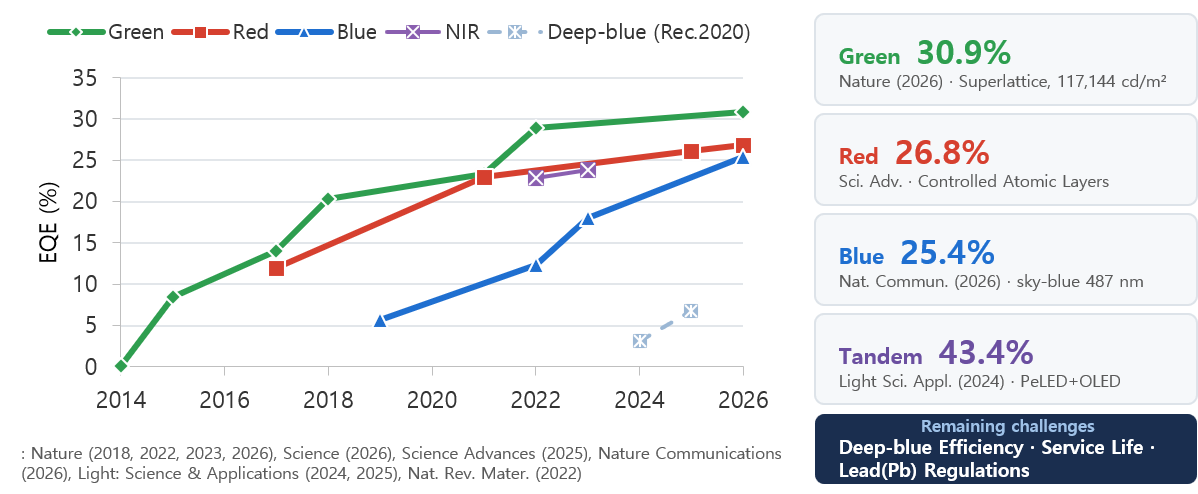
Figure 1. Efficiency progress of self-emissive PeLEDs. Source: UBI Research
Lifetime is an even larger gap. A continuous-operation T90 of more than 27,000 h has been achieved by simultaneously locking the lattice and surface of nanocrystals with a hierarchical shell (Science 2026), but the T50 of high-efficiency visible PeLEDs remains at the 1–100 h level—two or more orders of magnitude below the requirement for commercial OLEDs (10,000 h or more). By contrast, a PeLED+OLED tandem structure recorded an EQE of 43.42% and a T50 of 42,080 h at 100 nits, showing that hybrid structures may approach commercial requirements first. Because lifetime varies by three to four orders of magnitude depending on color, driving luminance, and measurement method, reported values should be compared only after checking measurement conditions.
Patterning to form RGB pixels is the next hurdle. At SID 2026, 3,000 PPI via SiNx shadow-mask co-evaporation, 5,080 PPI (64% aperture ratio) via photolithography-based PbX₂ patterning, and RGB over 10,000 PPI via a combination of nanostencil and MBHL were reported, and RGB pixels of 9,072–25,400 PPI were realized with a transfer yield above 99.9% using nanoimprint and reverse-transfer printing (Nature 2026). Pixel-formation technologies divide into inkjet (simple process but limited resolution), EHD printing (potential for fine patterns), photolithography (advantageous above 1,000 PPI but requires protection against film damage), and mask evaporation (solvent-free process), with their application areas split by required resolution. Resolution records are already sufficient. Success in mass production will hinge on overlay accuracy, throughput, AM backplane integration, mask lifetime, and defect density, and the higher the resolution, the more film-protection technology determines the outcome.
Single-junction perovskite solar cell (PSC) efficiency rose from 3.8% in 2009 to 27.3% in 2025 (NREL-certified). In two-terminal perovskite/silicon tandems, LONGi (隆基) announced 35.5% (ESTI-certified) in July 2026, surpassing the single-junction Shockley–Queisser limit (33.7%). The main path to industrialization is the tandem, which builds on the existing silicon ecosystem, and the p-i-n structure has become mainstream. What will change the landscape is not the cell but the module. Trina Solar (天合光能) has reported 29.2% for a 907 W module and Oxford PV 26.9% for a 60-cell commercial module, but 26.9% is effectively on par with the best mass-produced silicon modules (about 26.5%). For tandems to justify a price premium, module efficiency must reach the 30% range. According to NREL analysis, the cost of a 2T structure falls from $0.364/W at 25% efficiency to $0.303/W at 30%.
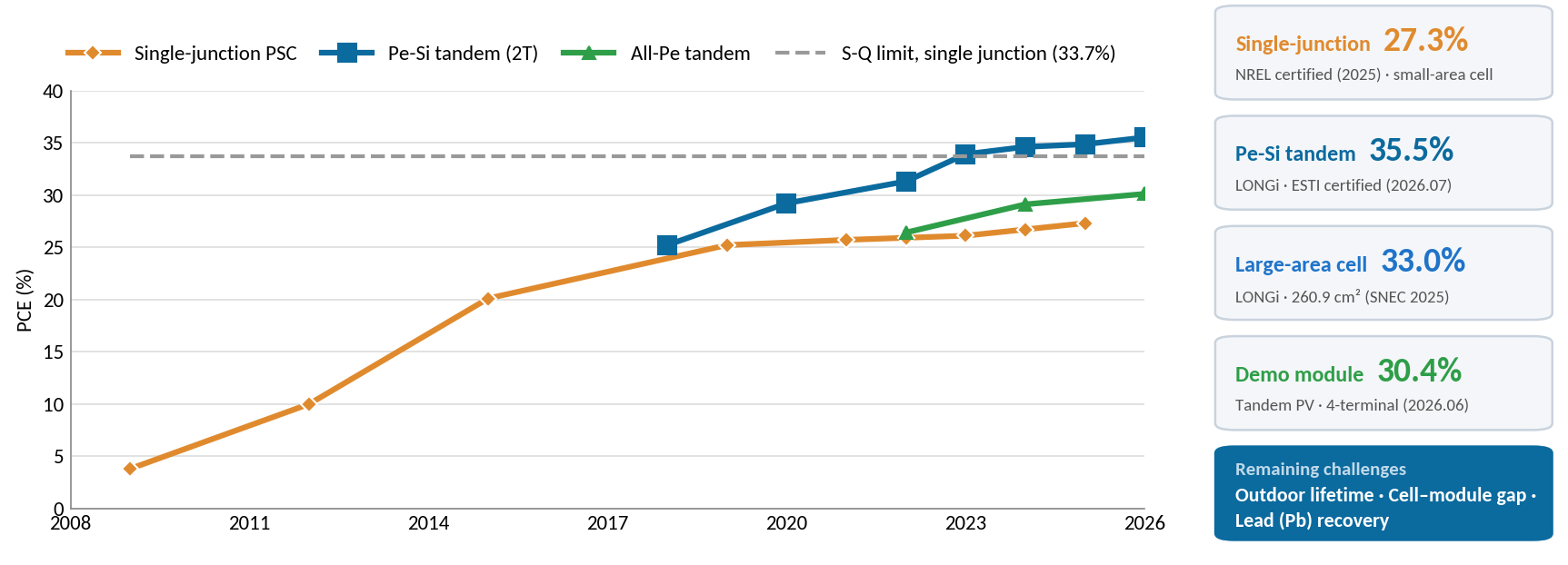
Figure 2. Efficiency progress of perovskite/silicon tandem solar cells. Source: UBI Research
The substantive change in 2026 is certification and procurement. Hanwha Qcells obtained IEC and UL 61215 certification for its tandem technology with cells and modules fabricated solely on mass-production processes, and GCL (协鑫) passed IEC 61215/61730 and 10,000-hour reliability testing. China Huaneng (中国华能)’s 1.2 MW commercial procurement required mass-production efficiency of 25% or higher, IEC certification, production capacity of 100 MW or more, and a 25-year performance warranty, and GCL was selected as the sole winning bidder. UBI Research regards this as a turning point in the industrialization of perovskite solar cells. However, current IEC standards were designed for crystalline silicon and cannot capture ion migration or halide phase segregation, and no dedicated accelerated-testing standard for tandems exists yet. The supply chain runs from coating and deposition through laser scribing (P1–P3), lamination, TFE/barrier, inline inspection, and IV measurement. VON ARDENNE, SINGULUS, and ULVAC in PVD/TCO; Jusung Engineering, SoLayTec, and Levitech in ALD; and FOM Technologies, Coatema, and Sono-Tek in slot-die are forming the equipment supply chain, and the maturity of the module-level equipment stack is a prerequisite for commercialization. In China, Liande Equipment (联得装备) is validating GW-scale coating, VCD, and HP equipment on customer pilot lines, but this should be distinguished from mass-production orders.
Table 3. Tandem commercialization status of major companies (as of September 2026)
| Company | Key achievements | Commercialization stage & timeline |
|---|---|---|
| LONGi | 2T tandem cell 35.5% (ESTI); large-area cell 33.0% (260.9 cm²) | Mass-production schedule not disclosed |
| Oxford PV | 60-cell commercial module 26.9%; commercial line in Brandenburg | Commercial shipments; licensed to Trina Solar and First Solar |
| Hanwha Qcells | IEC and UL 61215 certification for tandem technology | Demonstration linked to a national R&D project; commercialization targeted for 2029 |
| GCL | IEC 61215/61730; 10,000 h reliability testing; sole winner of 1.2 MW procurement | 500 MW line in operation; first-year shipment target of 50–70 MW |
Lead risk during the use phase has approached a level manageable through encapsulation. A fluorosilicone polymer gel encapsulant suppressed lead leakage by 99% in simulated rainfall tests, but in one reported case the lead concentration in the soil beneath a module with broken encapsulation rose to 70 ppm. Encapsulation integrity effectively determines environmental risk. Recycling infrastructure for end-of-life modules has not been scaled up, and tin- and bismuth-based lead-free materials, limited by oxidation and wide bandgaps, do not offer a near-term substitution path. Color-conversion films use small amounts of material and are encapsulated inside the panel, so their regulatory burden is lighter than that of solar cells, but the scope of RoHS application remains a variable that determines regional adoption speed. In the solar cell market, single-junction silicon led by TOPCon will remain mainstream (50–65%) through 2030, while tandems will begin initial penetration around 2027 in markets with area constraints and high efficiency requirements, growing their revenue contribution ahead of their shipment share on the strength of higher unit prices. UBI Research forecasts that tandems’ share of cell technology will reach 1–5% in 2030 and 5–15% in 2035, with revenue of US$2.16 billion in 2030 and US$8.4 billion in 2035, becoming the next growth axis for high-efficiency solar cells after 2035.
In displays, color-conversion PeQDs for Mini-LED are closest to commercialization. The material-side conditions for mass production—high-volume synthesis and roll-to-roll film processing—are falling into place in 2026. However, a developer’s announcement of mass production does not equal adoption by set makers. The points to watch over the next one to two years are whether large TV and monitor set makers officially adopt the technology and launch mass-production models, and durability data against light and heat under real-use conditions. Applications will then expand to in-pixel color conversion (In-Pixel CC) for microLED and XR microdisplays, followed by self-emissive applications; the entry timing of self-emissive PeLEDs will be determined by deep-blue efficiency and lifetime and by the manufacturability of patterning.
In solar cells, the criteria for judgment over the next three years are commercial module efficiency entering the 30% range, GW-scale capacity secured around 2028, track-record-based 25-year performance warranties, and the institutionalization of closed-loop lead recovery. The most important leading indicator is whether TOPCon-compatible tandems are certified at 32% or higher, and mid-2027 is likely to be the turning point.
The implications for the Korean industry are clear. Color-conversion PeQD is a rare field in which Korean researchers and companies lead in material synthesis and film processing. The key is how quickly this advantage can be converted into set-maker adoption and a supply track record. In solar cells, Hanwha Qcells has secured a lead in certification but will be the first to face price pressure created by Chinese companies’ earlier mass production.
This report analyzes the perovskite industry not through efficiency records but through a framework linking material properties, process technology, reliability, supply chains, and market outlook. Organized into material technology and industrial base, display technology and industry trends, solar cell technology and industry trends, and future technology development directions and industry outlook, it presents development roadmaps through 2033 for each application—displays, solar cells, and detectors. Grounded in the latest publications, including SID 2026, Nature, and Science, it will serve as a practical basis for strategy development by display and PV manufacturers, materials and equipment companies, investors, and policy institutions.