
Written by: Dr. Chang-ho Noh
1. Overview: AR Glasses Market Expansion and a Shifting Display Landscape
The AR glasses market is growing faster than expected. Shipments are projected to more than double in 2026, from about 600,000 units in 2025 to around 1.3 million, and strong growth is likely to continue in 2027. Early in the year, many expected 2026 shipments to fall short of one million units, but forecasts kept rising as component orders for Meta Ray-Ban Display increased repeatedly after launch. Glasses with built-in displays have entered the stage of proving real demand.
As shipments grow, the supply chain is asking which display will capture this volume. In 2026, OLEDoS and LEDoS are expected to account for about 80% of the market combined, with OLEDoS slightly ahead. OLEDoS is strong in video-viewing glasses, while LEDoS leads in lightweight information-display glasses. LCoS, which takes the remaining 20% or so, roughly matches Meta’s share of the AR glasses market (about 20%). In effect, the LCoS share depends on sales of a single product, Meta Ray-Ban Display, and this picture could change significantly depending on what Meta chooses for its next product.
This report outlines the characteristics of the three technologies and their adoption by application, then analyzes the challenges and switching conditions for each. It goes on to examine the information-display glasses market, which has emerged as a new competitive arena, and the outlook for each technology through 2030, and closes with implications for the Korean display industry.
2. Comparison of Microdisplay Technologies
2.1 Classification
Microdisplays for XR fall into two groups depending on whether they emit their own light: non-emissive types such as LCoS, DLP, and LBS, and self-emissive types such as OLEDoS and LEDoS (Figure 1). DLP and LBS are niche in AR glasses because of their complex optics and limits in resolution or FoV, so the real competition is among three technologies: OLEDoS, LEDoS, and LCoS.
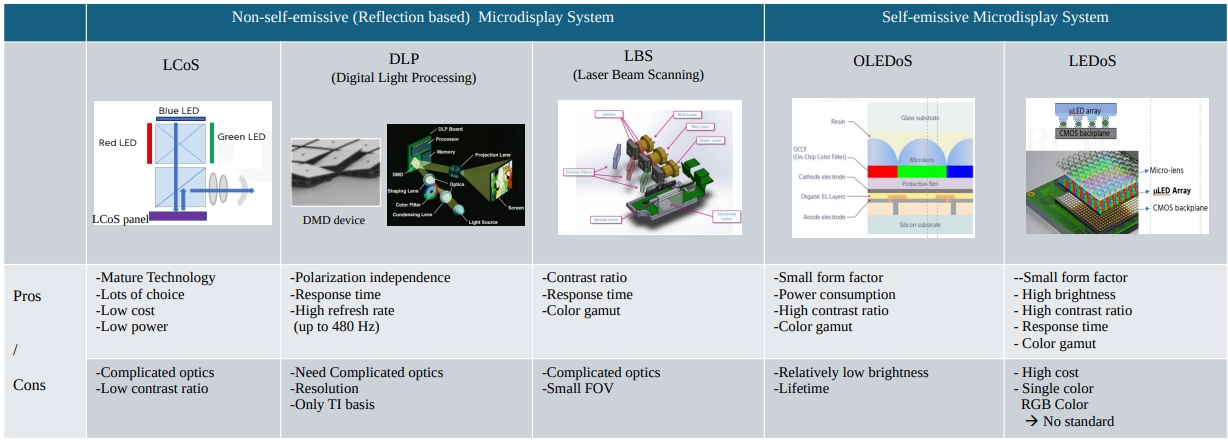
Figure 1. Microdisplay technologies for XR: reflective vs. self-emissive
All three technologies build pixels on a CMOS silicon backplane, but they differ in emission mechanism and cost structure (Table 1). OLEDoS is a self-emissive device with deposited organic emitting layers; its strengths are contrast and full-color image quality, and its weakness is the trade-off between luminance and lifetime. LEDoS is a self-emissive device bonded with inorganic GaN and AlGaInP LEDs; panel luminance reaches millions of nits, but full color and red efficiency remain challenges. LCoS reflects and modulates light from an external source; its process is the most mature and its panels are inexpensive, but polarization loss and the bulk of the illumination optics come with it.
Table 1. Key Characteristics of OLEDoS, LEDoS and LCoS
| Item | OLEDoS | LEDoS | LCoS |
| Emission | Self-emissive, organic | Self-emissive, inorganic | Reflective modulation, external light source |
| Best disclosed density | 6,020 ppi @0.9″ (BOE) | 10,160 ppi @2.5 μm (JBD) | 3.0 μm, 1,632×1,536 (OMNIVISION) |
| Peak luminance (panel) | 40,000 nit (Samsung Display RGB 1.3″) | 2,000,000 nit (JBD Phoenix) | 350,000 nit (Himax·AUO front-lit) |
| Weak point | Blue material lifetime, few-μm RGB patterning | Red efficiency, full-color cost | Polarization loss, power floor at low APL |
| Shipping in | MR headsets, viewer glasses | Mono AI glasses, 3-panel full color | Meta Ray-Ban Display |
Source: company announcements, compiled by UBI Research. Luminance values are panel-level figures disclosed by each company under different test conditions.
2.2 Caveats in Comparing Performance
Comparing performance figures requires normalizing for panel size. Among disclosed examples, panel area differs by about 100 times and pixel area by about 9 times (Figure 2). Luminance is a per-area value and can be compared directly, but power and luminous flux scale with area, so they must be compared per unit area or per lumen delivered to the eye. The luminance figures companies disclose are also measured at different points, whether the panel, the light engine, or the eye, so the same “nit” can mean values hundreds of times apart. At the panel level, all three technologies already exceed the luminance and resolution that AR glasses require. Real competitiveness is decided by the luminance that reaches the eye through the optics, the power needed to get there, and cost.
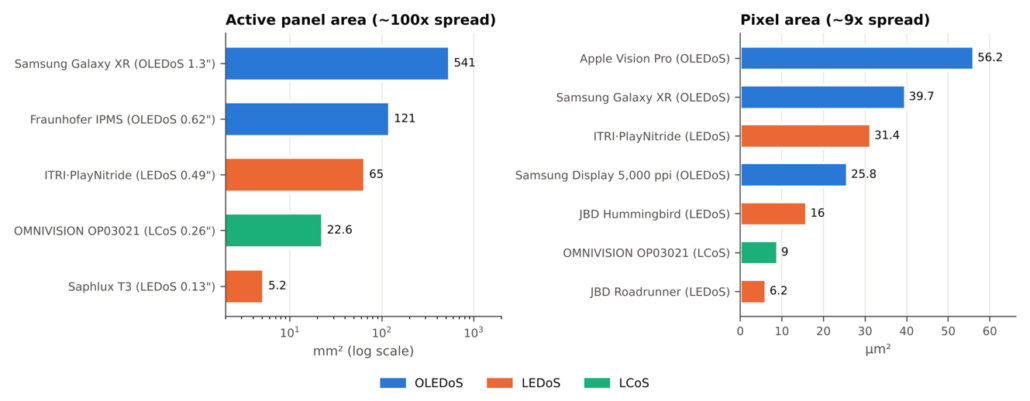
Figure 2. Panel Area and Pixel Area of Disclosed Microdisplays / Source: company announcements, compiled by UBI Research.
3. Technology Adoption by Application
3.1 Technologies by Device Type
The choice of technology is made together with the optical architecture (Table 2). MR headsets with pancake lenses use panels of 1 inch or larger, birdbath viewer glasses use panels of about 0.5 inch, and waveguide AI glasses use panels of 0.3 inch or smaller. Meta shows this division most clearly. It uses LCoS in the shipping Ray-Ban Display, Micro LED in the Orion technology prototype, and OLEDoS in the VR Glasses announced in 2026. Rather than replacing one another, the three technologies divide roles by application and timing.
Table 2. Display Technology by XR Device Segment
| Segment | Optics | Panel size | Main technology (2026) | Direction to 2030 |
| MR / VR headset | Pancake, VST | > 1.0″ | OLEDoS (LCD for cost-oriented) | OLEDoS stays; higher luminance via RGB direct patterning |
| Viewer glasses | Birdbath | ~0.5″ | OLEDoS | OLEDoS stays; price competition intensifies |
| Info-type AI glasses | Waveguide | < 0.3″ | LCoS, mono LEDoS | Mono-green OLEDoS vs. LEDoS; two-color LEDoS |
| Full-color AR glasses | Waveguide | < 0.3″ | 3-panel LEDoS | Single-panel LEDoS (QDCC, etc.) as candidate |
Source: UBI Research analysis based on public announcements.
3.2 Key Suppliers by Technology
The supply side also looks different for each technology (Table 3). In OLEDoS, leading Japanese and Korean companies compete with Chinese makers backed by 12-inch lines. In LEDoS, Chinese companies lead mass production, while Japanese, Taiwanese, and European companies pursue full color with different architectures. In LCoS, a small number of US, Taiwanese, and Korean companies supply panels. Korea has a presence in each field through Samsung Display in OLEDoS, RAONTECH in LCoS, and Sapien Semiconductors in LEDoS driver ICs, but with LG Display putting its OLEDoS business on hold, the mass-production base is concentrated in Samsung Display.
Table 3. Key Microdisplay Suppliers and Status in 2026
| Technology | Region | Key suppliers | 2026 status |
| OLEDoS
|
Japan / Korea | Sony, Samsung Display(eMagin) | Sony is main supplier for MR and viewers; Samsung Display is second source for Galaxy XR and pursuing RGB direct-patterning investment |
| China | SeeYA, BOE, SIDTEK, BCDTEK, Homways, Rayvision | Race to light up and expand 12-inch lines; SeeYA listed (Mar 2026) | |
| LEDoS | China | JBD, Hongshi, Raysolve, VJIO, QiuShui | JBD leads mono mass production; new entrants start lines (QiuShui 8-inch, Oct 2026) |
| Japan / Taiwan / Europe | Sony, PlayNitride, Porotech, MICLEDI | Developing single-panel full color via Cu-Cu bonding, QDCC, monolithic, etc. | |
| LCoS | US / Taiwan / Korea | OMNIVISION, Himax, RAONTECH | Supplying Meta Ray-Ban Display; 3 μm pixels, front-lit illumination |
Source: company announcements, compiled by UBI Research.
- Challenges and Switching Conditions by Technology
4.1 OLEDoS: Capacity Expansion and RGB Direct Patterning
The first factor reshaping the OLEDoS market is China’s 12-inch capacity. China’s 12-inch OLEDoS capacity is expected to grow from about 20,000 wafers per month at three companies (SeeYA, BOE, SIDTEK) in 2025 to more than 50,000 wafers per month at seven or more companies by 2027. Assuming 50% yield, that is enough to supply 10 million MR headsets and more than 300 million AI glasses a year, far ahead of demand forecasts. Although 12-inch process yields are still reported to be below 30%, pressure for price cuts from oversupply is bound to grow. The leader, SeeYA (视涯科技), listed on the Shanghai STAR Market in March 2026; its first-half revenue rose 288% year on year, and overseas revenue exceeded domestic revenue for the first time. BCDTEK (芯视佳) lit its first panel on a 12-inch line in December 2025, and Homways (宏禧科技) targeted first light in October 2026.
The second factor is the color architecture. In the current mainstream white OLED with color filter (W+CF) approach, the filters absorb about two-thirds of the emitted light. When pixel pitch falls below 4 μm, a lower aperture ratio and higher current density combine, making color filter removal a prerequisite not only for luminance but also for high PPI. Samsung Display leads in RGB direct patterning. Building on silicon mask technology gained through its acquisition of eMagin, it unveiled a 5,000 ppi 1.4-inch panel and a 20,000 nit 1.3-inch panel at K-Display 2025, and a 40,000 nit-class 1.3-inch panel at AWE 2026. According to the industry, an investment of about KRW 300 billion in 12-inch RGB OLEDoS mass production has passed internal review, with mass production targeted for 2028.
The third factor is blue materials. Blue is still fluorescent, so it sets the luminance and lifetime ceiling of the whole stack. The timing of blue phosphorescent or hyperfluorescent materials will determine when OLEDoS can enter high-luminance AR.
4.2 LEDoS: A Stepwise Transition from Monochrome to Full Color
Most LEDoS shipments today are monochrome, and for full color the three-panel approach, which combines three single-color panels, is effectively the only mass-production path. Candidates for single-panel full color are QD color conversion (QDCC), monolithic RGB, and bonding-based vertical stacking, and presenters at CIOE 2026 expected volume production only after 2029–2030. Two-color red and green fills the gap. According to the industry, the LEDoS supply chain is developing two-color solutions rather than moving straight to full color. Information-display UIs can express most content with red for warnings, green for information, and the yellow tones produced by mixing the two. Blue has the highest emission efficiency, but the eye is less sensitive to it, so it contributes little to luminance and has limited impact on text legibility. Dropping blue for a two-color design therefore reduces the burden of three-color combination while securing the color expression needed. QDCC, the closest candidate for single-panel full color, still has development issues. Reliability targets presented in a QD color conversion talk are tens of hours at a blue flux of 2.5–7.5 W/cm² for MR, and more than 100 hours above 25 W/cm² for AR. The best cited example, Mojo Vision’s red QD (2.3 μm subpixels), reached an LT90 of about 500 hours at 10 W/cm², approaching MR conditions but still far from AR conditions. On the supply side, JBD (上海显耀显示) leads monochrome mass production, while Hongshi (鸿石智能), Raysolve, VJIO, and QiuShui (秋水半导体) are catching up fast. QiuShui plans to start up an 8-inch line in October 2026 using a damage-free structure without etch damage and hybrid bonding (about 1,000 wafers per month at full capacity).
4.3 LCoS: From Near-Term Mainstay to Entry-Level and Specialty Uses
With the launch of Meta Ray-Ban Display (600×600, 5,000 nit, FoV 20°), LCoS was adopted in the mass consumer market for the first time. However, because its illumination must always be on, it is at a power disadvantage with low-APL content such as notifications and captions, where most of the screen is black. The industry generally views LCoS as a transitional solution until LEDoS cost and ecosystem mature, and Meta has also built partnerships with Micro LED-related suppliers such as Plessey, JBD, and Sapien Semiconductors. Even so, LCoS will hold its position in areas self-emissive panels cannot replace, such as phase-modulation SLMs, and in entry-level glasses that lower power through front-lighting and local dimming of the light source.
Assessment: The gateways are capacity and cost for OLEDoS, colorization and reliability for LEDoS, and low-APL power for LCoS. Because these gateways open at different times, the competitive landscape will not change all at once but will be reshaped step by step by application.
5. Competition in Information-Display AR Glasses
The most notable recent change in the market is that the OLEDoS camp is considering a mono-green configuration to enter the information-display segment. Green is the color with the best efficiency and lifetime in OLED. No color filter is needed, and the burden of compensating for the lifetime limits of blue materials and for color-dependent waveguide efficiency also disappears. SeeYA already offers 20,000 nit-class mono-green versions across its 0.4–1.03-inch lineup, Guozhao (国兆光电) has a 12,000 nit mono-green 0.6-inch product, and BCDTEK has a 0.96-inch mono-green product. For Chinese OLEDoS makers facing oversupply, information-display glasses are an attractive new source of demand.
In the mono-green market, long the territory of LEDoS, the two technologies now compete under the same conditions for the first time. The criteria that decide competitiveness are shown in Table 4. LEDoS leads in luminance headroom and low-APL power, while OLEDoS leads in its mature production base and cost. Notification- and caption-centered UIs have a low APL of roughly 10% or less, the range where LEDoS’s power advantage stands out. OLEDoS, on the other hand, has a wide emission angle and therefore low waveguide in-coupling efficiency, so a collimation structure that gathers light into a parallel beam to narrow the emission angle, or microlenses, is a prerequisite.
Table 4. Mono-Green OLEDoS vs. LEDoS for Information-Type AR Glasses
| Criterion | Mono-green OLEDoS | Mono-green LEDoS |
| Panel luminance headroom | ~20,000 nit class | ~2,000,000 nit class (green) |
| Waveguide coupling | Wide emission angle; collimation structure needed | OCL and narrow emission angle readily achieved |
| Power at low APL | Self-emissive, good | Self-emissive, most favorable |
| Supply base and cost | 12″ overcapacity; room for cost reduction | Epi and bonding yields drive cost |
| Path to color | RGB direct patterning (2028~) | Two-color → 3-panel → single panel |
Source: company announcements; UBI Research analysis.
6. Outlook by Technology to 2030
UBI Research expects the competitive landscape to change in three stages through 2030 (Table 5). Through 2026, differentiation by application will become entrenched. OLEDoS will be used in MR headsets and viewer glasses, while LCoS and monochrome LEDoS will share information-display glasses. 2027–2029 will be a period of realignment in which competition in the mono-green segment, price competition from Chinese OLEDoS, and validation of RGB direct patterning in mass production overlap. After 2030, the mainstream technology for AR glasses will be decided by whether single-panel full-color LEDoS achieves manufacturability.
Table 5. Outlook by Technology and Switching Triggers, 2025–2032
| Period | OLEDoS | LEDoS | LCoS | Trigger to watch |
| 2025–2026 | Mainstay in MR and viewers; Chinese 12″ lines lit and expanding | Mono in volume; 3-panel full color shipping | ~20% from a single Meta product | Shipments of ~1.3M units; Meta sales |
| 2027–2029 | Enters info-type via mono green; price competition; RGB direct patterning in volume | Two-color spreads; shift to W2W/D2W2W; QDCC starts in MR | Moves to entry-level | Meta’s next-product display; SDC volume production in 2028 |
| 2030–2032 | High-quality video AR and MR | AR mainstream if single-panel full color is secured | SLMs and niche products | Red efficiency; QD reliability at 25 W/cm² |
Source: CIOE 2026 presentations, company announcements; UBI Research outlook.
The biggest uncertainty in this outlook is Meta’s choice. If Meta’s next display glasses switch to LEDoS, the LCoS share will shrink quickly and LEDoS could take the lead in share. Conversely, if Chinese mono-green OLEDoS products solve both cost and waveguide coupling efficiency, a scenario in which OLEDoS secures volume in both video-type and information-display glasses is also possible.
7. Implications and Key Indicators to Monitor
First, the basis for comparing performance must change. Panel luminance is already high enough, and real competitiveness is decided by the luminance reaching the eye through the waveguide and the system power at that point. Fair comparison requires the industry to adopt, as common practice, measurement points that distinguish the panel, the light engine, and the eye, along with stated APL and duty conditions.
Second, the Korean industry is racing against time. Samsung Display’s RGB direct-patterning OLEDoS is an asset that sets it apart from China’s volume competition in WOLED+CF, but the mono-green information-display market is opening earlier, and China’s 12-inch capacity and LEDoS supply chain are likely to capture it first. Another burden is that Korea’s supply base is thin apart from LCoS (RAONTECH) and LEDoS driving (Sapien Semiconductors).
Third, the industry should look for opportunities in areas where demand arises regardless of technology. Blue phosphorescent and hyperfluorescent materials, 12-inch deposition and encapsulation equipment, and microdisplay inspection and metrology are needed no matter which technology takes the lead. Indicators to monitor going forward are listed in Table 6.
Table 6. Key Indicators to Monitor
| Indicator | Why it matters | Next checkpoint |
| Panel type of Meta’s next display glasses | Decides the fate of the ~20% LCoS share | Next product launch |
| Chinese 12″ OLEDoS wafer starts and yield | Pace of price declines and capacity to enter mono green | Whether capacity reaches 50K wafers/month in 2027 |
| Design wins for mono-green OLEDoS | Confirms OLEDoS entry into info-type market | Specs of new AI glasses |
| Volume shipments of two-color LEDoS | Validates LEDoS path to color | Mass-production announcements by Chinese makers |
| QD reliability (blue ≥ 25 W/cm²) | Condition for QDCC to enter AR | Conference papers (SID 2027, etc.) |
| Execution of Samsung Display RGB OLEDoS investment | Timing of Korea’s differentiation | Equipment orders (expected Q4 2026) |
Source: UBI Research.