
1. Overview: What AURA, the First Android XR Glasses, Tells Us
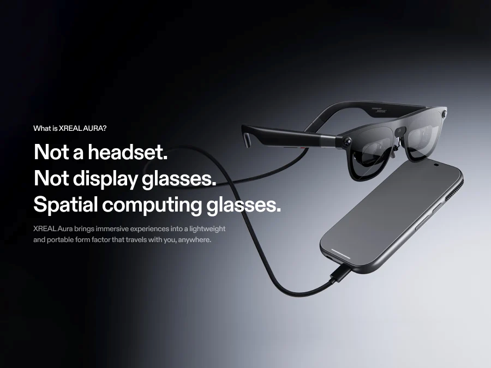
Figure 1. XREAL AURA: Optical See-through Glasses with Tethered Compute Puck
Source: XREAL.
On October 28 (local time), Google and XREAL (太若科技) officially launched XREAL AURA, the first wired XR glasses running Android XR. Orders opened the same day in the United States, Canada and Korea, with Japan following on November 2; first shipments are due in mid-November. The 12GB/256GB model is priced at $1,279 and the 16GB/512GB model at $1,499, with introductory prices of $1,099 and $1,299 respectively through the end of the year. At launch, more than 150 made-for-XR apps are available alongside Google Play apps. With Korea among the first-wave markets, Korean consumers can now buy Android XR glasses directly for the first time.
Each eye is driven by a Sony micro OLED (OLEDoS) panel with 1,920×1,200 resolution at up to 120Hz (Table 1). The optical see-through (OST) design delivers a 70° field of view, the widest of any OST product XREAL has released and 13° wider than the 57° of its predecessor, the One Pro. The Qualcomm Snapdragon Reality Elite handling compute and the battery sit in a puck connected by cable, leaving only XREAL’s X1S coprocessor for low-latency image processing in the frame and bringing the glasses under 95g (Figure 1). AURA is the first commercial product to ship with the Snapdragon Reality Elite. The lenses use electrochromic dimming, so users can darken their surroundings when focusing on content. Peak brightness has been reported at 1,050 nit, but whether this is measured at the panel or at the eye has not been disclosed.
Table 1. XREAL AURA Key Specifications
| Item | XREAL AURA |
| Launch | Oct 28, 2026 (orders: US, Canada, Korea; Japan from Nov 2); shipping from mid-Nov |
| Price | $1,279 (12GB/256GB), $1,499 (16GB/512GB); launch price $1,099 / $1,299 through Dec 2026 |
| Display | Sony Micro-OLED (OLEDoS), 1,920 × 1,200 per eye, up to 120 Hz |
| Brightness | 1,050 nit (reported; measurement point not disclosed) |
| Optics | Optical see-through, 70° FoV (widest in XREAL lineup), electrochromic dimming |
| Weight | < 95 g (glasses only; compute puck excluded) |
| Compute | Puck: Snapdragon Reality Elite (first device) + battery; glasses: XREAL X1S coprocessor |
| Platform | Android XR, Gemini; 150+ made-for-XR apps at launch |
Source: Google and XREAL announcements (Oct 2026); press reports. Brightness figure is as reported.
AURA shows clearly where OLEDoS stands in AR glasses today. Optical see-through designs that do not use waveguides are far more efficient than diffractive waveguides, so current OLEDoS brightness is enough to support a wide field of view and use both indoors and outdoors. The trade-off is that the bulk of the optics keeps the glasses in the 90g range, well above the 50g often cited as the threshold for all-day wear. Getting below 50g requires waveguides, whose optical efficiency is around 1%, and at that point the demands on the display change completely. Taking AURA as a starting point, this report examines the luminance that optical efficiency demands of the display and the fit of each display technology to each optical path, and then reviews the competition among the three waveguide approaches, the next battleground.
2. Optics Sets the Ceiling on Luminance
2.1 Efficiency Varies by an Order of Magnitude Across Optical Paths
The share of light that travels from the panel to the eye differs widely by optical approach. Birdbath optics used in media viewer glasses deliver 25–30%, pancake lenses in VR and MR headsets 10–20%, and geometric reflective waveguides about 10–12%. Diffractive waveguides, by contrast, deliver only 0.4–4%. The same panel can therefore produce eye luminance that differs by more than an order of magnitude depending on the optical path it feeds.
2.2 Luminance Required by Ambient Light
In see-through AR, virtual images are legible only when they are sufficiently brighter than the background. The eye luminance needed for text legibility is about 40 nit in an indoor office, about 320 nit outdoors on an overcast day and about 3,200 nit in direct sunlight, a gap of roughly 80 times between indoor and direct sunlight. Dividing these targets by optical efficiency gives the panel luminance each optical path requires (Figure 2). Pancake MR and Birdbath need 1,300–1,400 nit and geometric reflective waveguides about 4,200 nit, levels current OLEDoS can deliver. Diffractive waveguides need about 12,200 nit even with an optimized design, and about 36,600 nit outdoors in daylight.
Table 2. Eye-Luminance Budget by Ambient Light (Weber Contrast 0.5)
| Condition | Scene luminance | T = 1.00 | T = 0.85 (clear WG) | T = 0.35 (dimmed) |
| Indoor office | 80 nit | 40 nit | 34 nit | 14 nit |
| Overcast outdoor | 637 nit | 318 nit | 271 nit | 111 nit |
| Direct sunlight | 6,366 nit | 3,183 nit | 2,706 nit | 1,114 nit |
Source: UBI Research model. T is see-through transmittance; scene luminance values are model assumptions.
As the table shows, lowering the see-through transmittance of the lens reduces the required luminance proportionally. Raising panel luminance is constrained by heat and lifetime, whereas darkening the background has no effect on panel lifetime. This is why Meta Ray-Ban Display uses photochromic lenses and Snap Specs uses electrochromic lenses. XREAL AURA, launched in October, also uses electrochromic dimming.
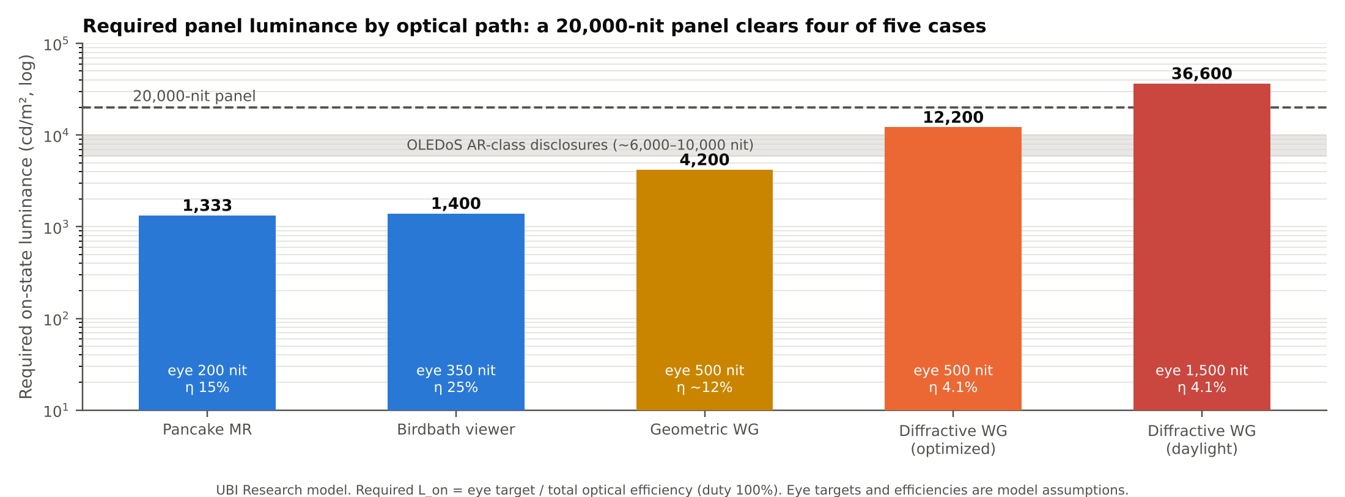
Figure 2. Required Panel Luminance by Optical Path
Source: UBI Research model. Required on-state luminance = eye target / total optical efficiency (duty 100%).
Figure 2 also shows where AURA sits. Optical see-through glasses without waveguides and Birdbath viewers can cope with overcast outdoor conditions at panel luminance in the 1,000-nit range, within what mass-produced OLEDoS delivers today. Diffractive waveguides, by contrast, require a panel about nine times brighter even with an optimized design. Waveguide design directions for narrowing this gap are discussed in Chapter 4.
3. The Optical Path Chooses the Display Technology
Differences in optical efficiency translate directly into differences in which display technologies fit. The lighter the device on the face, the less efficient the optics it must use, and for glasses under 50 g that can be worn all day, diffractive waveguides are the only option left. In this segment, LEDoS, with its ample luminance headroom, and LCoS, which matches easily with light engines, have the advantage. By architecture, OLEDoS’s position falls into three zones: secure, contested and exposed (Table 3).
Table 3. OLEDoS Position by XR Architecture
| XR architecture | Optical efficiency | OLEDoS position | Competing technology | Deciding factor |
| Passthrough MR (pancake) | 10–20% | Secure: no real substitute | LCD (declining adoption) | Contrast, pixel density |
| Birdbath viewer glasses | 25–30% | Secure: current standard | LCoS (cost) | Single-panel full color, cost |
| Geometric reflective WG | ~10–12% | Contested: conditional | LCoS, LEDoS | Cost, color architecture |
| Diffractive WG see-through | 0.4–4% | Exposed: structurally disadvantaged | LEDoS, LCoS | Optical loss, daylight contrast |
Source: UBI Research analysis.
OLEDoS holds a firm position in passthrough MR and viewer glasses. These closed optical systems do not have to compete with sunlight, and high pixel density and true black are what decide competitiveness. The same reason explains why AURA, which emphasizes a wide field of view and immersive viewing, chose Sony OLEDoS. Geometric reflective waveguides can physically accommodate OLEDoS, but as Meta Ray-Ban Display, the flagship product on this path, chose LCoS, cost and color architecture decide the outcome. With diffractive waveguides, OLEDoS cannot cope under a baseline design and can enter only through conditional paths that combine a monochrome green configuration, a restrained FoV and dimming. This is also why the OLEDoS camp is considering monochrome green products for information-display glasses.
4. The Next Battleground: Competition Among Three Waveguide Approaches
4.1 The Challenge After AURA: Sub-50 g Glasses and Waveguides
AURA gains a wide field of view and high optical efficiency at the cost of nearly 95g of weight and bulky optics. Moving to everyday glasses under 50g requires replacing the optics with a thin plate of around 1 mm, and today only waveguides can play that role. Notably, the field of view the waveguide industry has set as a post-2028 target is 70°, the same as AURA’s (Section 4.4).
The low efficiency of waveguides stems from physics, not immature processes. A waveguide replicates a small input pupil across a wide eyebox so the image stays visible as the eye moves, and spreading light over a wider area inevitably lowers luminance. Thinner plates mean smaller input pupils: reducing plate thickness from 1.0 mm to 0.3 mm requires a panel about 11 times brighter for the same brightness. Full color in a single plate requires a high-index substrate with a refractive index of 1.8 or higher, and self-emissive panels emit light over wide angles, losing a substantial share outside the narrow acceptance angle of the light engine.
Simply raising panel luminance is not the answer. Designing diffractive waveguide glasses around the 20,000 nit OLEDoS the industry has set as its target, a conventional design using three low-index waveguide layers and low-persistence driving yields only 20 nit at the eye. By contrast, combining a single-layer waveguide with a refractive index of 1.9, continuous (DC) driving, a narrow eyebox and a 25° FoV raises it to 824 nit. The same panel produces a 42-fold difference, all of it coming from waveguide structure, driving scheme and system specifications. Adding electrochromic dimming to darken the lens brings text legibility even in direct sunlight within reach.
4.2 Classification by How Light Is Folded
Waveguides fall into three approaches according to the element that folds the light: geometric reflective waveguides (GWG), which reflect light with an array of partially reflective mirrors inside the substrate; surface relief grating waveguides (SRG), which diffract light with nano-gratings on the surface; and volume holographic waveguides (VHG), which record volume gratings inside a photosensitive film. The in-coupling method (grating or prism) and substrate material (high-index glass, lightweight resin, silicon carbide) are combined differently in each approach. The three share the same basic structure, but because of how they fold light they differ markedly in efficiency, color quality, light leakage, thickness and cost (Table 4).
Table 4. GWG vs. SRG vs. VHG: Key Characteristics
| Item | GWG (geometric reflective) | SRG (surface relief grating) | VHG / PVG (volume holographic) |
| Light folding | Array of partially reflective mirrors | Diffraction by surface nano-gratings | Diffraction by volume Bragg gratings |
| Color dispersion | Negligible | High (rainbow, color non-uniformity) | Moderate (mitigated by Bragg selectivity) |
| Efficiency | High | Low to moderate | Moderate (strong in mono, drops in full color) |
| Front leakage | Low | High (privacy concern) | Low |
| Thickness / weight | Thick; sub-1 mm in development | Thinnest (0.5–0.8 mm per layer) | Thin (0.6–0.8 mm) |
| Maturity | Entering volume production | Most mature; widely mass-produced | Early production |
| Key vendors | Lumus, SCHOTT, Quanta, Raypaitech | GreatAR, Goeroptics, SEEV, Snap | DigiLens, Nikahood, Crystal-Optech |
Source: company presentations at CIOE 2026 and public disclosures; UBI Research analysis.
4.3 Strengths and Challenges by Approach
Because reflection is nearly independent of wavelength, GWG can deliver full color in a single plate with little light leakage. Its adoption in Meta Ray-Ban Display made it the first approach validated in consumer display AI glasses. The challenge is the cost and thickness of a process that stacks glass plates, slices them at an angle and polishes them. Designer Lumus expanded its production base with a license agreement with Quanta in September 2026, following SCHOTT, and China’s Raypaitech (理湃光晶) is operating a new plant with capacity of more than one million sets per year.
SRG can use semiconductor processes and nanoimprinting, making it the most favorable for volume production and thin form factors, and it has the longest mass-production track record. However, because the diffraction angle varies with wavelength, it suffers from rainbow artifacts and color non-uniformity, and light leaking outward makes the image visible from the outside. Chinese companies are broadening their lineups from monochrome green to full color, and from nanoimprinting to etching and silicon carbide (SiC) substrates. Yet as GreatAR (至格科技) has noted, with monthly capacity of 100,000 units against shipments of around 20,000, the current bottleneck is demand and customer qualification rather than capacity.
Because VHG diffracts only light at specific angles and wavelengths, it shows less rainbow effect and leakage, and its gratings are hard to see, making it well suited to everyday glasses where appearance matters. Nikahood (尼卡光学) has released a 0.6 mm, 3.1 g monochrome green product. However, full-color efficiency is about half that of monochrome green, and the environmental reliability of photosensitive films is still being validated.
4.4 The Unit of Competition Is the Light Engine and Waveguide Together
Waveguide efficiency is not determined by the waveguide alone. The size, angle and polarization of the light leaving the light engine must match the waveguide’s input. LCoS, whose illumination optics can be designed, makes this matching easy, while Micro LED and OLEDoS, which emit light over wide angles, must narrow their emission angle through on-pixel microlenses or chief ray angle (CRA) design. This is why a growing number of suppliers, such as Goeroptics (歌尔光学) and Crystal-Optech (水晶光电), bundle the display, light engine and waveguide. Crystal-Optech projects the 2030 waveguide share by technology at about 50% SRG, 31% GWG and 19% VHG. Rather than one approach replacing the others, GWG is likely to serve high-quality full-color information display, SRG the cost-sensitive mass market and VHG lightweight designs where appearance matters.
Lightweighting is also moving fast. Goeroptics has set a post-2028 target of a waveguide weighing 3 g and under 0.5 mm thick at a 70° FoV. Judged on weight and thickness alone, the lightweight waveguides shown at CIOE 2026 are close to this target (Figure 3). Nikahood’s monochrome green VHG measures 0.6 mm and 3.1 g, and SEEV’s (广纳四维) full-color SiC SRG is under 0.6 mm and under 3 g. However, all disclosed products are specified at a 25–30° FoV and cannot be compared directly with the 70° target. A wider FoV needs thicker plates or more layers, so achieving the same weight and thickness at 70° will require SiC-class high-index substrates.
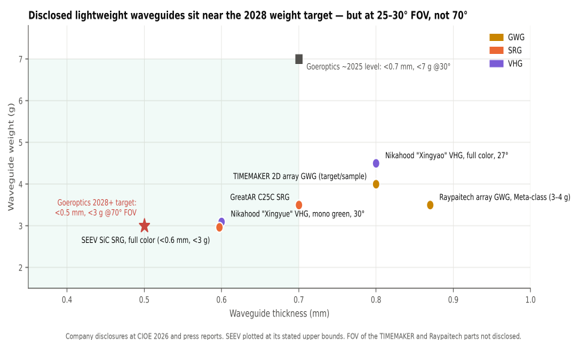
Figure 3. Disclosed Lightweight Waveguides vs. the 2028 Target Source: company disclosures at CIOE 2026 and press reports
The supply chain is split between Western companies focused on design and materials (Lumus, SCHOTT, DigiLens and others) and Chinese IDMs rapidly expanding capacity (Raypaitech, GreatAR, Goeroptics, SEEV, Nikahood and others). Apart from LetinAR with its pin-mirror approach, Korea’s waveguide supply base is thin.
5. Implications
The unit of competition in AR glasses displays is shifting from the panel to the system. Optical efficiency ranges from 0.4% to 30% depending on the optical path, and even with the same panel, eye luminance can differ 42-fold depending on design. In the waveguide industry, too, companies that design light engines and waveguides together are gaining an edge. Display suppliers need to propose system design points that include optics and driving, not just panel specifications, and should adopt the practice of stating the measurement point, APL, duty, FoV and eyebox when disclosing specifications.
Which product categories use which optical paths, and how large those categories grow, will determine volumes by technology more than which display technology wins. As everyday glasses under 50 g grow, the share of diffractive waveguides, LEDoS and LCoS will rise, while passthrough MR, media-viewing optical see-through glasses such as AURA, and monochrome green information displays will remain OLEDoS territory.
Assessment: Korean companies face three tasks. First, OLEDoS makers should address optical losses with low-APL luminance and lifetime data and panel structures that narrow the emission angle, rather than peak luminance figures, and build a portfolio that captures both monochrome green information-display demand and VR and MR demand. Second, since real demand for display-equipped glasses is currently concentrated in Chinese brands, they need to secure either partnerships with Chinese brands or entry into big-tech products in 2027 to build volume experience. Third, although Korea’s waveguide supply base is thin, high-index glass and SiC substrates, nanoimprint materials, dimming devices, and waveguide inspection and metrology equipment are areas that materials and equipment companies can enter. Indicators to watch include AURA’s early sales and its pricing after the introductory offer ends, the launch timing and pricing of big-tech display glasses in 2027, mass production of waveguides with a refractive index of 1.8 or higher, the launch of products using two-color LEDoS, and whether OLEDoS monochrome green products are adopted.