Logo of Xian Smart Materials, a key supplier of TFE ink for BOE, Visionox, and CSOT.

Xian Smart Materials, TFE Ink ‘BOE, Visionox’ 공급 확대…CSOT도 100% 점유 확보

Xian Smart Materials 공식 로고 (출처: Xian Smart Materials)

Xian Smart Materials 공식 로고 (출처: Xian Smart Materials)

중국 디스플레이 소재 업체 Xian Smart Material(시안 스마트 머티리얼, 思摩威)이 TFE(Thin Film Encapsulation) 잉크를 중심으로 주요 패널 업체향 공급 비중을 빠르게 확대하고 있다. 회사는 2017년 설립 이후 TFE Ink, 저온 Over Coat(OC), 유기 절연막, 바인더 등을 개발·생산해 왔으며, 신규 공장 건설을 위해 3.5억 위안 규모의 투자를 진행한 것으로 파악된다.

핵심 제품인 TFE 잉크는 BOE B12 라인 물량의 약 70%를 공급하고 있으며, BOE B7 라인에는 파일럿 생산을 진행 중인 것으로 알려졌다. 또한 Visionox V2·V3 라인에는 100% 물량을 공급하고 있고, TCL CSOT향 물량 역시 2025년 12월을 기점으로 100% 점유를 확보한 것으로 추정된다. 패널 업체별로 봉지 공정의 안정성과 공급망 최적화 요구가 커지는 가운데, 시안 스마트 머티리얼이 라인 단위에서 실질적인 공급 우위를 강화하고 있다는 점이 특징이다.

한편, 저온 OC(Over Coat) 분야에서도 고객 저변을 확대하는 단계에 있다. BOE B7과 Tianma를 대상으로 평가가 진행 중이며, 저온 구동 환경에서의 신뢰성 확보가 중요한 제품군에서 적용 가능성을 높이고 있다. 저온 OC는 공정 윈도우와 신뢰성 조건이 까다로운 영역인 만큼, 향후 평가 결과에 따라 채택 범위와 공급 규모가 결정될 전망이다.

실적 측면에서는 2025년 매출액이 약 1.1억 위안으로 예상된다. 생산능력 확대 투자와 주요 고객사향 점유율 상승이 맞물리면서, 단기적으로는 TFE 잉크 중심의 출하 확대, 중기적으로는 저온 OC 및 유기 절연막·바인더 등 포트폴리오 확장이 성장 동력으로 작용할 가능성이 크다.

기타 중국 디스플레이 SCM 관련 정보는 유비리서치의 중국 동향 보고서에서 확인할 수 있다.

유비리서치 김준호 애널리스트(alertriot@ubiresearch.com)

▶ 중국 동향 보고서 문의하기

※ 본 콘텐츠는 유비리서치넷(UBIResearchNet)에서 제작한 기사입니다.
무단 복제 및 출처 없는 인용을 금합니다.
인용 시 반드시 출처(UBIResearchNet)와 링크를 명시해 주세요.

[2022년 하반기 OLED 결산 세미나] Merck, 2.5 이하 저유전율 TFE용 유기 재료 샘플 개발 완료

스마트폰용 flexible OLED의 터치는 크게 add-on 방식과 on-cell 방식으로 나뉜다. Add-on은 필름 상부에 터치 전극이 형성되고, OCA를 통해 터치 필름이 봉지층 상부에 점착되는 방식이다. On-cell은 봉지층 상부에 바로 터치 전극이 형성되는 방식이며, 삼성전자의 ‘Galaxy’ 시리즈와 Apple의 ‘iPhone’ 시리즈에 적용되는 주류 기술이다.

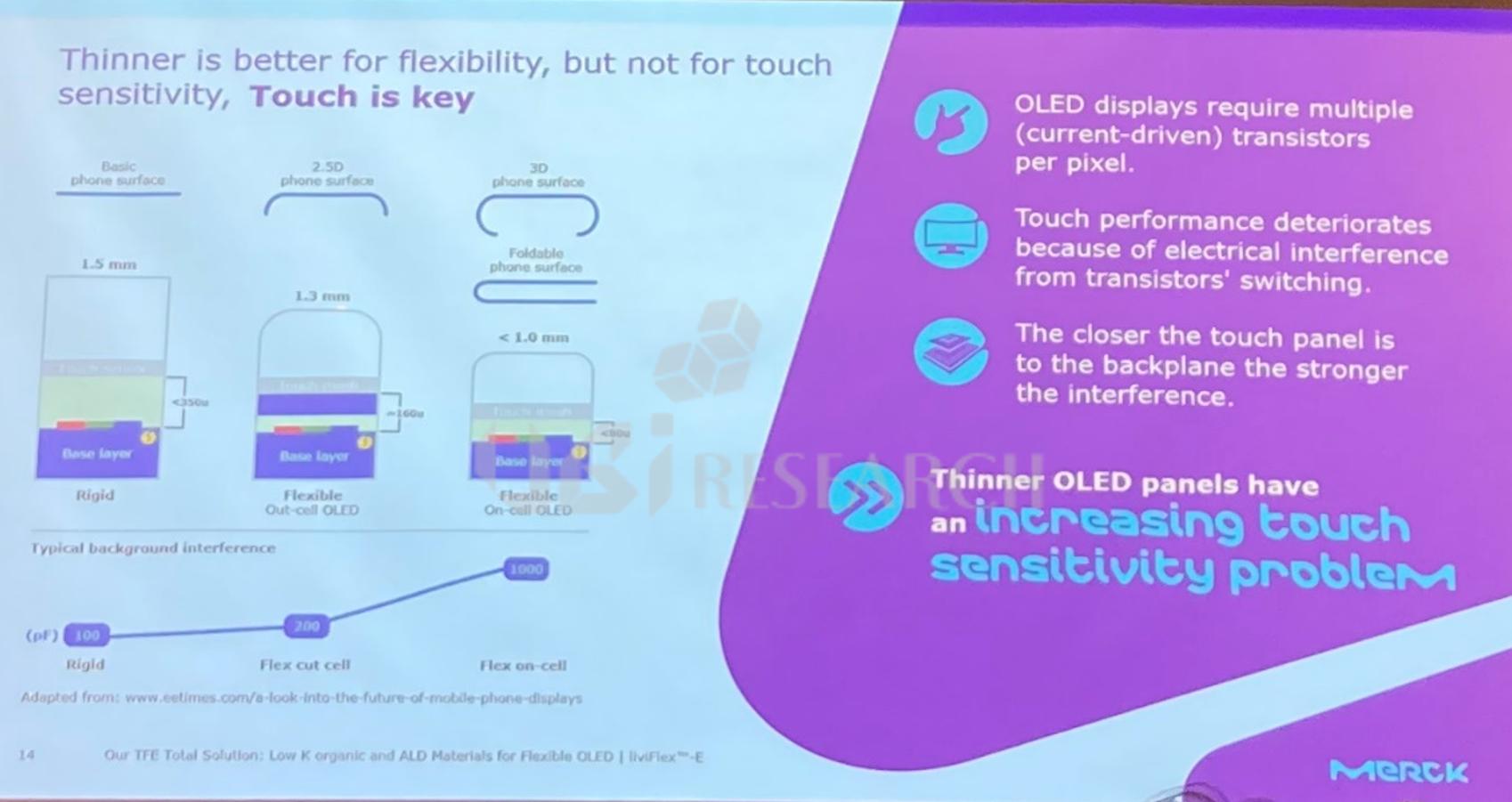
On-cell 방식은 필름과 OCA를 사용하지 않고 직접 전극을 형성하기 때문에 재료비 절감의 효과가 있는 반면, 필름과 OCA의 부재로 터치 전극과 TFT와의 거리가 짧아져 signal-to-noise(SNR)이 증가한다는 이슈가 있다.

Merck, TFE용 저유전율 유기 재료 (2022 하반기 OLED 결산세미나)

Merck, TFE용 저유전율 유기 재료 (2022 하반기 OLED 결산세미나)

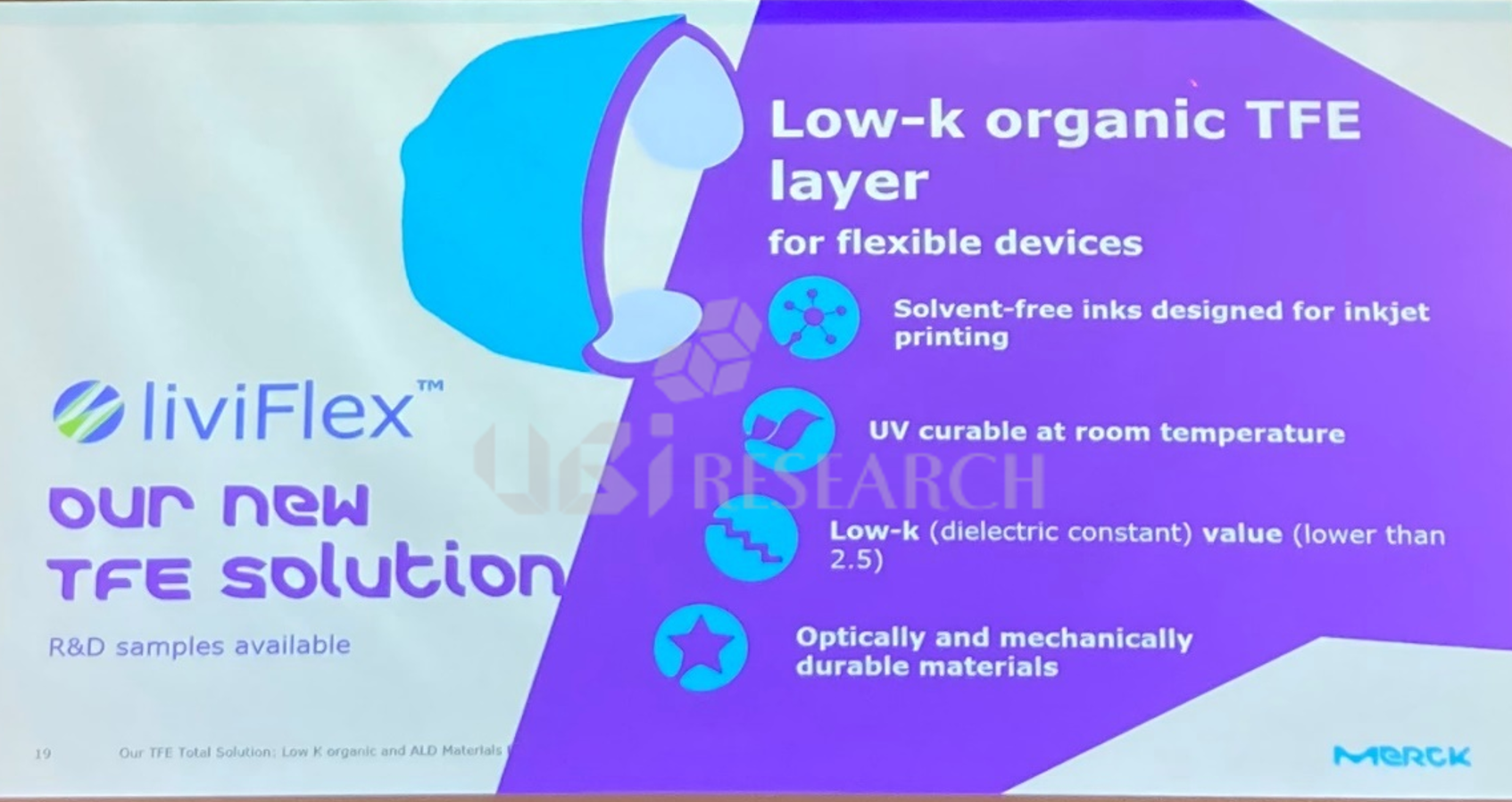
2022년 11월 9일에 여의도 전경련 회관에서 열린 유비리서치의 ‘2022년 하반기 OLED 결산 세미나’에서 Merck는 SNR을 줄이기 위한 TFE용 저유전율 유기 재료를 개발하고 있다고 밝히며, 현재 상용화 중인 TFE용 유기 재료의 3.1 유전율 값을 2.5 이하까지 낮추는 개발을 진행하고 있다고 발표했다.

Merck는 결국 TFT로부터의 노이즈를 차단하는 것은 TFE에서 가장 두꺼운 두께를 차지하는 유기물의 몫이라고 언급하며, N2 환경에서 사용 가능한 샘플 재료를 개발 완료했다고 밝혔다.

마지막으로 Merck는 유기물의 유전율이 낮아진다는 것은 막 밀도가 낮아져 신뢰성에 영향이 갈 수 있지만, Lab 환경에서는 신뢰성이 확보됐다고 판단하고 있고, 패널 업체와의 협력을 통해 양산에서의 신뢰성을 확보하겠다고 말하며 TFE용 유기 재료에 대한 발표를 마쳤다.

Merck, TFE용 저유전율 유기 재료 (2022 하반기 OLED 결산세미나)

Merck, TFE용 저유전율 유기 재료 (2022 하반기 OLED 결산세미나)

▶ 2022 OLED 발광재료 보고서 Sample 보러가기 

AUO, Touch Taiwan 2017에서 스마트워치용 원형 OLED와 foldable OLED 전시

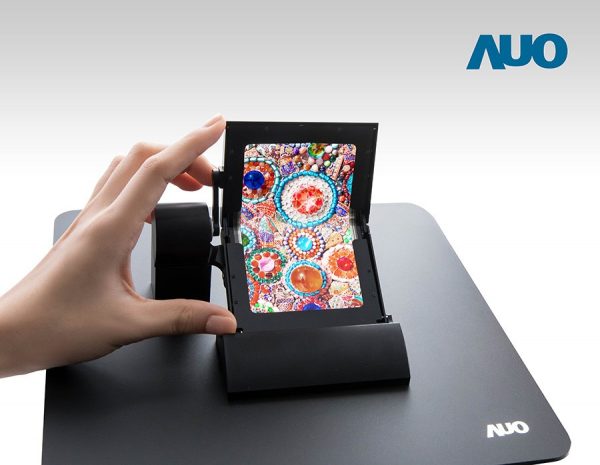
AUO는 20일 개최된 Touch Taiwan 2017에서 스마트워치용 원형 OLED 3종(1.2 inch, 1.3 inch, 1.4 inch)과 접을 수 있는 OLED를 공개하였다.

AUO의 1.2 inch와 1.4 inch 원형 OLED는 326ppi를 가지며, 기존 양산제품 대비 소비전력을 30%나 줄였다. 또한, AUO는 원형 OLED 2종이 밝은 태양광 아래에서도 디스플레이 화면이 정확하게 보일 수 있도록, 밝기조절모드(brightness increase mode)를 내장하여 야외시인성을 향상시켰다.

어린이용 스마트워치를 타겟으로 한 1.3 inch OLED는 가볍고, 절전모드와 직관적인 터치 인터페이스를 탑재하여 사용성을 강화시켰다.

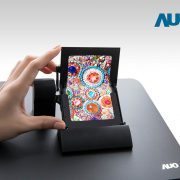
AUO는 접거나 돌돌 말 수 있는 2가지 형태의 5 inch foldable OLED를 전시했다. 5 inch foldable OLED 2종에는 plastic기판과 자체 개발한 구조(special structural layer)가 적용되었다.


<AUO, 5 inch foldable OLED touch panel 출처: AUO>


접을 수 있는 5 inch foldable OLED에는 독자적으로 개발한 유연한 터치스크린 센서가 내장되어 있다. AUO는 “접히는 부분의 곡률 반경이 4 mm 이하 일 때에도 우수한 화질을 제공한다”고 말했다.

5 inch rollable OLED에 대해 AUO는 “패널의 두께가 0.1 mm에 불과하며 무게는 5 g이다.”며 “4 mm의 rolling 반경을 가지는 이 제품은 넓은 색영역을 제공한다”고 설명했다.

한편, 지난 SID 2017에서 AUO는 5 inch foldable OLED가 folding시 인장이나 압축 강도를 견딜 수 있도록, TFT(thin film transistor)와 TFE(thin film encapsulation)를 neutral axis에 위치시키는 구조를 적용하였다고 발표한 바 있다.

AUO unveils round OLED and foldable OLED for the smart watch in Touch Taiwan 2017.

AUO showed the OLED that can be collapsible and three kinds of round OLEDs (1.2-inch, 1.3-inch, 1.4-inch) for the smart watch in Touch Taiwan 2017 held on 20th.

The round OLEDs in 1.2-inch and 1.4-inch of AUO are 326ppi, and it lowers an electric consumption at 30% versus former production goods. AUO also improves the visibility capacity in outdoor by embedding the brightness increase mode to make a display screen of two kinds of round OLEDs be clear even under bright sunlight.

The 1.3-inch OLED aimed at the smart watch for kids is light in weight, and strengthens the usability with a power saving mode and an intuitive touch interface function.

AUO displays two types of 5-inch flexible OLEDs that can be rolled or folded. Such two types of 5-inch flexible OLEDs apply the plastic board and AUO self-developed structure (special structural layer).


<AUO, 5 inch foldable OLED touch panel>


The 5-inch foldable OLED combines a flexible touch screen sensor that is developed by AUO itself.  The company said “it would provide excellent image quality, even if the curvature radius of the folded part is 4mm and less”.

For 5-inch rollable OLED, they explained “The thickness of the panel is just 0.1mm and only 5g. This model with the rolling radius of 4mm will provide wide color gamut”.

In last SID 2017, AUO has announced about that they applied the structure locating the TFT (Thin Film Transistor) and TFE (Thin Film Encapsulation) at the neutral axis to stand the compression stress or tensions during being folded.

OLED Encapsulation, TFE is the Top Trend

  • Expected application of TFE to all edge type and full screen use flexible OLED
  • PECVD manufacturing equipment, 62% of total encapsulation manufacturing equipment market


According to 2017 OLED Encapsulation Annual Report published by UBI Research, of OLED encapsulation technology, TFE (thin film encapsulation) will be applied to approximately 70% of total OLED panel in 2021, and become the key encapsulation technology.

OLED display trend is heading toward minimizing bezel for full screen actualization from edge type, and flexible OLED is being considered as the most optimal display for full screen. As such, Chinese panel companies, as well as Samsung Display and LG Display, are concentrating on flexible OLED mass production line investment rather than rigid.

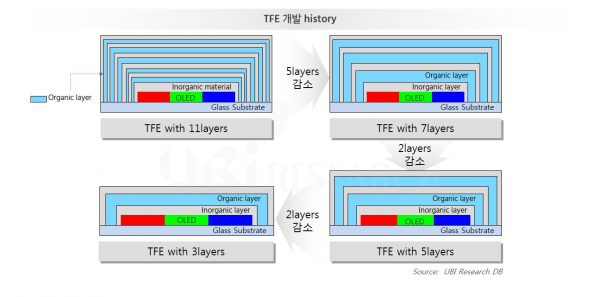
Flexible OLED must be thin and bendable; glass using frit encapsulation Is not suitable and TFE (thin film encapsulation) or hybrid encapsulation must be applied. TFE is a structure that is formed via laminating thin inorganic and organic materials. In the early stages of development, it had 11 layers of complex organic and inorganic material deposition with low yield. However, it now has been reduced to 3 layers and greatly improved productivity, yield, and cost and it is being applied to most of flexible OLED.
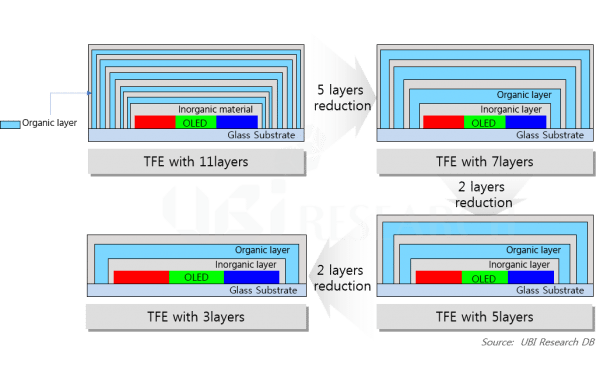
 

<Thin film encapsulation development history, 2017 OLED Encapsulation Annual Report>


Hybrid encapsulation, which uses barrier film, is being applied to some flexible OLED. However, due to the high cost of barrier film and relatively thick thickness, recent investment is focused on TFE application.

According to UBI Research analyst Jang Hyunjun, TFE encapsulation is expected to continue to be applied to edge type and full screen type flexible OLED panel, and related manufacturing equipment and material market will carry on their growth.

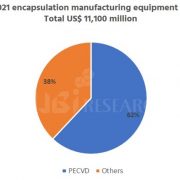
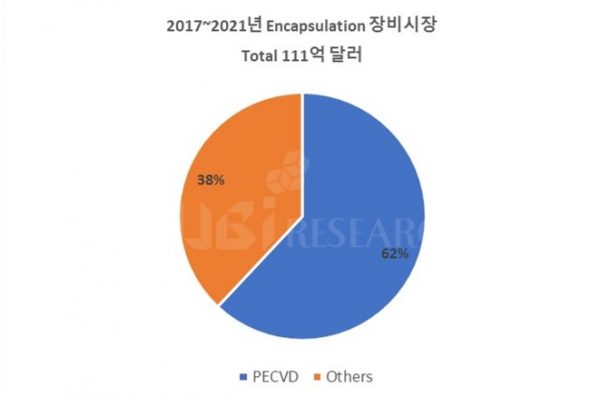
The report explains that TFE’s key manufacturing equipment are inorganic material forming PECVD and organic material forming ink-jet printer. In particular, PECVD is used in inorganic material film formation of hybrid encapsulation as well as TFE. Therefore, PECVD market is estimated to record US$ 6,820 million in 2017-2021, and occupy approximately 62% of the total encapsulation manufacturing equipment market.
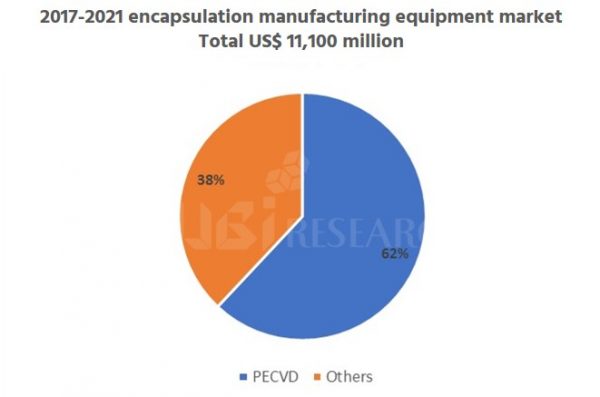
 

<PECVD manufacturing equipment market volume, 2017, 2017 OLED Encapsulation Annual Report>

The report includes encapsulation related key manufacturing equipment and material market in addition to encapsulation development history and trend, and key panel companies’ trend.

OLED Encapsulation, TFE가 대세

■ 모든 edge type과 full screen용 flexible OLED에 TFE 적용 예상

■ PECVD 장비, 전체 encapsulation 장비시장의 62% 점유


유비리서치에서 발간한 ‘2017 OLED Encapsulation Annual Report’에 따르면 OLED encapsulation 기술 중 TFE(thin film encapsulation)가 2021년 전체 OLED panel의 약 70%에 적용될 것이며, 핵심 encapsulation 기술이 될 것으로 내다봤다.


OLED display trend는 최근 edge type에서 bezel을 최소화하여 full screen을 구현하는 형태로 진행되고 있으며, flexible OLED가 full screen 구현에 최적화된 display로 손꼽히고 있다. 따라서 Samsung Display와 LG Display를 비롯한 중국 panel 업체들도 rigid가 아닌 flexible OLED 양산라인 투자에 주력하고 있는 상황이다.

Flexible OLED는 얇고, 휘어질 수 있어야 하므로 glass를 사용하는 frit encapsulation은 적합하지 않아 TFE(thin film encapsulation) 또는 hybrid encapsulation이 적용되어야 한다.

TFE는 얇은 무기물과 유기물을 적층하여 형성하는 구조로 개발 초기에는 11 layers의 유,무기 적층으로 복잡한 공정과 낮은 수율이었으나 현재는 3layers까지 감소시켜 생산성과 수율, 비용을 크게 향상되어 대부분의 flexible OLED에 적용되고 있다.


<Thin film encapsulation 개발 history, ‘2017 OLED Encapsulation Annual Report’>


일부 flexible OLED에는 barrier film을 사용하는 hybrid encapsulation도 적용되고 있으나 높은 가격의 barrier film과 상대적으로 두꺼운 두께 등으로 인하여 최근 진행되고 있는 투자는 모두 TFE가 적용되고 있는 추세이다.


유비리서치의 장현준 선임연구원에 따르면 “TFE encapsulation은 edge type과 full screen type의 flexible OLED panel에 지속적으로 적용될 것으로 예상되며, 관련 장비와 재료시장이 지속적으로 성장할 것”이라 밝혔다.


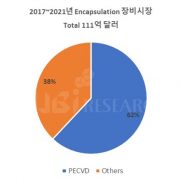
보고서에 따르면 TFE의 핵심 장비는 무기물을 형성하는 PECVD와 유기물을 형성하는 ink-jet printer이며, 특히 PECVD는 TFE 뿐만 아니라 hybrid encapsulation의 무기막 형성에도 적용된다. 따라서 PECVD 시장은 2017년부터 2021년까지의 68.2억달러의 시장 규모로서 전체 encapsulation 장비시장에서 약 62%를 차지할 것으로 예상했다.


<PECVD 장비 시장 규모, 2017, ‘2017 OLED Encapsulation Annual Report’>


이번에 발간된 보고서에서는 encapsulation의 개발 히스토리와 동향, 주요 Panel 업체들의 동향을 비롯하여 encapsulation 관련 핵심 장비들과 재료 시장을 다루고 있다.